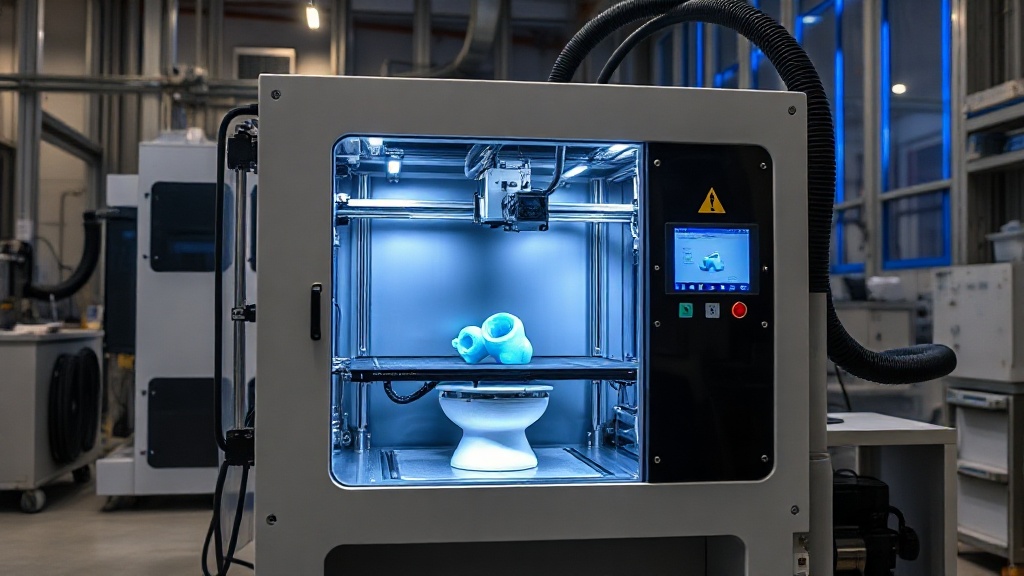

What Does R3 Printing 3D Printer Technology Promise for Production-Grade FDM?
R3 Printing 3D printer technology is emerging as a noteworthy development for companies seeking reliability and high-temperature material capability in production-focused FDM systems. According to a report published in TCT Magazine on June 15, 2026, the company introduced two new material extrusion-based systems after eight years of R&D. The closed-chamber temperature performance, broad material support, and production-environment positioning make this launch more than just a new device announcement — it becomes significant for the direction of industrial 3D printing as a whole.
What is the technical highlight of the announcement?
R3 Printing states that its next-generation systems were developed for real production conditions. According to information shared in the report, the standard model can reach a chamber temperature of 90 °C and a bed temperature of 155 °C; the higher-end Ultra model reaches 150 °C chamber and 235 °C bed temperatures. This profile points to an approach that targets not only common materials such as PLA or PETG, but also advanced engineering polymers such as PEEK, PEKK, PEI, and PPSU.
This point matters — because for industrial users, the question is no longer just about printing a part, but about producing that same part repeatedly with consistent quality. In operations working with high-performance polymers, thermal management, closed-cabinet stability, and mechanical reliability are among the primary decision criteria. If you would like to see print costs and a production plan for a similar project, you can review our 3D printing production pricing to build a clearer picture tailored to your needs.
Why does this matter for production-grade FDM?
In recent years, the line between desktop 3D printers and professional systems has thinned — but expectations on the production side remain different. Factory floors, workshops, and product development teams look for ease of maintenance, minimal downtime, material repeatability, and operator-friendly usability. R3 Printing’s message is positioned exactly here: offering a platform that can run reliably in the field, rather than an impressive prototype machine.
This approach is particularly relevant for fixture production, tooling, low-volume end-use parts, and functional prototypes. In Ucuz3D’s automation and robotics 3D printing solutions, the suitability of a part for its working environment — not just its shape — is likewise the deciding factor. For applications requiring high temperature resistance or chemical durability, selecting the right material is just as critical as selecting the right printer architecture.
What does this news mean for users in Turkey?
For businesses investing in 3D printing in Turkey, launches like this should be monitored for two reasons. First, every new platform that makes high-temperature polymers more accessible expands the application scope of additive manufacturing. Second, production-level FDM is now on the agenda not only of R&D laboratories, but also of teams producing spare parts, assembly fixtures, and short-run production runs. That is why, when selecting a printer, it is important to evaluate chamber temperature, bed stability, service approach, and supported engineering materials together — rather than looking only at the catalogued print speed.
- Closed-chamber temperature and thermal stability
- Real-world implications of processable engineering polymers
- Ease of maintenance and long-term usability
- Repeatable part quality and process reliability
If you would like a more systematic look at these criteria, the what to consider when buying a 3D printer guide also provides a solid foundation for the decision-making process.
Overall assessment
R3 Printing’s entry shows that competition in the industrial FDM market is now shaped not by print volume or speed alone, but by reliable production capability. If the company can validate the durability and process stability it promises in real-world conditions, it could become a strong alternative for production teams working with high-performance polymers. If you are also planning to take a similar part from prototype to functional production, you can quickly obtain a quote through Ucuz3D for the right material and manufacturing method for your project.




 Türkçe
 العربية
 Русский
 فارسی
فارسی Deutsch