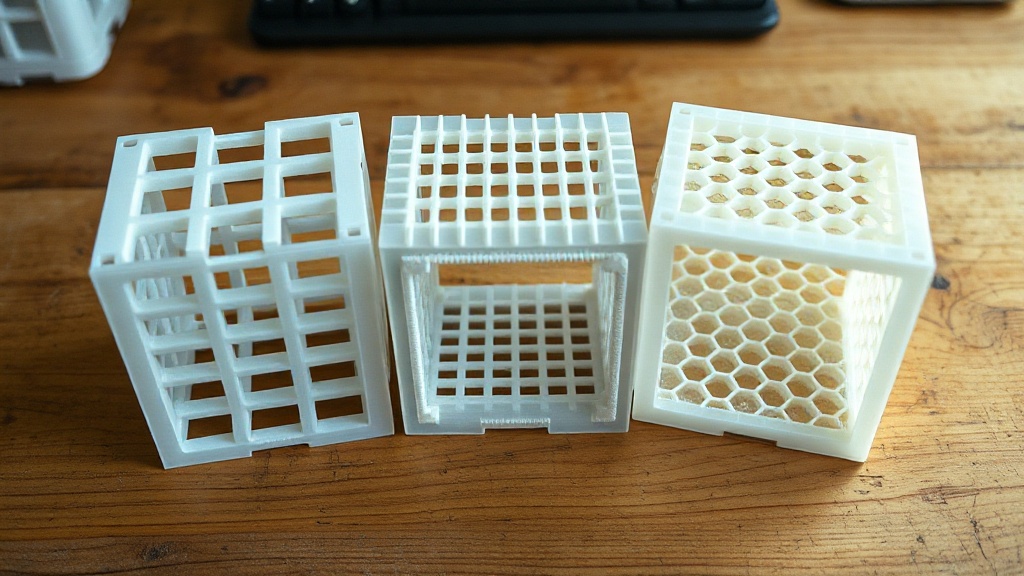

Which Infill Pattern Should You Choose? Differences Between Grid, Gyroid, and Honeycomb
Among the dozens of settings you encounter when opening a part in a slicing program, infill pattern is one of the most confusing. Most users print with the default pattern without ever changing it — yet choosing the right pattern can significantly affect a part’s durability, weight, and print time. In this article, we compare the three most commonly used patterns — grid, gyroid, and honeycomb — based on their real-world behaviour.
Grid: Fast and Practical, But Unidirectional
The grid pattern consists of perpendicular crossing lines and is the default setting in most slicers. It prints quickly, requires little computation, and produces clean results even at low infill percentages. The downside is that lines overlap at intersection points, which can cause slight over-extrusion and surface texture on some faces. In terms of strength, it performs well under planar loads but is not the strongest option for parts exposed to multi-directional stress.
Gyroid: The Modern Answer to Multi-Directional Strength
Gyroid is a self-supporting pattern that creates a three-dimensional wave-like structure. Its greatest advantage is that strength is distributed almost equally in every direction. This makes it the preferred choice for mechanical parts and components that experience loads from varying angles. It is also highly compatible with flexible materials (such as TPU) and works well in situations where liquid permeability of the filament is required. The trade-off is a slightly longer print time compared to grid.
Honeycomb: Classic Hexagonal Cell Strength
Honeycomb, made up of hexagonal cells inspired by nature, offers high strength-to-weight ratio per unit. It is extremely resistant to planar compressive forces, but because the cell walls overlap during printing, it is one of the longest-printing options. It is also visually striking and is frequently used with transparent materials.
Which Pattern for Which Situation?
- If speed is your priority: Grid is the most practical choice at low infill percentages.
- If multi-directional strength is required: Gyroid is a reliable choice for nearly every application.
- For maximum compressive strength: Honeycomb stands out if you can afford the extra time.
- If you are using flexible filament: Gyroid’s self-supporting structure makes your life easier.
In practice, for most hobby and functional parts, gyroid at 15-25% infill is the smartest starting point in terms of balance. Knowing how your part will be used matters even more than the pattern choice itself.
If you are unsure which pattern suits your part, share your model file with us and we will determine the most appropriate infill setting together based on your intended use. Simply fill in our order form to get a quick quote.


 Türkçe
 العربية
 Русский
 فارسی
فارسی Deutsch