
Infill Percentage Guide: %15 or %50, What Does Your Part Need for Strength?
One of the most frequently asked questions in 3D printing slicing settings is infill ratio. Many users wonder: “Is 15% infill enough, or should I go with 50%?” The answer isn’t simple, because the right infill percentage depends on the part’s intended use, the material, and the expected mechanical load. In this guide, we explain which ratio is right when — from decorative pieces to load-bearing functional parts.
What Does Infill Percentage Do?
The infill is the lattice structure that forms the interior of a print. This structure supports the outer shell (perimeter) and ensures top surfaces print without sagging. A low infill ratio saves filament and time, while a high infill ratio makes the part heavier and stronger. However, the relationship isn’t as linear as you might think: the most critical factor in a part’s durability is often not the infill, but the wall count.
Which Percentage Is Right for Which Job?
%0-5 (Empty or very low infill): Suitable only for visual prototype verification, very lightweight ornaments, or wall decor. Breaks easily when touched, and there’s a high risk of pillowing on top surfaces.
%10-20 (Decorative and lightly loaded parts): Ideal for visual-focused prints like vases, figurines, and models. For most users, 15% is a good starting point. It provides a lightweight print while keeping filament consumption reasonable.
%25-40 (Functional parts): Suitable for parts that will carry some load, light fixtures, enclosures, and everyday objects. In this range, infill noticeably increases the part’s impact resistance.
%50-80 (Load-bearing and mechanical parts): This range is preferred for parts subjected to force, such as brackets, fixtures, and connectors. However, keep in mind: at this level, the wall count should also be at least 4-5, otherwise infill alone won’t be sufficient.
%90-100 (Special cases): Fully solid printing is rarely necessary, as weight, cost, and time increase significantly. It should only be considered for parts that will work under water or pressure, or for models that will be machined and have material removed.
Infill Pattern Is Just as Important as Percentage
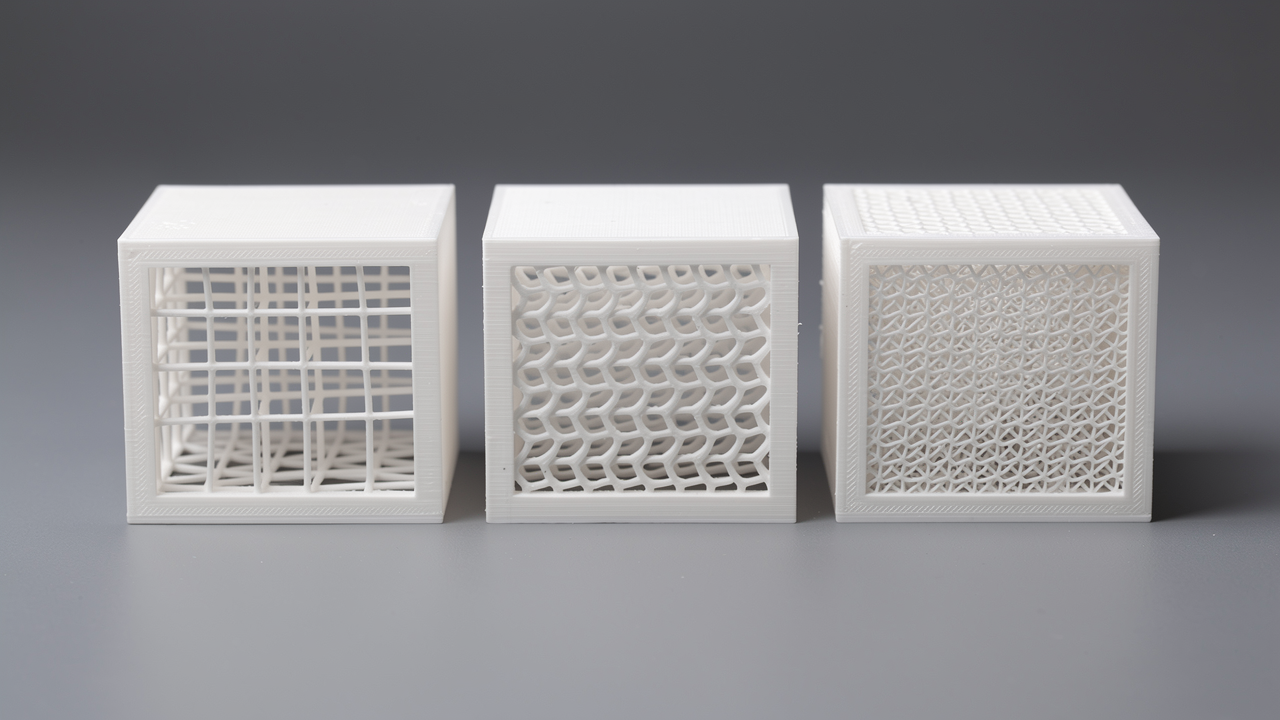
Infill ratio alone isn’t enough; the pattern you choose also affects strength. For example, the Gyroid pattern offers balanced strength in all axes, while the Grid pattern prints faster but only carries force in two axes. Honeycomb (hexagonal) is also successful in terms of weight-to-strength balance. At high infill ratios, pattern differences diminish because the interior is already nearly completely filled.
Tip: If you know your part will receive force in a specific direction, you can share this information with our engineering team when ordering 3d printing service to ensure the right slicing parameters are determined.
Common Mistakes
- Relying too much on infill: Many users think “if I set it to 100%, it won’t break.” In reality, breakage usually starts at the interlayer adhesion or thin walls. Increase the wall count first, then raise the infill.
- Using the same ratio for every part: A decorative vase and a mechanical bracket don’t need the same infill. Adjusting settings based on the part’s function saves both time and material.
- Forgetting the top layer count: With low infill, you need at least 4-5 top layers for a smooth top surface. Otherwise, pillowing occurs.
Choosing the right infill ratio for your part directly affects print time and cost. If you’re looking for a professional solution instead of testing ratios and patterns yourself, we optimize the slicing settings for you. Upload your STL file, calculate your instant price and have your part produced with the right settings. Alternatively, you can also check cheap 3d printing prices on our page our transparent per-gram prices to see your budget in advance.
For more detailed information about infill ratios and patterns, you can also check out our guide Infill Percentage (Infill) Nedir? Hangi Oranı Seçmelisiniz?. If you’re having trouble determining the right settings for your project, our technical team would be happy to help.



 Türkçe
 العربية
 Русский
 فارسی
فارسی Deutsch