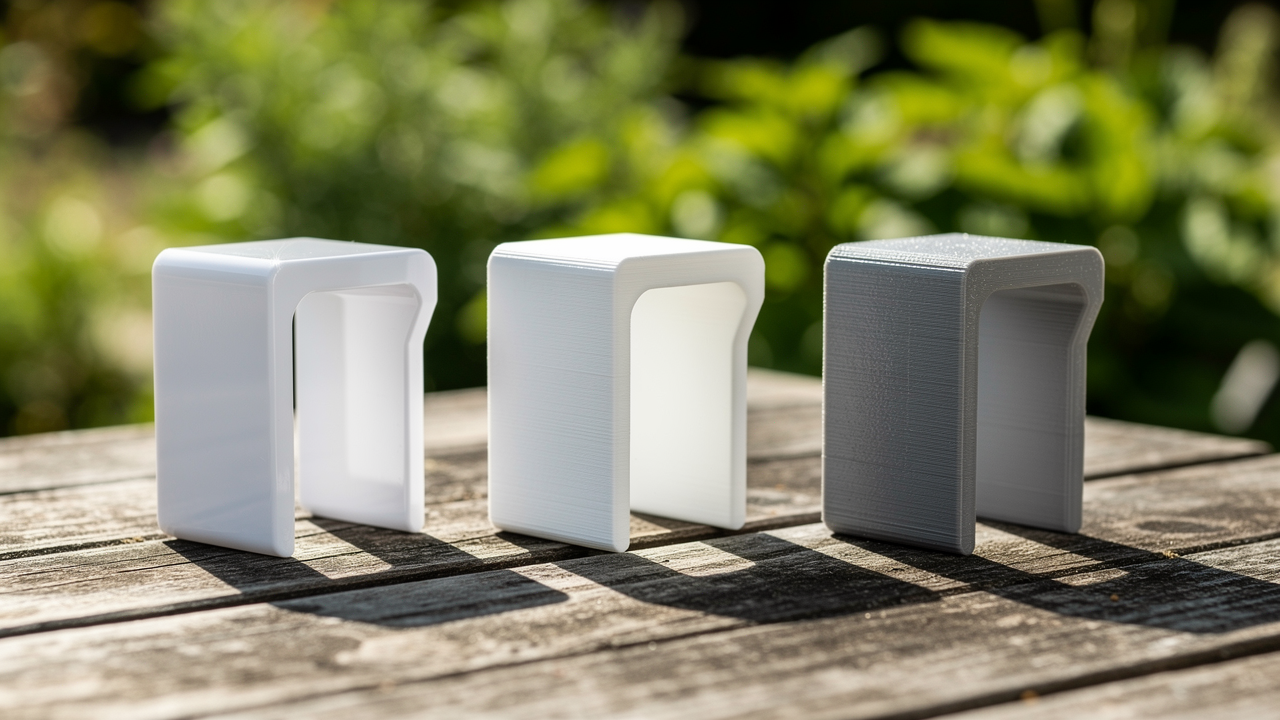

Which Filament for Outdoor Use: PLA, PETG or ASA?
The short answer to which filament for outdoor use is this: for parts that will face sun, heat and rain, PLA is usually too weak; PETG offers a good middle ground for most everyday outdoor jobs, while ASA is most often the right choice for long-term open-air use. The correct material decision depends on how long the part will sit in the sun, whether it will take impacts, and how well it needs to hold its shape after printing.
How do PLA, PETG and ASA differ outdoors?
PLA is very popular thanks to its ease of printing and clean surface finish; however, because it starts to soften at around 55-60 deg C, it can quickly lose shape in a hot car, behind a balcony window or in spots that get constant sun in summer. PETG, by comparison, is tougher than PLA, more balanced against moisture and more forgiving in daily use. With ASA, the real difference is UV resistance: it holds its color and mechanical properties under the sun better than PETG. That is why ASA stands out for outdoor fittings, boxes, hangers and certain parts used around vehicles.
If your project is a garden label, a planter fitting, an outdoor sensor enclosure or a sun-exposed mounting part, asking only “is it easy to print?” is not enough. When choosing the material, service temperature, UV exposure and impact needs should be assessed together. Especially for functional parts, taking an engineering-materials printing approach delivers a more durable result rather than a short-term one.
Which filament should you choose in which situation?
The practical summary below speeds up the decision:
- PLA: Suitable for decorative or lightly loaded parts that are not exposed to the sun. Outdoors, it should not be your first choice except for short-term use.
- PETG: A safe middle option for outdoor parts that require moisture resistance, moderate heat tolerance and general durability.
- ASA: The strongest candidate when there is UV exposure, temperature swings and long-term open-air contact.
For example, a cable clip mounted on a wall or a small enclosure exposed to rain may be fine in PETG. On the other hand, ASA behaves more safely for vehicle-mounted fittings, connectors near an exterior facade, or signage that will stay in the sun. PLA, meanwhile, can be cheap and fast for prototype validation, but as a final outdoor part it is often risky.
It is not just the material: design and print settings matter too
When parts fail outdoors, the filament is not always the culprit. Thin walls, the wrong print orientation and a low infill ratio also seriously shorten lifespan. For this reason, on a part meant for outdoor use, the wall count, the thickness of connection points and the layer orientation matter at least as much as the material. If you want to look at why PETG is so often preferred from a more technical angle, you can also check out our guide on how PETG positions itself between PLA and ABS.
One small note on cost is also important: in most projects ASA can be more expensive than PLA and harder to print, but producing a part twice because of the wrong material raises the total cost even more. Based on your part’s dimensions and material scenario, it is healthier to make a quick comparison via the calculate the price instantly link.
Final verdict: what is the safe default outdoors?
If you have to make a one-sentence choice, PETG should be preferred outdoors for short-term and lighter jobs, and ASA for jobs that require long life and sun resistance; PLA, where possible, should be left for indoor or temporary use. That way you can more accurately manage both the print performance and the part’s real service life.
If your project is a fitting, enclosure or spare part that will work outdoors, starting with the right material choice directly affects the outcome. If you would like to pin down the most suitable FDM option for your part, you can share your file via Ucuz3D, and together we can determine the most sensible production path based on the technical requirements.


 Türkçe
 العربية
 Русский
 فارسی
فارسی Deutsch