
3D-Printed Bicycle Parts: What the Pogačar and Fairlight Example Tells Us About Low-Volume Production
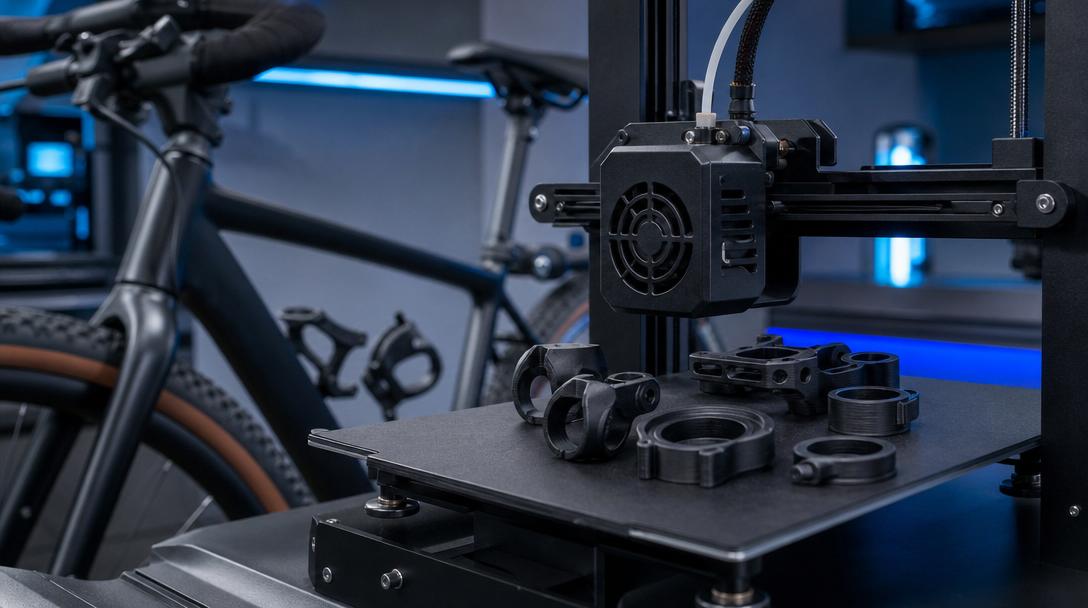
3D-printed bicycle parts are no longer just a hobbyist experiment when it comes to low-volume, user-specific components — they are becoming a genuine production alternative. What the Tadej Pogačar and Fairlight Cycles examples from the 18 June 2026 news story reveal is how clearly 3D printing exposes the cost and speed advantage, especially for holders, clips, small connectors and quick prototypes.
What is the signal in the news?
The examples reported by the source show that, in the cycling world, 3D printing is used not just as a showcase product but as a practical tool for customised small parts. The custom holders, buttons, clips and accessory mounts used by professional athletes make low-volume jobs — which are difficult in traditional manufacturing because of mould costs — far more sensible. This perspective lines up directly with the phone holders, handlebar fixtures, sensor housings, covers and broken plastic connectors we frequently see on the Ucuz3D side.
For one-off user needs or parts that require small revisions in particular, updating the CAD file and reprinting can be a far more agile method than cutting a new mould or waiting weeks for a suitable spare part. If you have a similar custom part need, the approach of getting an instant price calculation from a design or STL file dramatically shortens the decision process.
Why can FDM be a sensible choice for bicycle parts?
The critical point here is that not every bicycle part carries the same level of risk. Structural and safety-critical parts must be evaluated separately; however, at the accessory level FDM makes a lot of sense in many applications. For example, small carriers above the handlebar, sensor housings, cable guides, protective covers and personalised mounting elements can be produced in a short time.
- Low-volume advantage: for 1-5 units there is no need for a mould investment.
- Fast revision: after the first prototype, correcting a dimension or angle is easy.
- Material choice: depending on the need for outdoor use, impact or heat, PETG, ASA or more durable engineering-grade options can be considered.
- Personalisation: the geometry can be adjusted to different handlebar sizes, accessory standards or user habits.
For more durable, outdoor-exposed or functional parts, the approach of producing broken plastic parts and custom spare parts is especially valuable. On the material side, you need to consider the effects of load, vibration and temperature from the start; that is why, before deciding, taking a look at the 3D Printing in Spare Part Production guide is a good starting point.
Why does this news matter for a Ucuz3D customer?
This development shows that 3D printing is not a tool that stays confined to the labs of large manufacturers; in real-world use cases it has become economical for small but valuable parts. The cycling example is a reminder that the same logic works for drone accessories, electronics enclosures, temporary fixes in field equipment, and plastic spare parts that simply cannot be found.
Of course, it is not right to send every file straight into production. For parts under high load that affect road safety, the use case, print orientation, wall thickness and material choice must be assessed carefully. But when it comes to test-fit prototypes, accessory mounts and low-risk custom parts, FDM is a very powerful tool in terms of speed, cost control and repeatability.
In short, this news shows that, for low-volume personalised parts, 3D printing is no longer niche but an increasingly normal solution. If you too want to quickly validate a custom fixture, a broken connector or a personalised mounting idea, you can share your project details through Ucuz3D and clarify the right material and production route.


 Türkçe
 العربية
 Русский
 فارسی
فارسی Deutsch