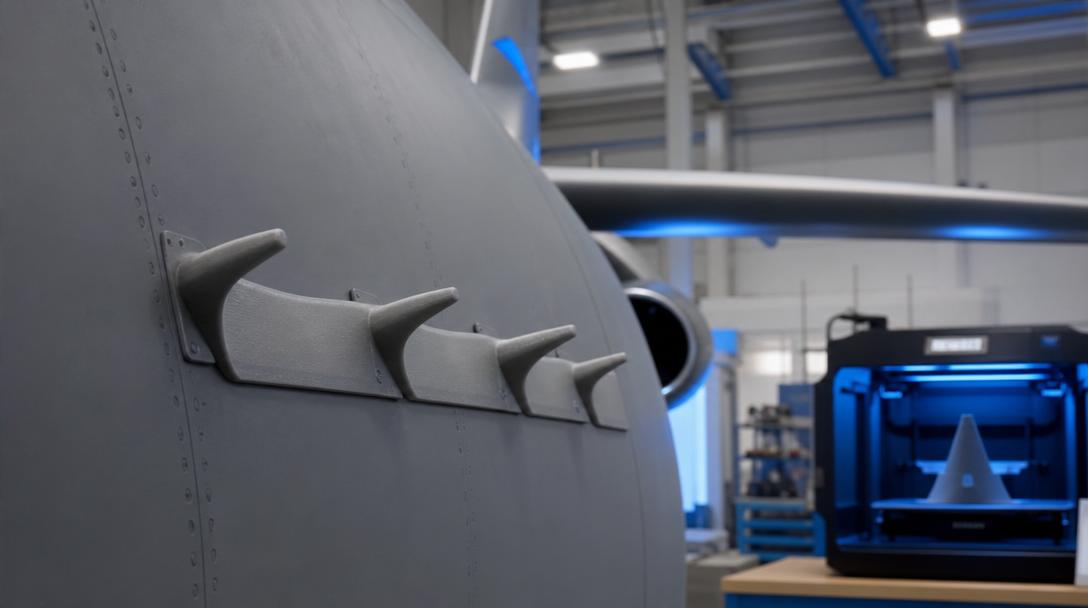

3D-Printed Microvanes Deploy Across the C-17 Fleet to Save Fuel
3D-printed microvanes are small aerodynamic parts the U.S. Air Force is preparing to roll out across its fleet of C-17 transport aircraft to cut fuel consumption. The news shows that 3D printing in aviation is no longer just a prototyping stage; it is also delivering serious value in low-volume, field-validated retrofit parts.
What exactly happened in the news?
According to 3D Printing Industry’s report dated 17 June 2026, teams from the Air Force Lifecycle Management Center, the Air Force Research Laboratory and Air Mobility Command developed blade-shaped microvane parts bonded to the aft fuselage of C-17 Globemaster III aircraft. Roughly 12 parts measuring about 10 x 40 centimeters were used on each aircraft, and tests showed a drag reduction of around 1 percent. The report states that this improvement creates a potential saving of more than 14 million dollars per year across the fleet.
The most striking point is that the solution does not require a complex change to a main system. Instead of a flight-critical major redesign, operational benefit is achieved with a relatively small but measurably effective set of parts. This clearly illustrates why additive manufacturing stands out in projects that need fast iteration, low-volume production and geometric flexibility.
Why does this matter from Ucuz3D’s perspective?
Although this news belongs to a large-scale aviation operation, the logic is quite familiar for engineering teams and product development processes in Turkey: the right design of a small part can affect the performance of an entire system. In Ucuz3D’s FDM-focused production approach, rapid trials likewise provide a major advantage for work such as housings, airflow-guiding parts, assembly fixtures, prototype covers or test jigs. Especially on the side of aviation and aerospace-focused 3D printing solutions, quickly validating low-volume functional parts can be critical.
The important distinction here is this: the end-use part in the news is a specialized application validated at military aviation scale. Ucuz3D, on the other hand, provides speed in work such as prototypes, fixtures, body parts, covers, channel-guiding elements and similar items that can be produced with FDM. So rather than reading the news as “we produce the same thing,” it is more accurate to view it as a strong example of how 3D printing creates value in small but effective parts.
Three practical lessons for the FDM side
- Small geometry can create a big impact: Sometimes the performance difference comes not from a large assembly but from a small part that touches flow or placement.
- Iteration speed is critical: If a design needs to be tested over several revisions, FDM prototyping provides a time advantage.
- Material and orientation choice change the result: For parts exposed to the outdoors, vibration or heat, the right filament and print orientation matter.
That is why in such projects not only the form but also the use case should be considered early. If strength and function are priorities, material selection and the production approach are just as decisive as the advantages of 3D printing in prototyping. At Ucuz3D, when needed for functional parts, making a quick assessment through the request a quote now flow is practical for this very reason.
In short, the 3D-printed microvanes story shows that additive manufacturing can scale not only in flashy concepts but also in small engineering parts that offer measurable benefit. If you too want to make a quick preliminary assessment with FDM for your airflow-guiding, housing, fixture or prototype needs, you can shape your project with the right material and production approach.



 Türkçe
 العربية
 Русский
 فارسی
فارسی Deutsch