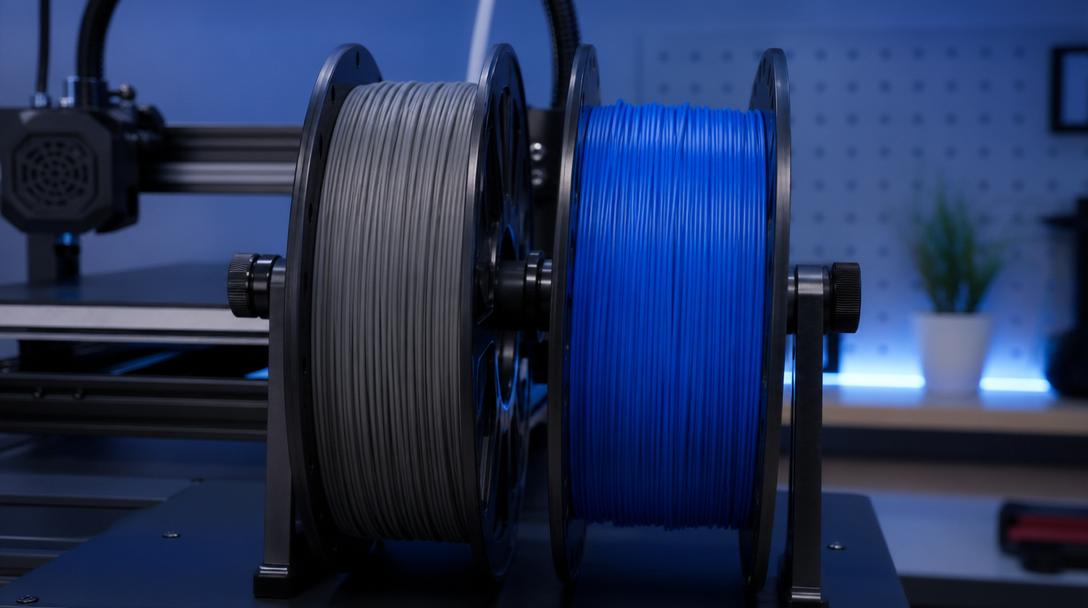

What Is PLA+? Is It More Durable Than Regular PLA?
What is PLA+? It is an improved formulation of PLA, the most common filament material in the 3D printing world. PLA, the first choice of both hobbyists and professionals for its ease of use, low printing temperature, and affordable price, has been increasingly compared in recent years to filaments labeled PLA+ that we often see on shelves. So what is the difference with PLA+ — is it really stronger than regular PLA, or is this just a marketing tactic? Let us compare with technical data.
Differences Between PLA+ and Regular PLA
PLA+ is a variant produced by making improvements to the formulation of standard PLA polymer. Manufacturers add impact modifiers and flexibility-enhancing additives to the polymer blend to reduce PLA’s natural hardness and brittleness. Thanks to these additives, PLA+’s toughness increases, interlayer adhesion strengthens, and the part leaves more room for flexing before breaking. While standard PLA has a harder structure, PLA+ offers a tougher material profile — meaning it gains resistance to breaking, not hardness. You can also see these differences in our PLA filament guide where we examine PLA filament’s properties and applications in detail.
Mechanical Durability: Hardness or Toughness?
The most noticeable difference between the two materials appears in impact resistance. PLA+ typically shows 30–50% higher impact resistance than standard PLA. In other words, when you drop a part on the floor, the PLA+ version is less likely to break. Layer adhesion is also stronger in PLA+ — it performs noticeably better especially under forces coming from the Z-axis direction. In comparison, standard PLA is still very successful in terms of dimensional accuracy and surface quality. PLA+ generally requires a nozzle temperature a few degrees higher and its flow characteristics may be slightly different. However, with the right settings, PLA+ can be confidently preferred across a much wider range of applications.
Which Projects Should Prefer PLA+?
- Functional parts: PLA+ is safer for prints subject to mechanical stress such as hinges, clips, and fasteners.
- Spare parts: If you are replacing a broken part of a frequently used item, printing with PLA+ provides long-lasting results.
- Prototypes: Ideal for mechanical prototypes with risk of dropping or impact during testing.
- Portable products: PLA+ provides extra assurance for parts carried in bags or assembled and disassembled.
- Mechanical fixtures: In parts requiring repeated use such as production line jigs and assembly fixtures, PLA+ is more economical in the long run.
For comparison, standard PLA is more than sufficient for decorative models, display prints, and parts that do not bear mechanical loads. Additionally, in situations requiring high temperature or UV resistance, materials like PETG or ASA should be considered instead of the PLA family. While choosing your material, you can determine the most suitable material for your project from among our 17 different material options.
PLA+ Print Settings and Tips
When printing with PLA+, some setting differences need attention compared to standard PLA. Nozzle temperature is usually between 210–230°C, 5–10°C higher than standard PLA. A bed temperature of 50–60°C is sufficient. Keeping fan speed slightly lower (e.g., 50–70%) improves layer adhesion and provides a cleaner surface, especially on parts with fine details. Print speed can be kept similar to standard PLA, but reducing speed improves quality if layer height is above 0.2 mm. With these settings, PLA+ delivers much more successful results compared to standard PLA on functional parts.
Price-Performance Balance
PLA+ is typically 20–30% more expensive than standard PLA. This extra cost pays for itself, especially in functional parts. While using PLA+ for a decorative figurine provides no extra benefit, in a broken household appliance spare part it returns as longevity and reliability. Choosing materials according to your project’s needs lets you manage both your budget and print quality effectively. You can use our calculation tool to select the right material for your needs and calculate your instant price, and find the most suitable solution for your project in minutes.


 Türkçe
 العربية
 Русский
 فارسی
فارسی Deutsch