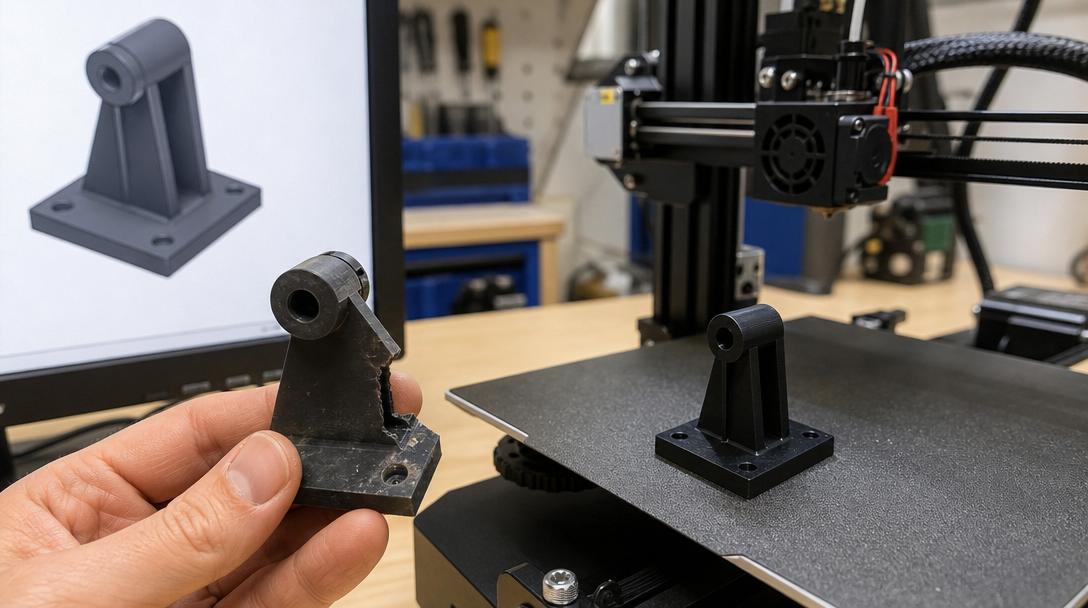

How to Reproduce Plastic Parts with Stripped Screw Holes Using 3D Printing?
Screw hole repair with 3D printing makes it possible to quickly produce a solution — especially for appliance covers, electronics enclosures, small household appliance bodies, and interior plastic car parts. If the part still functions but only the screw boss has cracked, broken, or the plastic has begun to crumble over time, in most cases a new part can be designed and reproduced using the FDM method. In such situations, the correct dimensions, the right material, and the proper wall structure determine the quality of the result.
3D printing saves significant time especially for parts that are no longer in production or are difficult to find on the market. Many parts that can be measured, photographed, or whose broken sample is on hand can be re-modeled and made suitable for everyday use. In the first step of the process, not just the external shape of the part but also the point where it bears the load must be examined.
Why do screw holes fail?
Screw holes in plastic parts typically suffer damage for three reasons: over-tightening, embrittlement over the years, and load concentration on a small area. Narrow cylindrical bosses in particular tend to crack over time due to thin wall thickness and low support surface area. If the part operates in a hot environment or is subject to constant vibration, deformation accelerates even further.
- Insufficient wall thickness relative to screw diameter
- Prolonged vibration and impact
- Old plastic becoming brittle
- Repeated removal and reinstallation
What to consider when reproducing with 3D printing?
For a good result, simply copying the broken area is not enough. In most cases, the weak point of the original design is reinforced. For example, the wall around the screw boss is thickened, a support rib is added to the base, or clearance is left for a heat-set insert in the screw seat. This way, the new part can outlast the original.
At this point, the right 3D printing service approach involves selecting the appropriate material — PLA, PETG, ABS, nylon, or TPU — based on the usage scenario. For load-bearing or high-temperature parts, choosing the right material for the application is necessary rather than opting for a general-purpose solution.
The more information available, the faster the process
If the broken part itself is on hand, the work progresses most quickly. If the part is unavailable, basic measurements taken with a ruler, clear photographs from different angles, and images showing where the part fits can also suffice. If the screw hole diameter, screw length, and surrounding seating surfaces are clear, modeling time is significantly reduced. Especially for parts intended to be reordered, creating the digital file also simplifies future productions.
For those who want to see the cost of a part in advance, getting an instant quote is a practical starting point. Those who want to make a more general comparison can review the per-gram approach on the cheap 3D printing prices page.
When is reproducing smarter than repairing the screw hole?
Super glue or epoxy can offer a temporary fix in some cases; however, the same spot may open up again when the screw is tightened once more. If the part operates under load, is close to a hinge, or if the screw hole has broken several times before, reproduction is usually the smarter choice — because the design can be updated and weak areas can be reinforced.
On the design side, clearances, fits, and connection tolerances also matter. For those who want a more technical background on this topic, the tolerance guide will be useful. Similarly, understanding how print orientation affects strength — reviewing the relationship between print orientation and strength — makes it easier to make the right decision.
Conclusion
Plastic parts with stripped screw holes do not have to go in the trash. With accurate measurement, the right material selection, and a design reinforced according to the load in use, individual spare parts can be reproduced. Especially for unobtainable spare parts, custom fixture bodies, and small-batch needs, 3D printing offers both a fast and a sustainable alternative.


 Türkçe
 العربية
 Русский
 فارسی
فارسی Deutsch