
Snap Fit Design: How to Make Unbreakable Snap Fits in 3D Printing
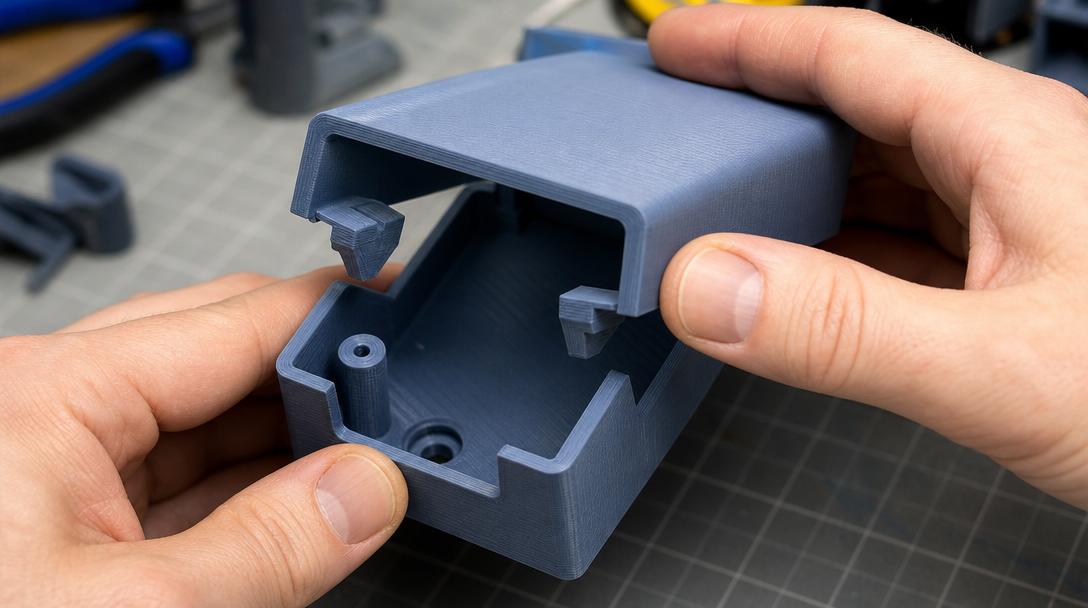
Snap fit design is a flexible locking structure that joins two parts without screws, and it yields highly successful results in FDM 3D printing with the right sizing, correct layer orientation, and suitable material. The most critical point to prevent your part from breaking on the first try: do not make the clip arm too thick, soften the corners, and choose the print direction according to the bending direction.
Snap-fit connections save considerable time, especially in electronic enclosures, covers, small apparatus, and plastic components that open and close during service. If you want to test your own prototype or perform pre-series functional verification, it is possible to quickly compare the part in different materials with professional 3d printing service.
Why does a snap-fit part break?
Most breakage errors stem from geometry rather than the material. In FDM printing, interlayer strength is lower than intralayer strength; therefore, if the direction in which the clip bends is not aligned with the print direction, the part may turn white and crack on the first insertion and removal. The second common mistake is designing the clip arm too short and thick. This geometry may look sturdier, but in reality it accumulates stress suddenly instead of bending.
- Short arm: Bends less, concentrates stress at a single point.
- Sharp inner corner: Creates a crack initiation point.
- Insufficient clearance: Part fits too tightly, unnecessarily increasing assembly force.
- Wrong material: A very brittle filament may fatigue under repeated opening and closing.
Therefore, in snap-fit design, the goal should not be the “stiffest part” but a controlled-flexing part.
4 basic design rules for unbreakable snap fits
1. Prefer a thin, long working arm
Achieving the same retention with a longer arm is generally safer. A longer arm bends more easily and distributes stress. Instead of unnecessarily increasing wall thickness, choose a form that allows controlled bending.
2. Use radius at the root area
Adding a fillet instead of leaving a sharp 90-degree corner where the clip connects to the body significantly reduces stress concentration. This small detail extends part life, especially in covers that open and close repeatedly.
3. Verify assembly clearance with a test piece
In FDM printing, the theoretical measurement does not always reflect the actual assembly feel. Therefore, it is wise to print a small test sample first. To better understand the general tolerance logic in interlocking connections, the What is Tolerance? How to Design Interlocking Parts guide is a good complement.
4. Choose the print direction according to the clip’s bending direction
Instead of the clip working in a direction that separates the layers, it should be aimed to bend along the layers as much as possible. Even this single decision makes a big difference in part life.
Which material is more suitable?
There is no single correct material for snap-fit connections; the use case is decisive. PLA is practical for rapid prototyping, but may be limited in parts that are frequently assembled and disassembled. PETG behaves tougher and is a balanced option for most cover and enclosure jobs. For more flexible or impact-prone use, TPU or engineering-grade options can be considered. Especially for PCB boxes, sensor enclosures, and custom covers, it is more accurate to think about material and clip geometry together with the electronic box 3d printing approach.
Quick checklist for better results on the first try
- Add a fillet to the clip root.
- Slightly chamfer the assembly opening.
- Print the first prototype as a low-cost test.
- If necessary, compare the same part with two different clearance values.
- To see the cost difference, check the overall part logic with cheap 3d printing prices before production, and if your file is ready, get an instant price.
In summary, a successful snap-fit design begins with correct geometry and correct print direction before choosing the right material. With a small test iteration, you can turn a broken clip into a reliable, reusable connection.



 Türkçe
 العربية
 Русский
 فارسی
فارسی Deutsch