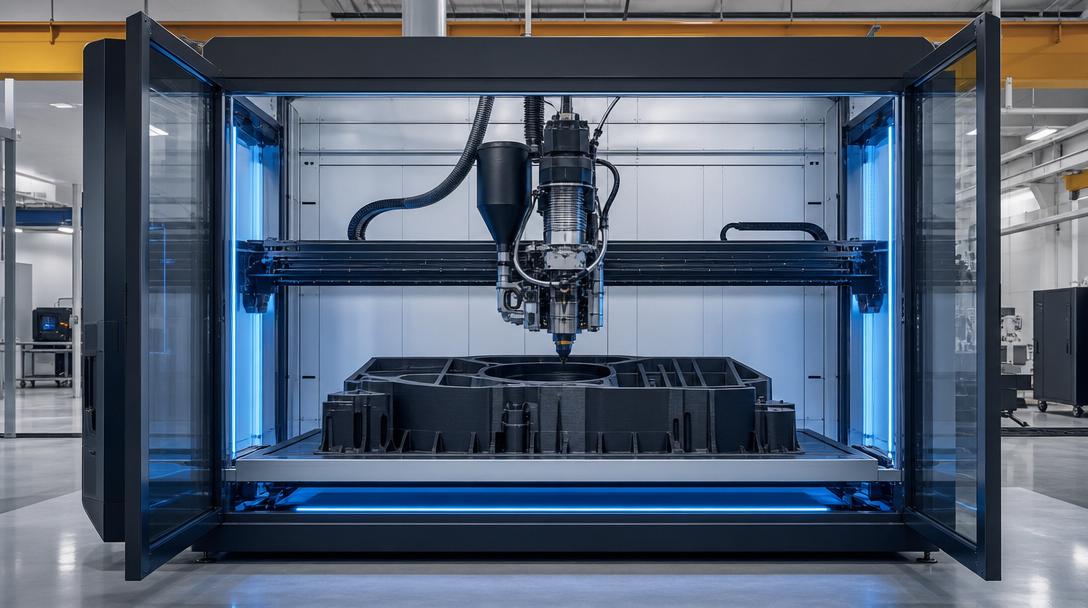

What Does the Peopoly GIGA 800 Change for Large-Format 3D Printing?
Large-format 3D printing can shift the balance between cost and speed, especially for big fixtures, molds and prototype parts. The GIGA 800 pellet extrusion system that Peopoly announced on June 1, 2026 focuses on exactly that: by using plastic granules instead of spooled filament, it aims to produce larger parts at a lower material cost.
Why is the GIGA 800 drawing attention?
According to the report published on 3D Printing Industry, the Peopoly GIGA 800 is a large-format pellet 3D printer with an 800 x 800 x 800 mm build volume. The system targets areas such as industrial tooling, composite mold production, automotive fixtures and architectural models. The real difference here is that the machine runs on raw plastic granules. Compared with the classic filament-based FDM/FGF workflow, this approach has the potential to lower material costs, particularly for high-volume parts. For anyone considering production with durable, functional materials, Ucuz3D’s printing with engineering materials approach offers a useful reference for seeing how similar needs are met on the desktop and mid-scale FDM side.
The technical highlights from the report matter too: a 400°C nozzle temperature, flow rates of up to 3 kg/hour, nozzle options ranging from 0.4 mm to 3.0 mm, an enclosed chamber, and a feed structure suited to engineering-grade materials. The fact that ABS, ASA, PETG, TPU and some carbon-fiber-reinforced variants are listed shows that the system is positioned not just for show pieces, but for functional prototypes and manufacturing aids.
Why does pellet extrusion matter?
For large parts, one of the biggest issues is not just print time but material cost. Pellet systems stand out here because granular raw material can be cheaper than filament in most scenarios. That can significantly affect the total cost of thick-walled mock-ups, production-line jigs or one-off large molds. On the other hand, surface quality, fine tolerances and part repeatability are still aspects that need careful evaluation depending on the application. That is why, before moving to a very large part, validating the geometry with a small-scale FDM sample is often the safer route.
At this point, the practical takeaway of the news for Ucuz3D customers is clear: if your goal is to quickly test the idea of a large part, it makes sense to first run a prototype validation with more accessible FDM processes. Once the wall thickness, print orientation and infill strategy of the design are settled, you can compare the total cost on a healthier basis. If you want to see the approximate budget for your part, using the instant price calculation step with your STL file gives you an early cost framework before a big production decision.
What is the lesson for the FDM side?
Systems like the GIGA 800 show that the question of “how do we print a bigger part more cheaply?” is becoming increasingly central in the additive manufacturing world. But this news does not mean every job requires a giant machine. Many spare parts, enclosures, prototype jigs and low-volume functional parts can still be brought online faster today with filament-based FDM. Especially for those who want to clarify the path from idea to test part, the Advantages of 3D Printing in Prototyping guide provides a good starting point.
In short, Peopoly’s launch puts the cost focus of pellet extrusion in large-format production back on the agenda. On the application side, the real winners will be teams that can match their mold, fixture and large-prototype needs with the right material and the right process. If you want to see how you could validate a similar part with FDM, starting with a short prototype trial is the most sensible first step.


 Türkçe
 العربية
 Русский
 فارسی
فارسی Deutsch