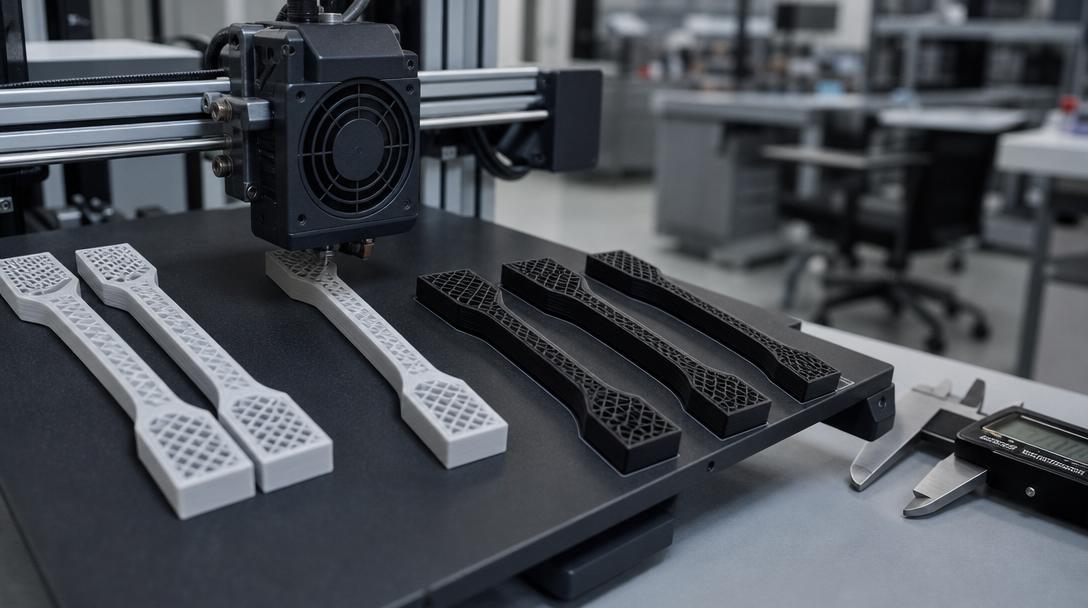

New Research on FDM Part Strength: Why Infill Density and Annealing Matter for PLA and CF-PLA
The short answer from this newly published research is this: FDM part strength is not just about the filament you choose; infill density and controlled annealing also have a major impact on the real-world performance of PLA and carbon-fiber-reinforced PLA parts. Especially for jobs such as functional prototypes, jigs, enclosures and low-volume spare parts, it is becoming clearer that process settings are just as decisive as geometry when it comes to the final result.
Published on 11 June 2026 in Scientific Reports, the study is based on comparative tests carried out by researchers from the Higher Technological Institute and Zagazig University on PLA and CF-PLA samples. The research examined infill pattern, infill density and annealing temperature together; the key finding was this: although the elastic modulus does not respond equally to every parameter, on the tensile strength and hardness side the material type and infill density stand out clearly. In addition, annealing at around 95 deg C can reduce brittle delamination between layers and shift the part toward a more integrated fracture mechanism.
Why does this news matter?
For Ucuz3D, the value of this kind of development is very practical: customers usually only ask “which material?”, yet what actually determines real performance is most often the combination of material + infill + post-processing. In other words, it is not only whether a part is lightweight, but also how it behaves under load, how well it holds up at a screwed connection, and whether it keeps its shape through temperature changes that must be taken into account. That is why, when planning a functional model, clarifying the use case before uploading your design and asking us to calculate the price instantly speeds up the right technical decision.
Three short lessons from the research for the shop floor
- Infill density still matters: Not only surface quality, but tensile strength and hardness also continue to be governed by the infill ratio.
- CF-PLA alone is not a magic solution: While carbon-fiber reinforcement offers some advantages, the wrong infill and poor layer bonding can limit performance.
- Annealing works when done in a controlled way: Especially for functional FDM parts, annealing at the right temperature can increase inter-layer integrity and deliver more reliable results.
The most valuable part of this news is that it shows once again that FDM production does not advance with a “one setting, one result” logic. For parts with high strength expectations, instead of thinking only of standard PLA, it can be more appropriate to consider printing with engineering materials when needed. On the other hand, it is not essential for everyone to go for high infill; for some parts, smart design, an appropriate shell thickness and the right orientation strike a better cost/performance balance. If you want a quick refresher on the basic logic of choosing infill, the guide What Is Infill Ratio? Which Ratio Should You Choose? is a good starting point.
What’s more, this kind of data can reduce time loss on small batches by cutting the need for a second production run caused by post-print breakage or unnecessary weight. Especially for test jigs, assembly fixtures and prototypes that will go into a usage trial, parameter optimization matters not just for quality but also for delivery predictability.
In short, this study shows that FDM is still an evolving engineering field and that small process changes can make a big difference in in-use performance. If your goal is not just a visual mock-up but a part that will actually function, you need to think about material selection and print parameters together. Carrying out a short technical assessment while planning the part suited to your application prevents parts that later break or end up heavier than necessary.
Clarifying the right material and printing approach for your intended use and only then moving to production is, more often than not, the most economical step.



 Türkçe
 العربية
 Русский
 فارسی
فارسی Deutsch