
Basalt-Reinforced PETG Filament: What Does the Voltage Eclipse X9 Launch Tell Us?
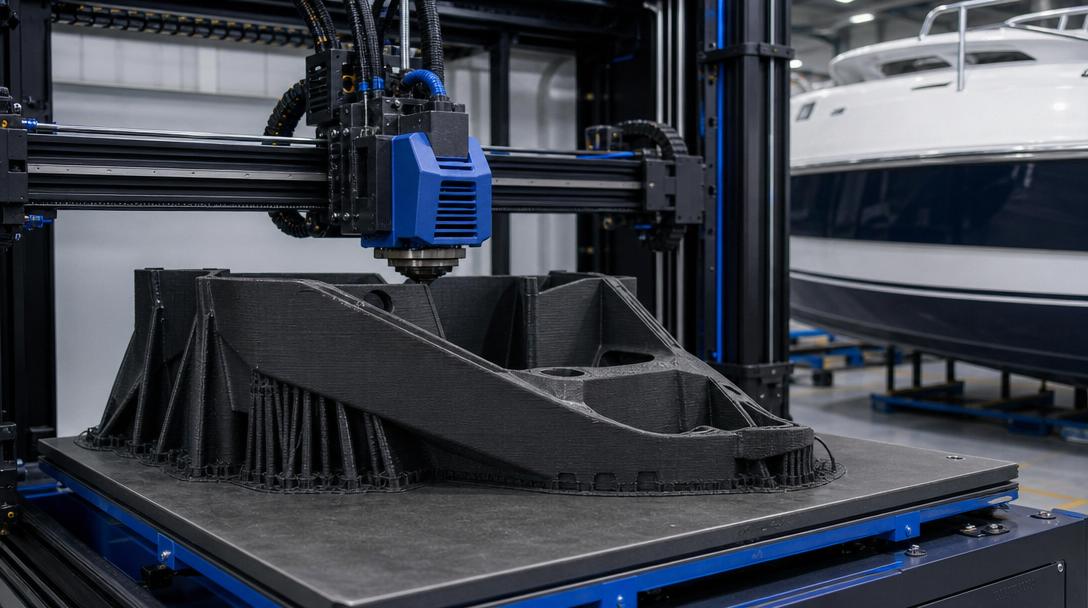
Basalt-reinforced PETG filament is back in the spotlight with the Voltage Eclipse X9 announced on 7 June 2026, especially for outdoor, marine, and large-scale FDM-style production applications. The news matters because this material combines a recycled PETG base with mineral reinforcement and long-term saltwater durability data, opening the conversation in functional part production beyond just “lightweight prototypes” to far more demanding use cases.
Why is the Voltage Eclipse X9 drawing attention?
According to VoxelMatters, Voltage Materials offers the Eclipse X9 in both pellet and filament form. Within the framework the company provides, the material can be evaluated across different platforms, from large-format robotic systems to desktop and large-volume FFF/FDM printers. The most striking point, however, is how the material is positioned for applications such as marine structures, buoys, tooling fixtures, and harsh coastal conditions.
For Ucuz3D, this news does not directly mean “we produce exactly the same thing”; however, it is valuable in showing where engineering-focused FDM parts are heading. Especially in projects where moisture, impact, rigidity, and outdoor performance matter, it clearly demonstrates why the approach of printing with engineering materials is being discussed more and more often.
What does the technical data say?
The test summary shared in the news pushes this launch beyond an ordinary material announcement. Validation from the University of Maine Advanced Structures and Composites Center, ASTM D638 and D790 testing, and ISO 12215 marine analysis show that the material is described not through marketing language but through a real application scenario. According to the data shared:
- Tensile strength: 108.2 MPa
- Flexural strength: 112.98 MPa
- Flexural modulus: 12 GPa
- Heat deflection: above 70 °C
- Water absorption: below 0.4%
- Saltwater durability: retaining more than 90% of its strength after 24–26 months of testing
This table is a reminder of why material selection is so critical, particularly for parts such as enclosures, fixtures, fastener carriers, or low-volume functional prototypes that operate outdoors. If you want to see the manufacturability of a similar part early on, you can request a quote right away by sharing your design.
How should this news be read from Ucuz3D’s perspective?
Although the Eclipse X9 is a large-format industrial material story, the real message is broader: in the FDM world, it is no longer just “a sample in PLA” but material selection driven by near-field, real-world conditions. When outdoor exposure, UV, moisture, and mechanical loads come into play, the choice between PETG, ASA, nylon, or reinforced filaments can directly affect the project outcome. That is why a material decision should be evaluated according to the use conditions rather than chosen on color or print ease alone.
In a similar decision process, our guide explaining the scenarios where PETG stands out can be a good starting point. If your goal is a prototype that works near a coastal environment, comes into contact with water, or needs to be more rigid, evaluating engineering-focused options from the start, instead of standard PLA, often reduces lost time and revisions.
Conclusion
Voltage’s Eclipse X9 launch points to a new direction where strength, recyclability, and outdoor performance are discussed together on the basalt-reinforced PETG filament side. The takeaway for Ucuz3D is clear: in FDM projects, choosing the right material is now just as important as the print itself. If you want to clarify the right material for your project, sharing your file along with the technical details is the right place to start.



 Türkçe
 العربية
 Русский
 فارسی
فارسی Deutsch