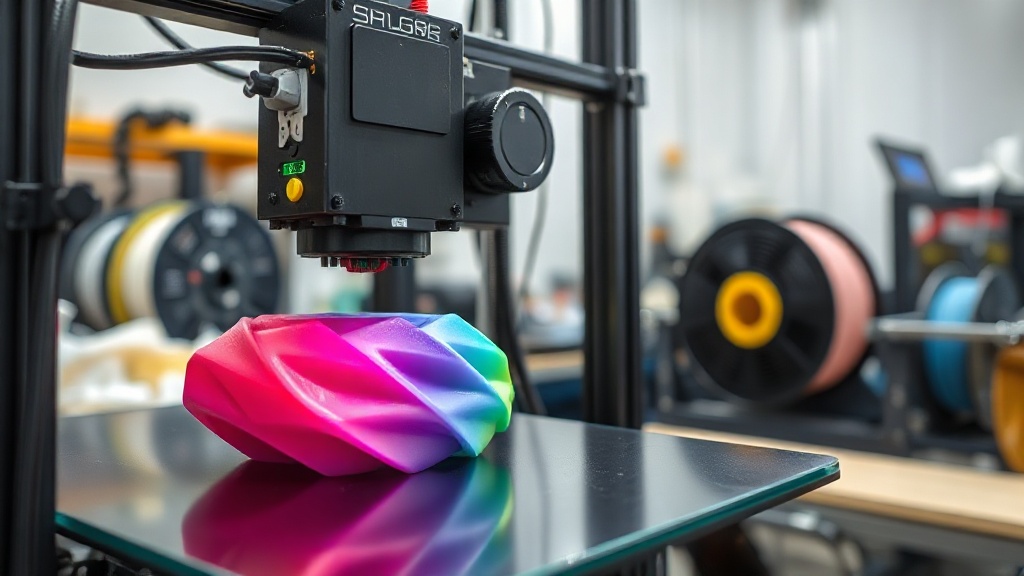

What Does Prusa’s ColorMix Move Mean for Multicolor 3D Printing?
The Prusa ColorMix news shows that multicolor 3D printing workflows are starting to become more accessible and more flexible. On the FDM side in particular, this development stands out for prototypes that call for tonal transitions on a single part, visual separation and stronger presentation quality.
According to a Notebookcheck report dated 30 May 2026, Prusa ColorMix is emerging as a new, open-source solution aimed at reaching dozens of color tones on multi-material 3D printers. While the news alone does not signal a breakthrough that reshapes the entire manufacturing world, it matters because tools are increasingly moving beyond closed ecosystems when it comes to multicolor 3D printing. After all, many businesses today need color FDM printing not only for aesthetics, but to indicate assembly orientation, distinguish different functional zones and make a part easier to understand in customer presentations.
Why does this news matter?
Although multicolor printing is often perceived as a “flashy” feature, in practice it delivers a serious communication advantage. Product development teams can make details that are hard to explain in a single color visible within seconds through color contrast. For example, when a cover, clip, direction arrow or contact surface on a housing is shown in a separate color, the use case can be tested far more clearly before the part ever goes into mass production. That is why multicolor 3D printing is becoming a topic not only for hobbyists but for professional prototyping as well.
The critical point here is how this approach fits into the FDM workflow. In FDM-focused production like Ucuz3D, color does not replace material selection; strength, heat resistance and operating conditions still come first. However, for prototypes that require visual verification, color separation paired with the right material choice produces far more functional results. If you want to weigh the differences between materials, comparing the classes suited to your use case among our 17 material options is a good place to start.
Practical takeaways for FDM users
- Color transitions make a part easier to understand in presentation prototypes.
- Assembly order, orientation information and contact surfaces can be shown more clearly with color.
- Visual separation on a single part can, in some scenarios, reduce the need for labels or paint.
Even so, expectations need to be set correctly here. Multicolor printing does not automatically mean a better result on every job. Issues such as nozzle changes, purge requirements, print time and waste volume can affect your production plan. For this reason, design and production decisions must be considered together on color jobs. If you want a closer look at the technical side of the topic, our guide How Is Multicolor 3D Printing Done? (AMS/MMU) will be helpful.
This is exactly where the real value of the Prusa ColorMix news lies: it signals a move toward making multicolor 3D printing accessible to more users. The open-source approach can, over time, mean more experimentation, more community contributions and more workflow variations. That, in turn, creates new possibilities especially for parts intended for short-run product validation, trade-show prototypes, educational models or user testing.
If you too are preparing an FDM prototype where color separation matters, planning your file early around production logic makes a big difference. To clarify the right printing strategy and quickly assess your model, request a quote now; the best path can be determined together based on how the part will be used.



 Türkçe
 العربية
 Русский
 فارسی
فارسی Deutsch