
Spare Part 3D Printing: Why It Took Center Stage in Rheinmetall UK’s Ducting Production
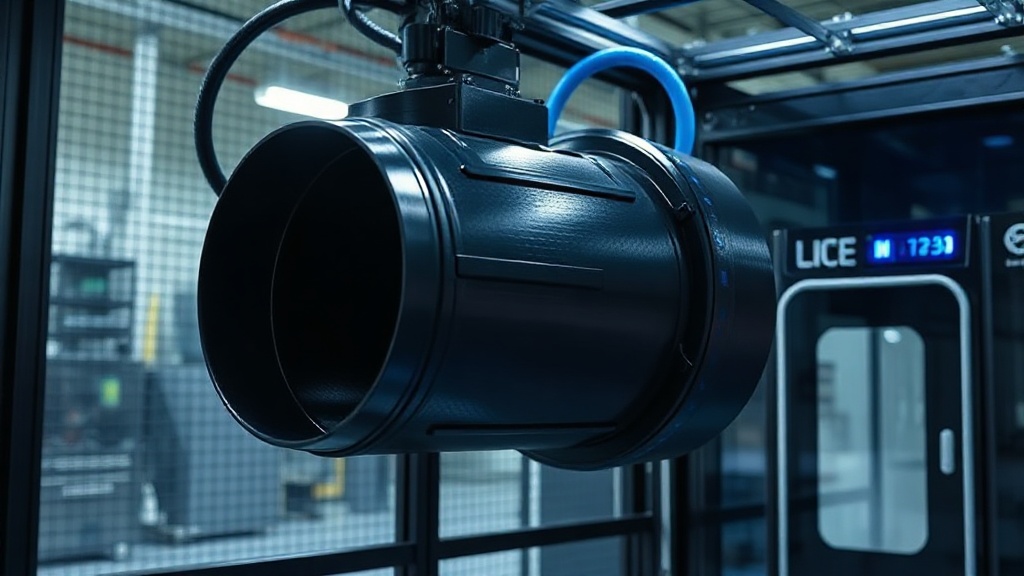
Spare part 3D printing is becoming increasingly critical for industrial parts that are needed in low volumes but require fast revisions. Rheinmetall UK’s decision to start producing complex ducting parts with the FFF/FDM method using the miniFactory Ignite clearly demonstrates how this approach creates value: without cutting a mold, by making changes within the same day, and by quickly printing a new one whenever needed.
What is the key development in the news?
According to VoxelMatters’ report dated 18 June 2026, Rheinmetall UK installed an industrial FFF system called miniFactory Ignite for the complex air duct and ducting parts in its Challenger 3 program. The striking point in the news is not just that the company says “we use 3D printing”; it has made this the core solution of its production flow directly. Especially for parts that are low in volume, geometrically tight and require revisions over time, classic sheet metal fabrication, injection molding or rotational molding may not always be the most practical route.
At the heart of this decision lie three needs: shorter lead times, lower tooling costs and a process open to design changes. That is precisely why the news concerns not only the defense sector, but also machinery, automation, prototyping and the functional spare parts side closely. With the same logic, before you produce a low-volume housing, duct, fixture or a broken plastic component, you can quickly see whether your file is truly suitable for FDM with an instant price calculation approach.
Why was FFF/FDM specifically preferred?
The news states that Rheinmetall UK turned to FFF after evaluating different options such as FFF, SLS and SLA. The reasoning is quite familiar: lower initial investment, a more limited safety and training burden, an open-material approach, and the advantage of producing large-volume parts economically. In addition, the miniFactory Ignite’s ability to process high-temperature materials such as ULTEM 9085 provides a critical plus for parts like ducting that carry heat and functional expectations.
- Mold-free production: No mold investment is expected for low-volume parts.
- Fast iteration: When a design change occurs, you need an updated file, not a new mold.
- On-site spare part logic: A part can be re-produced whenever needed.
- Batch production: At a suitable volume, multiple parts can be placed on the same build plate.
This logic also explains why it matters in sector-focused applications such as Ucuz3D’s 3D printing solutions in the defense industry: the goal is never “the most exotic technology,” but choosing the production route best suited to the project’s schedule and volume structure.
Why is this news important from Ucuz3D’s perspective?
The truly instructive side of this development is that 3D printing is now positioned as the main solution not only for prototypes, but also for low-volume functional part production. Especially geometries resembling ducts, housings and brackets can offer a serious advantage with FDM in terms of internal volume usage, weight control and fitting into the assembly space. Of course, the high-temperature-class materials mentioned in the news are not standard work for every workshop; but the principle does not change: when the right material, the right geometry and the right volume range come together, additive manufacturing creates a serious time saving.
The second important lesson here is revision speed. In the news, a Rheinmetall UK manager emphasizes that they can apply design changes rapidly and produce a spare part within a day. This leads us to a broader question: Is only the first production of a part important, or is the ability to later correct and re-produce it? If the second option carries more weight, the 3D Printing in Spare Part Production guide offers a useful reference that explains exactly this way of thinking.
The practical takeaway from this news
The Rheinmetall UK example shows that the spare part 3D printing approach does not belong only to the desktop hobby world; it is used in real production programs to ease lead-time pressure, accelerate design revisions and improve the economics of low volumes. If you have a functional part with volumes too low to justify a mold, FDM-based production can often be a more sensible starting point than you expect.
If you want to move a similar part from prototype to functional product, you can share your model so we can clarify the right material and production route together.


 Türkçe
 العربية
 Русский
 فارسی
فارسی Deutsch