
What Does Laempe’s Award-Winning Sand Mold Technology Tell Us About Industrial 3D Printing?
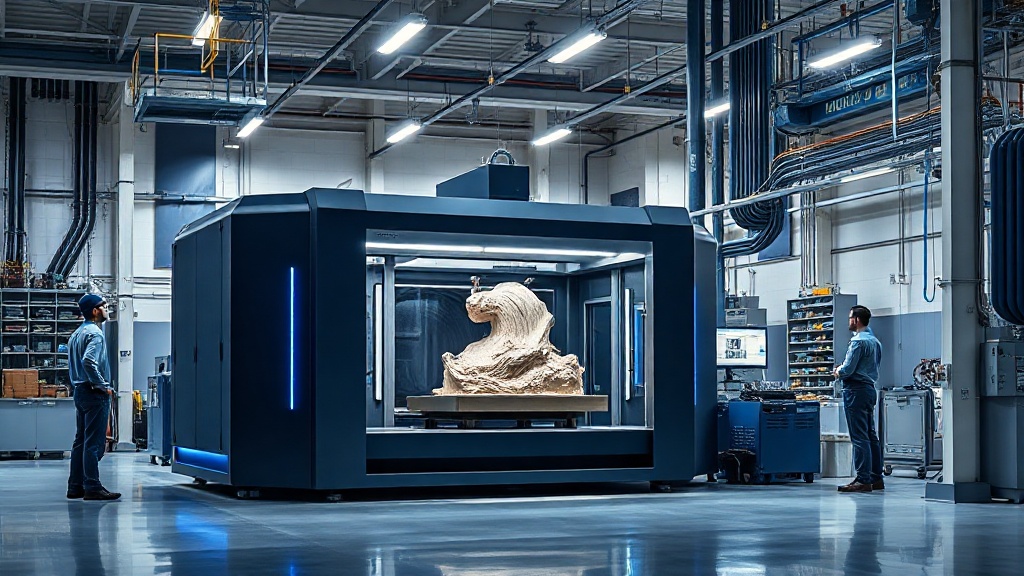
One of the standout news items in industrial 3D printing recently was Laempe Mössner Sinto winning the Hugo Junkers Innovation Award 2026. According to the story published on Foundry-Planet on June 16, the company stood out thanks to an approach focused on producing sand cores and molds automatically with 3D printing. This development matters because it shows how additive manufacturing is starting to play a stronger role not just in prototyping, but directly within the production flow.
Why is the award-winning system drawing attention?
The key point highlighted in the news is how Laempe brings the logic of toolless production more firmly into casting processes with its L3D-200 system. According to the company, this system makes it possible to produce complex sand cores and molds directly from digital data, reducing classic tooling preparation and long setup times. For low-to-medium volume custom parts, components with high geometric complexity, and projects that demand fast iteration, this approach can create a serious time advantage.
Another important detail is that the solution is not just “innovative” but is engineered with enough automation and quality control to actually enter the production line. For additive manufacturing to create lasting value in industry, being able to print is not enough; the process must be measurable, repeatable, and plannable. That is exactly where the real message of the Laempe story lies.
What signal does this news send to the manufacturing world?
Additive manufacturing has been talked about for years for the design freedom it offers; now the real difference emerges when that freedom is combined with production efficiency. That is why the news emphasis on use in demanding production environments such as the BMW Group is so significant. Because in automotive and industrial production, a new technology only becomes widespread if it delivers meaningful results in terms of speed, quality, and process reliability. A similar expectation can be seen on the automotive 3D printing solutions side at Ucuz3D: a part should not simply be printed, it must genuinely shorten the assembly, testing, and iteration cycle.
- Toolless production: Makes the shift to custom geometry easier.
- Shorter preparation time: Provides an advantage especially when bringing new products into production.
- Digital workflow: Reduces data loss from design to production.
- A discipline close to series production: A more scalable structure is built with quality control and automation.
What lesson can be drawn from this development on the FDM side?
Although Ucuz3D’s focus is FDM production, this kind of industry news offers strong clues for our field as well. Today, many companies want to quickly produce fixtures, assembly jigs, test models, housings, or process-validation parts with FDM before moving on to a final metal or cast part. In other words, the “learn fast first, then start the expensive process” approach is becoming increasingly valuable. That is why correctly applying basic principles like those in our design guide for 3D printing for design validation, assembly checks, and early iteration can significantly affect the total project time.
Likewise, it is worth remembering that cost is not only about material. Setup, revision, waiting, and rework times often inflate the total burden. For that reason, before starting on prototypes, jigs, or functional FDM parts, a calculate your price instantly approach makes the decision process far more transparent.
Why does it matter?
This award won by Laempe shows that additive manufacturing is no longer just an eye-catching technology headline in industry, but has become part of the production methodology. As solutions that move directly from digital to production become more visible even in long-established fields like casting, speed, flexibility, and process integration will become more decisive across the entire 3D printing ecosystem, including FDM. If you too need fast validation, jig production, or functional prototypes in your project, the right FDM approach can let you start the process earlier than you expected.


 Türkçe
 العربية
 Русский
 فارسی
فارسی Deutsch