
How Can 3D-Printed PLA Geometries Affect Concrete Beam Performance?
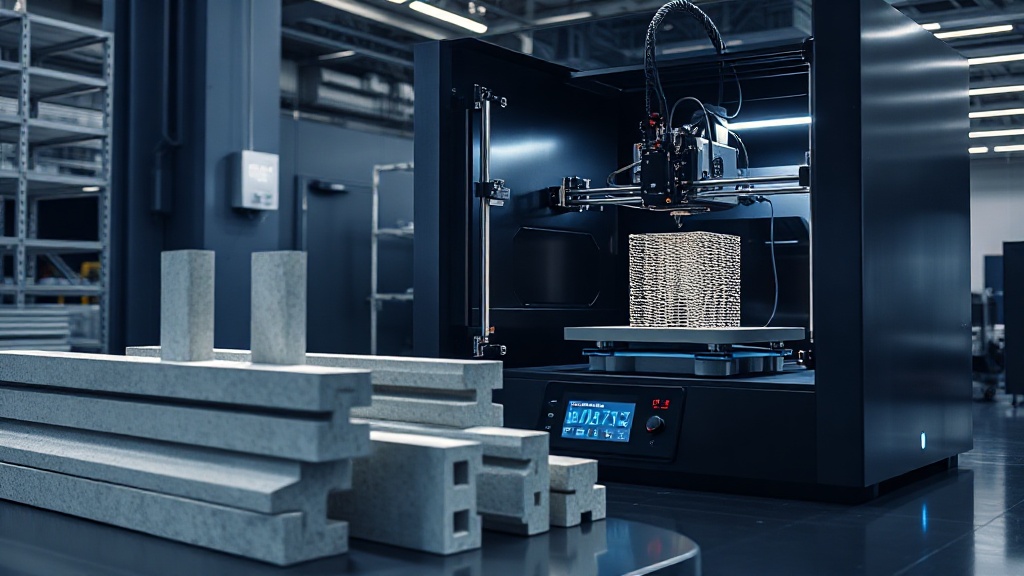
3D-printed PLA geometries are emerging as a new field of research aimed at improving load-bearing performance in concrete beams. According to a report shared on 16 June 2026, a team led by the University of Sharjah showed that PLA profiles produced with FDM can make a difference not only through their material but also through their surface form and cross-section design. This development shows that additive manufacturing is now being discussed far more seriously, not just for prototyping but also in the engineering approach to structural components.
What makes this research stand out?
Although concrete is strong under compression, it needs reinforcement on the tension side. The traditional solution here is steel rebar, but its drawbacks, such as corrosion risk and weight, have long been known. The Sharjah team’s approach is different: instead of switching to a more expensive material, they seek performance gains by optimizing the geometry of PLA profiles that can be produced with FDM printing. The study tested different PLA reinforcements with flat, wavy, serrated, and triangular surface features, and the surface texture in particular was found to increase mechanical interlocking with the concrete.
One of the standout findings in the report was that in some configurations the flexural performance approached the level of steel, with competitive results on the ductility side as well. Of course, this does not mean that PLA will directly replace conventional reinforcement today. Even so, the research clearly demonstrates how important geometry-focused design can be when combined with additive manufacturing.
Why does 3D printing play a critical role here?
The real strength of this kind of approach comes from being able to quickly try out complex cross-sections without investing in molds. In conventional manufacturing, testing different surface patterns and cross-section variations one after another can be difficult in terms of both time and cost. With FDM printing, however, you can produce a new sample in a short time simply by changing the design file. This opens up far more room for iteration for research and development teams. If you want to think more systematically about parameters that affect part strength, such as print direction, layer structure, and profile form, our guide explaining how print orientation affects part strength can be a good starting point.
The practical reality we see at Ucuz3D is close to this: industrial teams usually do not want the final part on the first attempt, but rather the right prototype that speeds up decision-making. For this reason, in 3D printing applications for different industries, geometry optimization is one of the most critical topics that comes right after material selection.
What is the opportunity today and the limit for tomorrow?
The most valuable aspect of this news is that it pushes 3D printing beyond the narrative of merely producing lightweight parts and strengthens the idea of improving structural behavior through design. The ability to produce custom surface forms without requiring a mold, in particular, can open up new areas of thinking for construction, precast, test fixtures, and engineering validation processes.
- Fast iteration: Different profile geometries can be tested in a short time.
- Low entry cost: The need for special tooling in sample development is reduced.
- Design flexibility: Application-specific surfaces can be tried instead of standard bar forms.
- Data-driven development: Results can be compared by changing only the geometry while keeping the same material.
That said, the limits of the research are also clear. Creep behavior under long-term loading, the effect of high temperatures, and fatigue performance have not yet been studied in enough detail to be decisive for real field use. So while the news is exciting, it would not be right to read it as an immediate, definitive transformation of the field. A more accurate reading is this: additive manufacturing makes it easier to ask new design questions in structural engineering.
What can manufacturing teams in Turkey take away from this?
For teams in Turkey with needs in product development, pre-mold validation, and custom test fixtures, news like this offers direct inspiration. Because the real value sometimes emerges in quickly validating the right geometry, even before the final end-use part. If you too want to quickly test the form, surface, or functional prototype of your part, you can reach us through our urgent 3D printing quote page. With the right design and the right production approach, you can significantly shorten the time it takes to go from idea to physical part.



 Türkçe
 العربية
 Русский
 فارسی
فارسی Deutsch