
EPFL Reaches a New Threshold in Volumetric 3D Printing Compatible With Living Cells
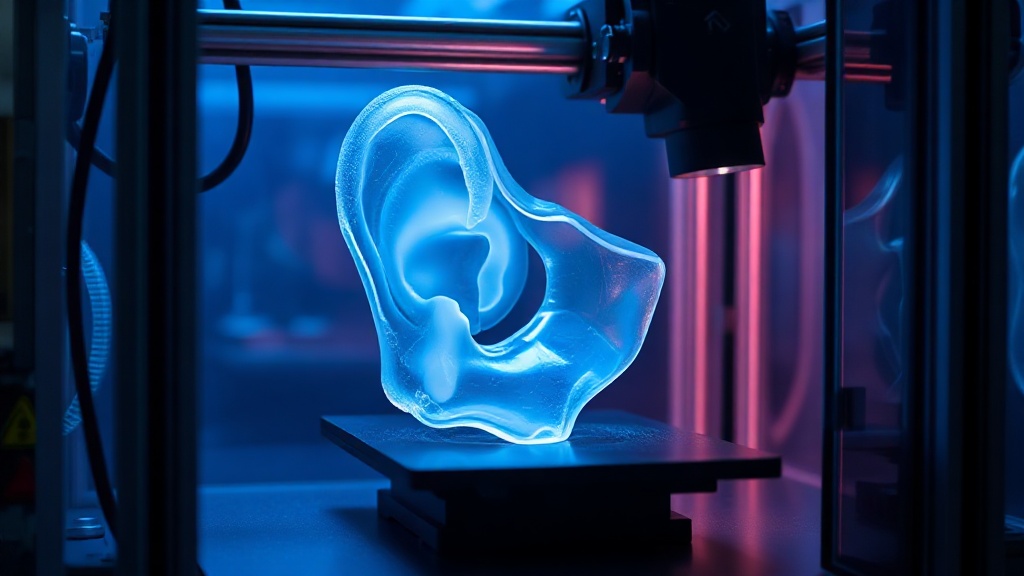
Volumetric 3D printing has long been discussed for its promise to solve the speed problem in additive manufacturing; however, working safely with living cells has so far been the most critical threshold. The latest study shared by the EPFL team in Switzerland shows that this threshold is now beginning to be crossed in practice. While producing a life-size ear structure containing human cells inside a gel-based hydrogel, the team reports that the cells remained alive days after printing and started to form networks. This development sends a striking signal, especially for patient-specific medical parts and research-oriented bioprinting applications.
How does it differ from classic layered manufacturing?
Instead of building the part layer by layer, the tomographic volumetric manufacturing approach forms it in a single step by delivering energy from different angles into a rotating volume of resin or hydrogel. This allows production time to be expressed in seconds or minutes. In the new stage reported by EPFL, the roughly 70-fold improvement in the system’s energy efficiency compared with previous versions makes the method not only fast but also gentler on living cells. This is precisely where the real value emerges on the medical side: as energy-related cell damage decreases, larger and more functional tissue-like structures can be produced.
Why does it matter for medical manufacturing?
In bioprinting, time, precision and cell viability must all be preserved simultaneously. Slow processes can strain cell health and production efficiency; too much energy can damage the material or the biological structure. EPFL’s approach is significant because it brings this balance to a more realistic point. Of course, an ear structure like this is not ready today to be used directly as a clinical implant; but it opens a promising path for personalized tissue models, validation parts for surgical planning and research laboratories. If you would like a broader framework on which method is more suitable in medical manufacturing, you can also take a look at Ucuz3D’s guide to 3D printing in the medical field.
What does this news tell us from Ucuz3D’s perspective?
Ucuz3D’s focus area is not bioprinting; however, developments like this clearly show why the logic of patient-specific production and the need for rapid iteration are growing. For most companies in the field today, the value-creating issue is not printing biological tissue; it is being able to quickly produce design validation, fixtures, surgical planning models or functional prototypes with the right technology. Especially in medical and dental 3D printing solutions, process selection, material decisions and tolerance management directly affect the project outcome.
- Speed alone is not enough; part accuracy and process safety must be evaluated together.
- Living-cell compatibility may give rise to new production models in bioprinting in the future.
- For today’s production projects, however, proper file preparation and the right technology choice remain the most critical steps.
The important point here is that this news should not be read merely as a laboratory success. Cell-friendly, fast and more scalable production logic may, in the long run, also influence the speed of decision-making in biomedical R&D, personalized test samples and advanced prototyping processes.
What should we follow in the period ahead?
The key topics to watch in this area are how printing accuracy will be increased, whether higher cell densities can be managed, and how well the system will integrate into workflows approaching the clinic. If you too would like to see rapid production feasibility for a medical, dental or technical part, you can submit your project through our urgent 3D printing quote page and clarify the right production approach in a short time.


 Türkçe
 العربية
 Русский
 فارسی
فارسی Deutsch