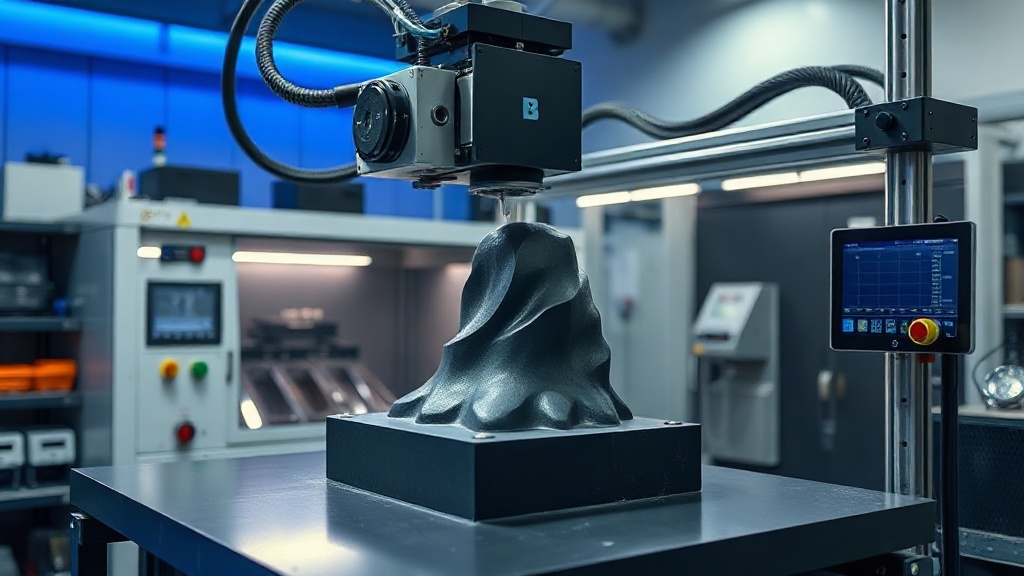

Why Xenia’s New LSAM Materials Could Speed Up Large-Scale 3D Printing Molds
LSAM materials are becoming critical in large-scale 3D printing not just for end-use parts, but also for molds, jigs and production tooling. The new thermoplastic composite pellet range announced by Italian material developer Xenia on 26 May 2026 speaks directly to manufacturers seeking thermal stability and dimensional accuracy, especially on pellet-extrusion-based systems. The news is notable because it shows that additive manufacturing is accelerating not only in prototyping, but also on the more predictable side of industrial tooling production.
What exactly did Xenia announce?
According to details shared on VoxelMatters, Xenia has positioned eight different carbon-fiber and glass-fiber reinforced thermoplastic grades for large-scale additive manufacturing applications. This portfolio is designed for use in production tools such as jigs, lamination masters, thermoforming molds and master models. The most important point in the announcement was that the materials target not only strength, but also low thermal expansion, high stiffness and more controlled geometric behavior during printing.
This approach aims to reduce problems commonly seen on large parts, such as warping, shrinkage and tolerance drift. Particularly in mold applications that go through post-autoclave processes, being able to trust the material’s service temperature and dimensional stability directly affects production time. That is why this should be read not merely as a new material launch, but also as a process-reliability story.
Why does it matter for large-scale 3D printing?
On the LSAM side, material selection has far more drastic consequences than on desktop FDM. As the part grows, the cost of failure rises; a poorly chosen material can cause a print that ran for hours to be scrapped before any post-processing. The fact that Xenia offers different grades such as PETG, ABS-CF, PC-CF, PC-HT-CF, PEI-CF, PESU-CF, PEEK-CF and PEKK-CF gives manufacturers the chance to choose by application rather than being locked into a single recipe.
The key message here is this: large-scale 3D printing is no longer driven solely by the question of whether something can be printed; it focuses on whether the same quality can be delivered again and again. If you too are developing industrial prototypes, fixtures or production aids, you should consider the material’s heat, stiffness and surface requirements together when evaluating industrial 3D printing application areas.
What does this news mean from Ucuz3D’s perspective?
For Ucuz3D’s FDM-focused production approach, this development matters because the market is increasingly shifting toward an application-specific material logic. As the one-filament-for-every-job approach weakens, selecting the right polymer family for different mechanical and thermal needs becomes more valuable. If you want a closer look at why carbon-reinforced options stand out, our guide to carbon-fiber reinforced filaments can be a good starting point.
- On large parts, low thermal expansion helps preserve tolerances.
- Reinforced polymers provide a stiffness advantage in reusable equipment such as molds and jigs.
- An expanding material portfolio makes cost-performance optimization easier.
- Pellet-based systems, in the right application, support faster and higher-volume production scenarios.
In short, Xenia’s new range is another reminder that in the additive manufacturing ecosystem material is no longer secondary, but a primary factor that directly determines process performance. If you want to clarify the right material and production approach for your project, or quickly see your part’s cost, you can review our 3D printing production prices or start your quote process.




 Türkçe
 العربية
 Русский
 فارسی
فارسی Deutsch