
The Right Nozzle Temperature for PLA, PETG and ABS: A Step-by-Step Calibration Guide
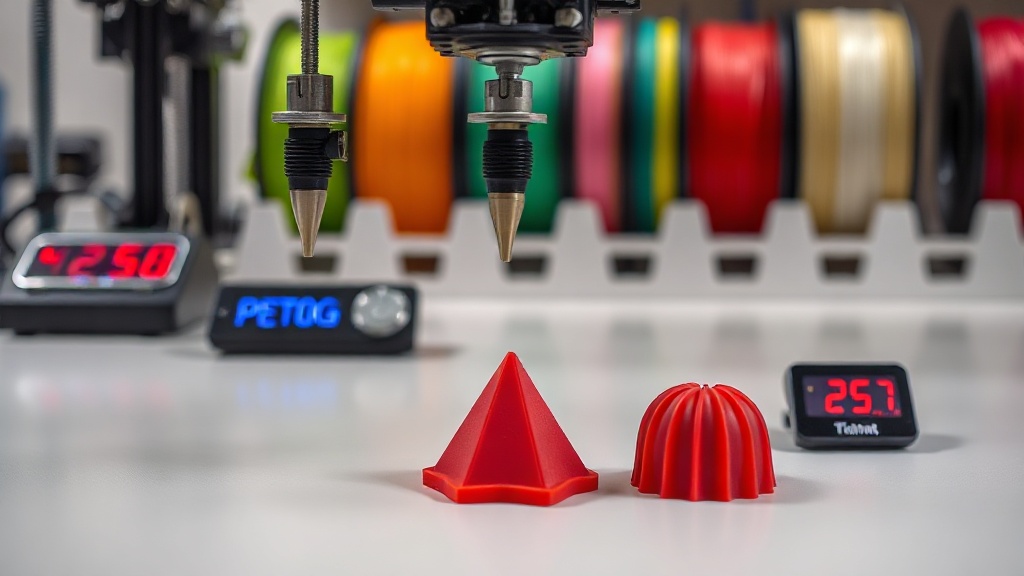
If your layers aren’t bonding, thin wisps are forming on the surface, or your part is coming out dull and rough, the culprit is most likely the wrong nozzle temperature. Even the same spool of filament can demand different temperatures depending on the manufacturer, color, and ambient conditions. That’s why there’s no single correct answer to “what temperature should I use?” — the right approach is to start from a range based on your material and fine-tune from there.
First, Know Your Material’s Typical Range
Every material group has a generally accepted working range. These are your starting points, not the final word:
- PLA: Typically 190–220 °C. Prints at lower temperatures, adheres easily, and produces little odor.
- PETG: Typically 230–250 °C. Prone to stringing, so temperature and retraction must be adjusted together.
- ABS: Typically 235–260 °C. Requires high temperature and an enclosed chamber; ambient heat matters to reduce warping and cracking.
The Logic of Step-by-Step Calibration: The Temperature Tower
The most reliable method is printing a temperature tower. This test piece is designed so that each block prints at a different temperature. For PETG, for example, you can run a sweep starting at 235 °C and dropping 5 °C every 10 mm up to 255 °C. When the print is done, inspect each block and select the temperature that gives you the cleanest bridges, the least stringing, and the strongest layer adhesion.
What Do the Symptoms Tell You?
- Temperature too low: Weak layer adhesion, dull and rough surface, brittle part.
- Temperature too high: Stringing, sagging, bridge failures, browning or discoloration.
- Ideal range: Smooth surface, strong layer bond, and clean fine details.
Don’t Forget Fine-Tuning
Temperature doesn’t work in isolation. When you increase print speed, more filament pressure builds up at the nozzle, so you may need to raise the temperature by a few degrees. Similarly, the cooling fan — especially with PLA — directly affects surface quality. It’s best to think of temperature as part of a whole, together with speed, fan, and retraction settings.
Finding the right settings across different materials takes time and experimentation. If you’d like to skip this calibration process and get quality results straight away, you can order prints using any of the 17 different materials we’ve already calibrated. Simply get a quick quote for your project and leave the rest to us.


 Türkçe
 العربية
 Русский
 فارسی
فارسی Deutsch