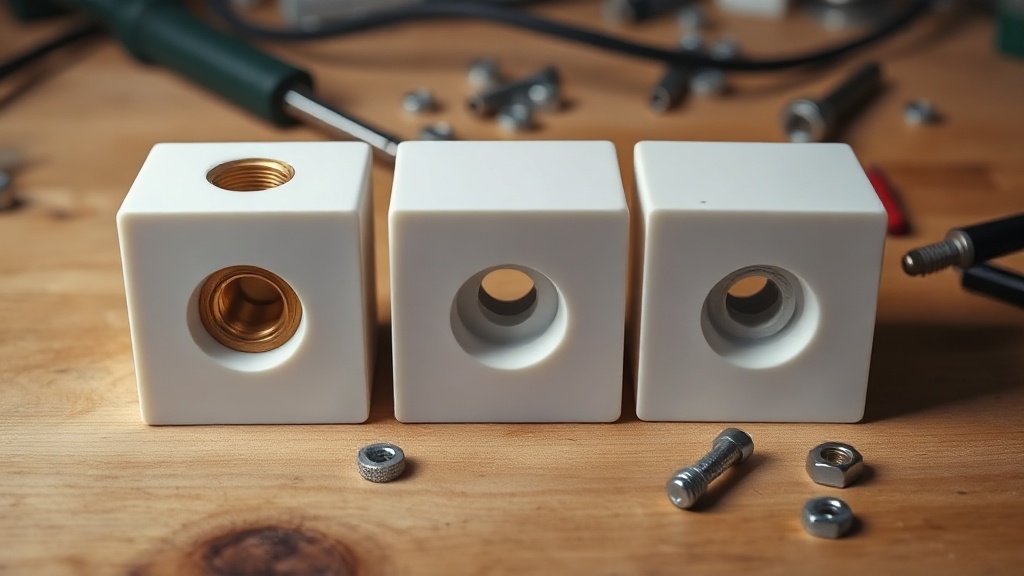

Screw Boss Design: Heat-Set Insert, Direct Thread, or Nut Trap?
When it comes to fastening a 3D-printed part to something else with a screw, that’s where the real challenge begins — because a poorly thought-out screw boss design will strip after a few assembly cycles and render the part unusable. The choice between a heat-set insert, direct thread, and nut trap depends on how many times the part will be disassembled and how much torque it will experience.
Heat-set insert: For parts that will be disassembled repeatedly
Brass heat-set inserts are heated with a soldering iron or a dedicated tip and pressed into the plastic. Once the plastic melts around the insert’s threads and re-solidifies, you have a metal threaded socket. The biggest advantage is that it withstands repeated assembly and disassembly.
- Pros: High torque resistance, suitable for repeated assembly, professional finish.
- Cons: Additional part cost and installation takes time; the hole diameter must be precisely designed to match the insert.
Direct thread: Fast and without extra parts
Driving the screw directly into the printed plastic is the fastest approach. You leave a pilot hole and let the screw cut its own thread. It works well for single-use or rarely disassembled, low-torque parts.
Key point to watch
With direct threading, hole diameter is critical: too narrow and the part will crack, too wide and the screw will spin freely. Leaving a pilot hole close to the screw’s minor diameter is the safest approach. If you disassemble the same boss more than three or four times, expect the thread to strip.
Nut trap: Strength at low cost
Embedding a standard hex nut into a pocket inside the part — either during printing or afterwards — is also a very common method. You can bridge over it and pause the print to insert the nut, or design a side-sliding slot.
- Pros: Very low cost, high strength, easy to source.
- Cons: Tolerance matters; too loose and the nut spins, too tight and it won’t seat.
Which one should you choose?
In short: use heat-set inserts for parts that will be disassembled frequently and subjected to torque; use direct threading for one-time assemblies; and use nut traps when you want both an economical and robust solution. If you’re not sure which method suits your part, send your model through our quick order page and we’ll fine-tune the boss tolerances together based on your material.
Tell us about your assembly scenario and we’ll recommend the best solution for a screw boss that holds on the first try.


 Türkçe
 العربية
 Русский
 فارسی
فارسی Deutsch