
Robotic 3D Printing in Action: The 3D-Printed Footed fLEX Robot Tests World Cup 2026 Pitches
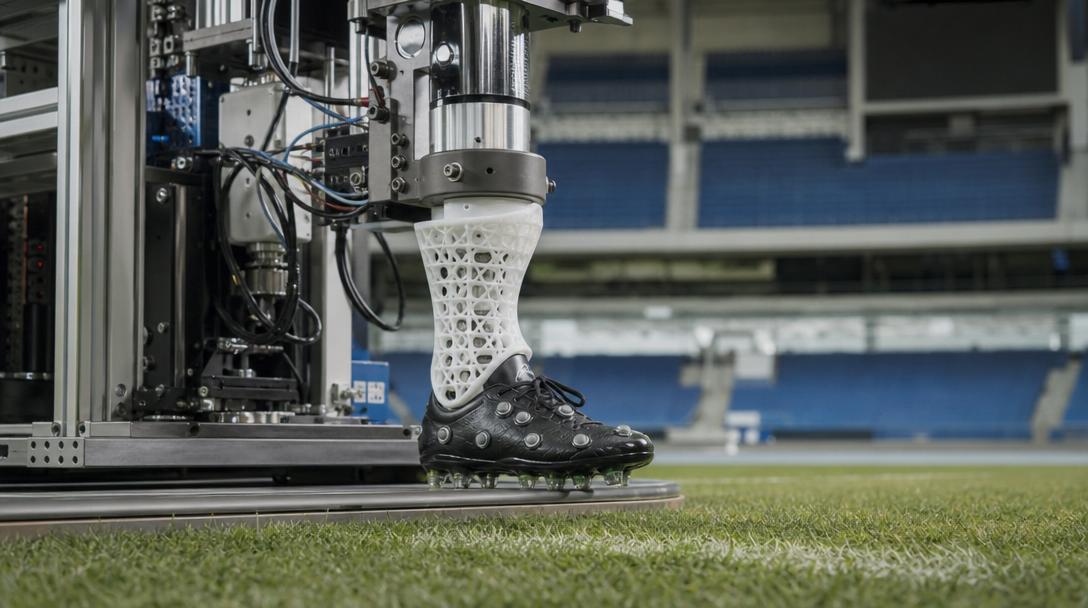
Robotic 3D printing is back in the spotlight, this time with an application that directly measures on-field performance. Developed by the University of Tennessee, the fLEX robot uses a 3D-printed foot and a sensor-equipped soccer boot to help test World Cup 2026 pitches for player safety and surface consistency.
The key takeaway from the story is that 3D printing is used not only to build prototypes, but also in a functional robot part that performs repeated testing. The fLEX system collects data such as ball bounce, surface hardness and how a player’s foot interacts with the turf from different points, giving pitch-preparation teams measurable output. This clearly illustrates why additive manufacturing is growing in niche fields like sports, robotics and field equipment.
Why does this story matter?
In professional football, the pitch surface affects not only the quality of play but also player health directly. The fLEX robot’s 3D-printed foot plays a critical role here, because it can apply the same motion over and over in a controlled way. Because it produces more standardized data than human testing, maintenance teams can spot problem areas faster.
From Ucuz3D’s perspective, this example shows that 3D printing solutions for automation and robotics are about far more than producing housings or covers. Sensor-carrying parts, field-testing fixtures, custom connectors and low-volume functional components can all gain real value from 3D printing with the right material and the right design.
Why are 3D-printed test parts preferred?
- The geometry can be revised quickly.
- No mold cost is required for low-volume production.
- Customization for sensor, connection and assembly needs becomes easier.
- It can be tested in the field and a new version produced in a short time.
In robotics applications especially, it is normal to iterate several times between the first and final version of a part. That is why 3D printing has become a powerful tool in R&D and field-validation processes. In a similar project, because the design of load-bearing areas, the layer direction and the wall thickness are critical, you need to factor in how print orientation affects part strength.
What lessons can be drawn on the FDM side?
Not every 3D-printed part is suitable for the same conditions; however, FDM-based production is highly effective for prototype feet, test fixtures, carrier brackets, electronics enclosures and sensor-mounting parts. In scenarios that require impact, flex or outdoor durability, material selection becomes important. Depending on the project’s needs, PETG, ASA, TPU or more engineering-focused filaments can be chosen.
This story also shows the following: in robotics or sports technology, innovation often starts not with large-scale mass production but with small yet customized parts that solve the right problem. If you too are working on a robotic prototype, a test fixture, a custom enclosure or a functional part, you can speed up the process via the request a quote now option on Ucuz3D.
In short, the fLEX example shows that using robotic 3D printing can solve very concrete real-world problems such as data collection, safety and field standardization. If you have an idea for a customized part, 3D printing can quickly turn it into a testable product with the right design and material choice.


 Türkçe
 العربية
 Русский
 فارسی
فارسی Deutsch