
Why Does the NAMI and MBK Global Partnership Put Spare Part 3D Printing in the Spotlight?
Spare part 3D printing is becoming a critical topic once again for operations stalled by long lead times. The collaboration between NAMI and MBK Global in the Gulf region, focused on additive manufacturing, reverse engineering and digital inventory, points to exactly this: instead of waiting months for the part you need, prepare the right part digitally and produce it faster.
Why is digital stock at the heart of the partnership?
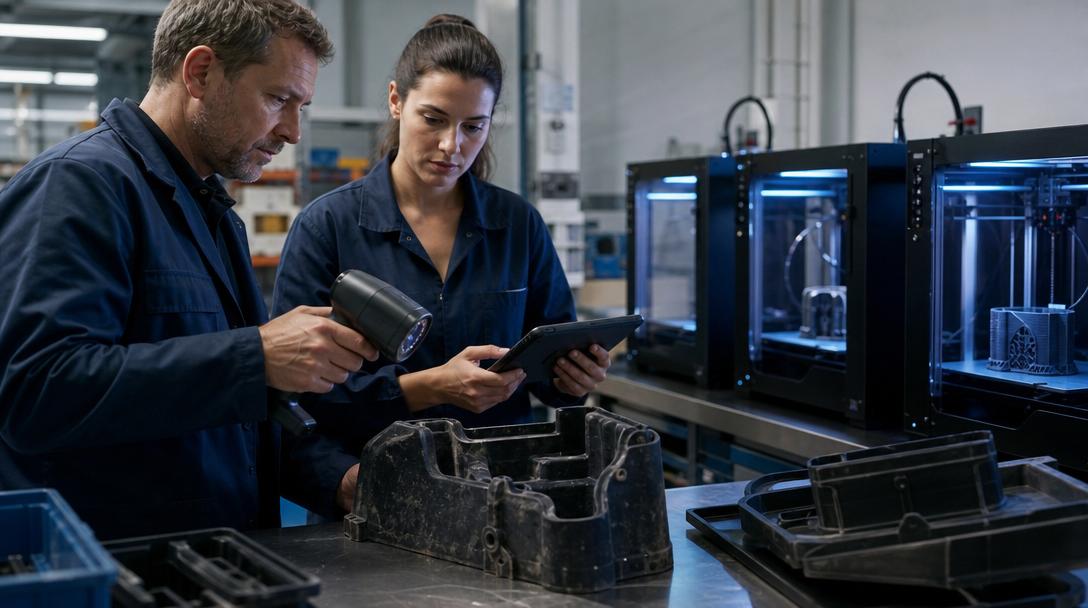
According to the news shared on VoxelMatters on 19 June 2026, NAMI and MBK Global aim to expand additive-manufacturing-based access to spare parts, particularly for industrial operators. The real value here is not simply “using a 3D printer”; it is turning a part into a digital asset that can be scanned, measured, remodeled and reproduced whenever needed. This approach reduces waiting times for businesses dependent on imported supply, while also making maintenance planning more predictable.
This model works especially well for low-volume parts, items that are expensive to keep in stock, or components whose originals are no longer available. While conventional manufacturing comes with the pressure of tooling, minimum orders and logistics, the digital inventory logic stores the part information and triggers reproduction only when the need arises. This news matters because it shows that 3D printing is used not just for prototypes, but for operational continuity as well.
What does this mean in practice for Ucuz3D?
Since Ucuz3D focuses on FDM-based production, this approach is especially meaningful for plastic housings, connection fittings, air ducts, covers, separators and functional parts operating under low-to-medium loads. If a plastic component that has broken in the field can be reproduced with the right dimensions and material choice, this can sometimes offer a far faster solution than waiting for a new part from abroad. For this type of work, the use cases on the broken plastic part 3D printing service page are directly relevant to the subject.
The critical point here is not to try to print every part with the same material. While PLA may be sufficient for indoor, low-heat and quick test parts, more durable needs call for PETG, ABS, ASA, TPU or engineering-grade filaments. For an urgent need, you can request a quote right away for a fast assessment based on dimensions, photos or an existing sample. This way it becomes clear from the outset whether the part is genuinely suitable for FDM or whether a different production approach is required.
How does the digital inventory approach work in the field?
What the NAMI and MBK Global news really teaches is not just to produce a part once, but to make it reproducible. In practice, the process usually proceeds in this order:
- Identifying the part: The broken or unavailable component is selected.
- Measurement and modeling: A CAD model is prepared from a sample, technical drawing or measurements.
- Material and print trial: A suitable filament is chosen according to the part’s use case.
- Validation and archiving: If the part works, the file is stored and the same data is reused for future needs.
If you want to see in a broader context why this logic is increasingly being adopted, the 3D Printing in Spare Part Production guide offers good complementary reading. Because the real gain lies not in a single print, but in the dramatic shortening of preparation time for subsequent failures.
Is it the right solution for every spare part?
The short answer: no. For parts that endure very high heat, intense friction, chemical contact or critical safety loads, simply “holding their shape” is not enough. However, as the news also indicates, in the manufacturing world the greatest value is often created in more modest but frequently needed parts: covers, carriers, protective housings, fasteners, fixtures and auxiliary production tools. That is why the role of 3D printing must be defined correctly; the goal is not to print everything in 3D, but to produce the most sensible parts faster and with more control.
The NAMI and MBK Global partnership matters precisely for this reason: it positions 3D printing not as a one-off novelty, but as an operational tool that strengthens the supply chain. If you have a plastic part sitting idle or lost, digitizing it and making it reproducible is often the most practical first step.


 Türkçe
 العربية
 Русский
 فارسی
فارسی Deutsch