PETG or TPE? A Hard, Easy-to-Manage Part or Flexible Protection?
Choosing a material for an FDM part is often not based solely on durability. Whether the part should remain rigid, how it will handle impact, whether it will operate outdoors, and how smoothly the printing process will proceed are also important. PETG and TPE do not address the same needs in this respect: PETG is a more rigid and practical functional material, while TPE is intended for parts that require noticeable flexibility and impact absorption.
What are PETG and TPE used for?
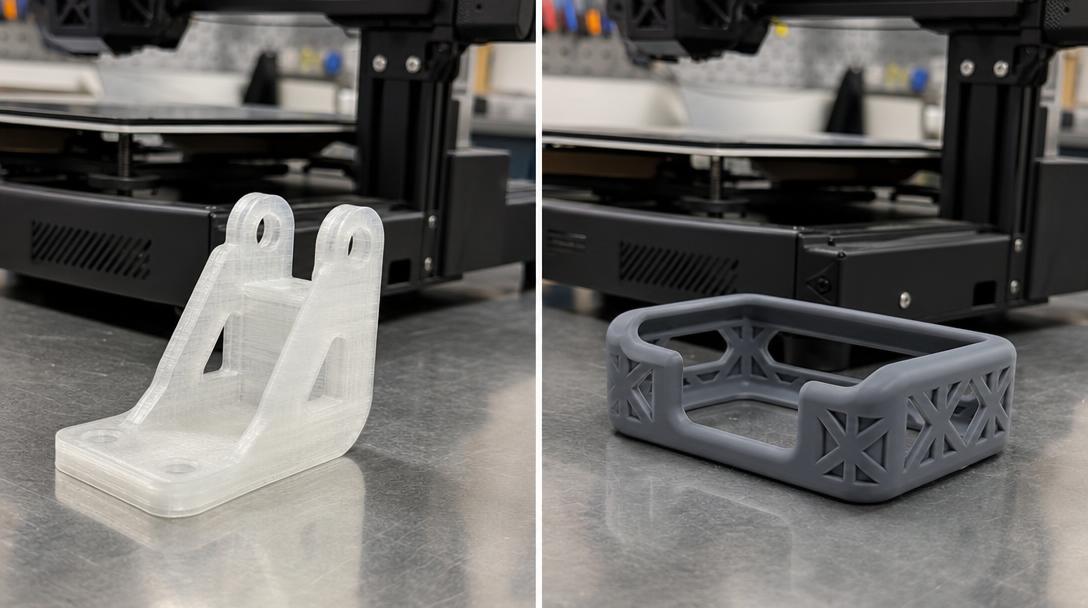
PETG is a balanced choice for parts that need to retain their shape, such as boxes, mounting accessories, protective covers, brackets, and prototypes. Its tougher behavior compared with PLA and its ability to provide sufficient durability in everyday use make it useful for many functional parts. However, PETG is a rigid material; it should not be expected to bend continuously or work like an elastic seal.
TPE is a family of filaments with flexible and elastomeric behavior. It can be considered for parts such as impact-softening bumpers, vibration-damping feet, flexible protectors, and grip surfaces. TPE’s flexibility level can vary depending on the product formulation, so you should check not only the material name but also the hardness grade specified by the manufacturer.
Outdoor and temperature performance
PETG may be a more sensible option than PLA for moderate outdoor use; however, under continuous exposure to sunlight, rain, and temperature cycles, actual usage conditions are just as decisive as the design and color selection. It should not automatically be considered trouble-free for long-term UV exposure. Although TPE retains its flexibility, its outdoor performance also depends on the additives in the specific product and environmental effects. With both materials, it is advisable to test a prototype under actual usage conditions before relying on it as a final part.
When temperature is a factor, PETG can be a practical solution at low and moderate temperatures; the possibility of losing rigidity as the temperature rises should be taken into account. TPE’s behavior depends on both temperature and its flexible formulation. Rather than looking only for flexibility in a heat-exposed part, evaluate the operating temperature and load together.
The difference in impact resistance, rigidity, and flexibility
- Rigidity: PETG is advantageous for parts that need to retain their shape and dimensions. TPE can deform more under load.
- Impact: TPE may be more successful at absorbing impact and vibration. PETG, on the other hand, behaves more consistently as a hard protective body or connecting part.
- Flexibility: TPE stands out for surfaces that bend, compress, or provide grip; PETG may break or suffer permanent deformation in these tasks.
Printing ease and the cost perspective
PETG is generally easier to manage than TPE on desktop FDM printers. Although profile adjustments may be required for bed leveling, stringing, and surface adhesion, its rigid structure provides a more predictable flow through the feed path. TPE may require a low printing speed, short and controlled retraction settings, and a feeding setup suitable for the filament. Since soft filament can jam or curl in Bowden systems, printer compatibility should be checked in advance.
When making a cost decision, do not look only at the price of the spool. With TPE, test prints and slower production times can increase the total cost. When PETG enables standard functional parts to be produced faster and more consistently, it may become more practical in terms of price per gram. You can clarify the appropriate material choice by reviewing our printing materials for your project.
Which material for which part?
If you are printing a rigid electronics enclosure, a dimensionally critical accessory, a mounting foot, or a protective cover, start with PETG. If the surface that the part contacts needs to soften impact, reduce vibration, or flex in a controlled way, TPE is the more suitable candidate. Correctly defining the areas where each material performs best is more valuable than carrying out long and costly experiments with the wrong filament.
While preparing your part for production, you can consider 3d printing service options and review your project budget based on the price per gram model. If your file is ready, you can quickly view an estimated price through the online 3d printing tool.



 Türkçe
 العربية
 Русский
 فارسی
فارسی Deutsch