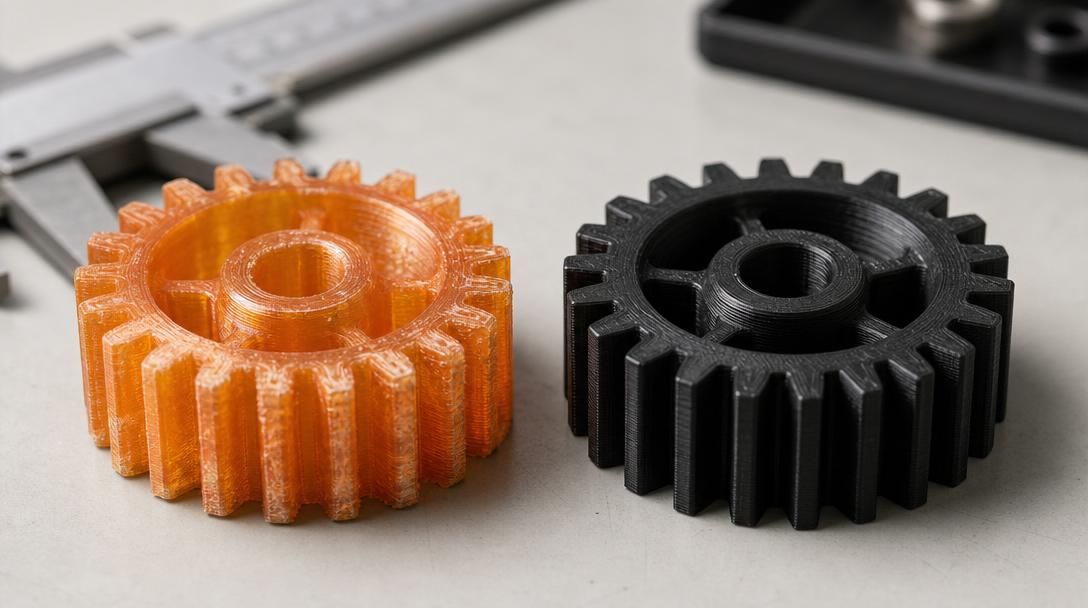

Nylon or PETG? Which One Is Right for Wearing and Load-Bearing Parts
In 3D printing, the question of nylon versus PETG is one of the most critical material decisions for parts exposed to friction and working under load, such as gears, pulleys, bushings or hinges. Choosing the right filament directly affects how long your part lasts. If you are torn between these two popular FDM materials, let us answer the question directly: for load-bearing and wearing parts, nylon (PA) is clearly ahead of PETG when it comes to wear resistance and toughness. But this comes at a cost. Let’s compare the two materials specifically for wearing and load-bearing parts.
Why does nylon (PA) filament stand out in wear resistance?
Thanks to its low coefficient of friction and self-lubricating structure, nylon (polyamide) is long-lasting on surfaces that rub continuously. In parts such as gears, sliding bearings, pulleys and rails, nylon holds its shape under load and is far more resistant to wear than PETG. It also has high impact toughness: a nylon part flexes and distributes energy instead of cracking. That said, nylon rapidly absorbs moisture from its surroundings, which makes drying before printing absolutely essential. It also requires a high printing temperature (250-280°C) and usually an enclosed chamber.
PETG, on the other hand, offers a balance of ease of use and price
PETG is an engineering material that combines the print ease of PLA with the durability of ABS. Although it falls behind nylon in wear resistance, it is more than sufficient for parts under low to medium load while also being more economical. PETG’s biggest advantage is that it is far less moisture-sensitive than nylon — it doesn’t immediately draw moisture from the air, and drying before printing is usually not required. It also prints at a lower temperature (230-250°C), doesn’t require an enclosed chamber, and is more affordable than nylon. However, under continuous friction, PETG wears over time and its surface degrades. For this reason, PETG is ideal for parts that bear load occasionally and stay stationary.
Which one should you choose in each case?
To make your decision easier, here is a quick summary:
- Choose nylon (PA): continuously rotating gears, load-bearing pulleys, sliding bearings, mechanical parts working under heavy load, industrial components exposed to impact.
- Choose PETG: light and medium-load structural parts, enclosures, brackets, functional prototypes, parts that will operate in humid environments, budget-sensitive projects.
There is also a difference in surface quality: nylon offers a matte, slightly rough surface, while PETG comes out glossier and smoother. If painting is planned, PETG holds the top coat better, whereas nylon is more suitable for sanding. Your project’s operating conditions — ambient temperature, humidity level, continuous or intermittent load — will determine the final decision.
If your part will be exposed to both wear and impact and the printing difficulty doesn’t scare you, nylon is a much sounder investment in the long run. If you’re looking for a solution that is easier to print, less fussy about moisture and affordable, PETG won’t let you down. If you’re going to produce mechanical parts, the basic rule is this: if surfaces will rub against each other and bear load, choose nylon; if the part will stay stationary or carry load only occasionally, choose PETG.
At Ucuz3D, we provide solutions for your industrial and mechanical part needs with 17 different material options, including both nylon (PA) and PETG. With our 3D printing service, we are by your side at every stage from prototype to mass production. To find out which material suits your project, calculate your price instantly or explore our nylon, PETG and carbon-fiber-reinforced options on our engineering materials page. For detailed material information, you can also take a look at our nylon (PA) filament guide.




 Türkçe
 العربية
 Русский
 فارسی
فارسی Deutsch