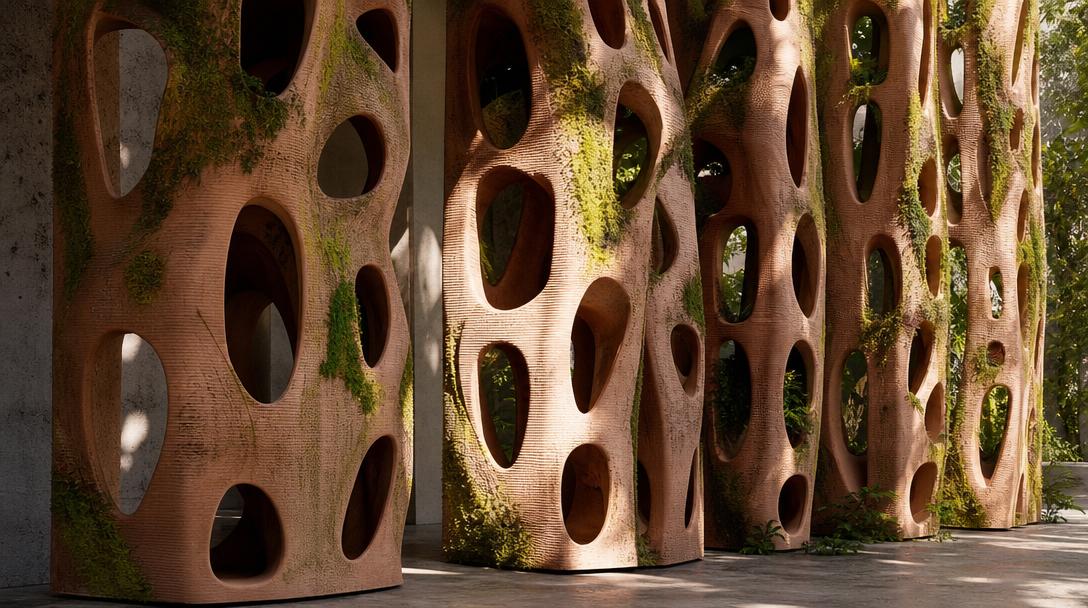

Minimal Matter: Biology-Inspired Architecture Built from 3D-Printed Terracotta Modules
3D printing technology is not limited to plastic and metal parts; experimental work with clay, ceramic and earth-based materials is opening the door to a new way of thinking in architectural production. Designer Rameshwari Jonnalagedda’s Minimal Matter project combines minimal surface mathematics with layered clay fabrication to present a biology-inspired building system made of 3D-printed terracotta modules. Let’s take a closer look at this innovative approach and the role 3D printing plays in architectural prototyping.
From Minimal Surfaces to Physical Modules
The minimal surface geometries at the heart of the project draw inspiration from mathematical forms that are common in nature, optimizing volume while minimizing surface area. By adapting these geometries to clay 3D printing, Jonnalagedda produces modules that each have distinct curvatures and void ratios. Achieving this level of geometric variety with traditional ceramic methods is almost impossible, whereas 3D printing delivers continuous variation in every module without any additional mold cost.
A Building Material That Grows With Nature
The most striking aspect of the Minimal Matter modules is that they are designed to interact with their surroundings rather than degrade over time. The porous, open-structured terracotta surfaces are engineered to host moss, insects, air and light. In other words, the building elements become more functional as they are used and exposed to nature. The modules can be used on their own as a sculptural object, stacked to form a column, or placed side by side to create a continuous facade cladding.
The Advantage 3D Printing Brings to Prototyping
Projects like this reveal 3D printing’s biggest advantage over traditional manufacturing: the ability to produce low-volume parts with complex geometries quickly, economically and without molds. With FDM technology, it is equally possible to produce complex prototypes, architectural models and functional parts using materials such as PLA, PETG, ABS or carbon-fiber-reinforced filament. Whether it is a building model or an industrial prototype, 3D printing cuts the time from idea to physical product from weeks down to days.
For your architectural prototypes or custom-designed parts, you can quickly turn your ideas into reality with our 3D printing service; with our online 3D printing price calculator you can upload your STL file and get an instant quote. For detailed material options and design tips, don’t forget to check out our guide to 3D printing in architecture.


 Türkçe
 العربية
 Русский
 فارسی
فارسی Deutsch