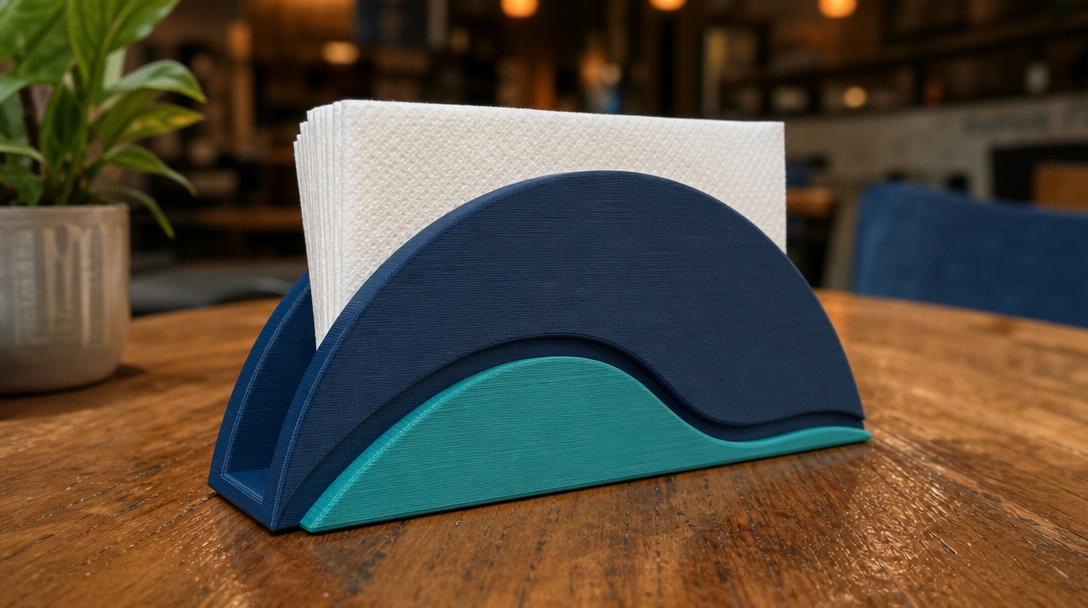

How a Custom Napkin Holder Was Made for a Coffee Shop with Prototype 3D Printing
A coffee shop owner had a clear idea in mind: a custom napkin holder for their tables that no one else had and that reflected their brand. Off-the-shelf plastic products were either too generic or simply not available in the desired dimensions. This is exactly where prototype 3D printing came into play. With digital modeling and a few print iterations, the idea turned into a working product within a week. In this article, we walk you step by step through how you can apply the same process to your own project by leveraging the advantages of 3D printing in prototyping.
From Idea to Design: Taking Measurements and Modeling
Every successful prototype starts with good measurements. The thickness of the table tops at the coffee shop, the dimensions of the napkins, and how far users would have to reach were all taken into account. With this data, a simple model was drawn in CAD software such as Fusion 360. The design followed the 45-degree overhang rule to reduce the need for supports, and hole compensation was applied to prevent horizontal holes from becoming oval. These kinds of design tips help the first prototype come out cleaner and reduce the need for reprints.
Prototype Production and Material Selection
For the first prototype, getting a fast result was the priority. At this stage, PLA is an ideal starting material: it is easy to print, odorless, and rigid enough. Recently, new filaments focused on rapid prototyping such as Prusament PLA High Speed have hit the market; these materials make it possible to get clean prints even at higher speeds compared to standard PLA. Major chemical manufacturers like Dow are also working on tougher, more reliable PLA formulations. These developments show that PLA is becoming increasingly attractive for prototyping.
The printer infrastructure used to produce prototypes is also evolving rapidly. Multi-color FDM printers like the Elegoo Centauri 2 series now start at $299, making it easier for small businesses to produce their own prototypes at home. In addition, innovations such as AtomForm’s 12-nozzle system reduce color-transition waste in multi-color prints by up to 90 percent, lowering both cost and material waste. These kinds of innovations make desktop prototyping more accessible than ever.
Testing and Refinement: The Prototype Loop
When the first PLA prototype was placed on the table, two issues emerged: the napkins were a bit too tight, and the surface texture was not as matte as desired. At this point the measurements were revised, the inner cavity was widened by one millimeter, and the number of top layers was increased in the slicing settings. The second prototype was ready just one day after the first print and was accurate in every respect. This is the biggest advantage of prototype 3D printing: being able to try multiple versions quickly and at low cost. While this loop takes weeks with traditional injection molding, prototyping with FDM brings the same work down to days. Moreover, thanks to the adaptive layer height feature in slicing software, you can use thin layers on curved surfaces and thick layers on flat areas, gaining both quality and speed at the same time.
Moving to Series Production and Pricing
Once the prototype was approved, the material decision for series production was made: given regular use and exposure to light moisture, PETG was a more durable option than PLA. Thanks to our transparent per-gram pricing, the cost per unit was calculated precisely. For your own project, you can upload your STL file on our calculate your price instantly page and see a clear cost within seconds.
This story shows that the path from idea to prototype and series production is not as hard as it seems. With the right measurements, the appropriate material choice, and a few iterations, you too can bring your own product to life. If you would like professional support for your project or want pricing information, you can start the process with our online 3D printing service. Prepare your design, get a quote, and move into production.



 Türkçe
 العربية
 Русский
 فارسی
فارسی Deutsch