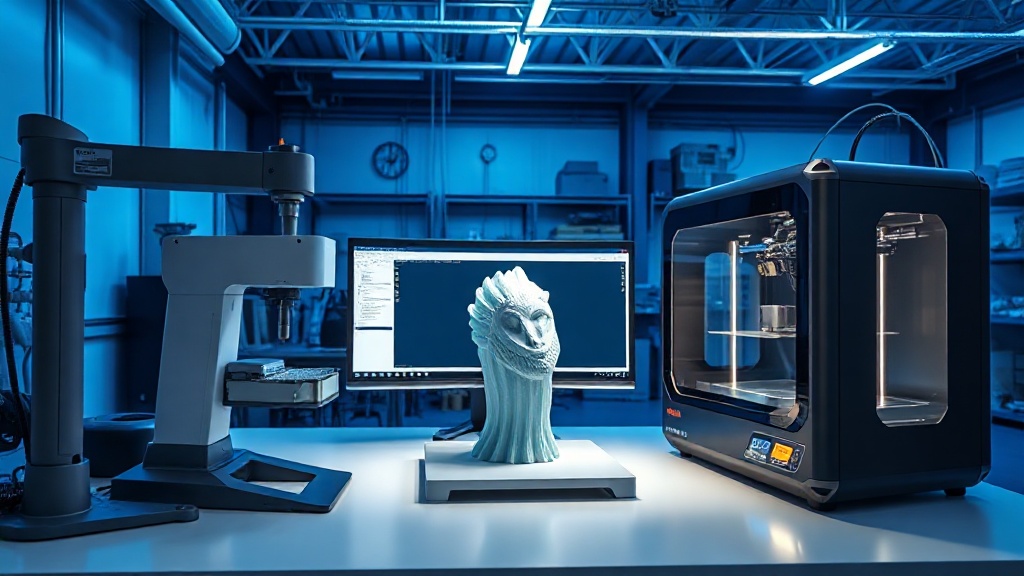

From Prototype 3D Printing to Full Product Development: Surface Scan’s New Move
Prototype 3D printing has seen one of its most striking trends in recent years: bringing scanning, design, prototyping and final-part production together under a single team. According to a report published on 3D Printing Industry on 17 June 2026, UK-based Surface Scan now offers end-to-end product development and manufacturing rather than just 3D scanning and rapid prototyping. This move clearly illustrates why customers in additive manufacturing increasingly want fewer suppliers, a shorter decision chain and faster validation.
What exactly is Surface Scan expanding?
According to the details shared in the report, the company is consolidating geometry capture, CAD design, iteration, prototyping and finished-part delivery under one roof. To support this, a new design engineer has been hired, a Formlabs SLA printer has been added, high-performance engineering plastics such as PEEK have been brought into the portfolio, and CNC machining capability has been expanded. In other words, this is not just an investment in new equipment; it is about reducing the disconnects a customer experiences on the journey from idea to product.
This approach is especially important for product development teams. Running the scan in one place, the design with another team, the prototype at a third supplier and the final part at a fourth point both lengthens the timeline and increases the cost of revisions. Surface Scan’s message is clear: the fewer hands a part’s story passes through, the faster validation and the transition to production become.
Why does it make more sense now?
Today many companies use 3D printing not just for a “nice-looking demo part” but to accelerate real engineering decisions. Rapid iteration is critical especially for enclosures, assembly fixtures, test jigs, ergonomic models or low-volume functional parts. At this point, the single-window service model stands out for three reasons:
- Less communication loss: Scan data, design intent and production constraints are discussed within the same team.
- Faster revisions: Issues spotted in the prototype are fixed without searching for a new supplier.
- More realistic material selection: Not just the look of the part but also its operating conditions are taken into account early on.
In fact, this news points to the direction in which 3D printing is maturing: technology alone is not enough; it creates value to the extent that it simplifies the workflow. If you too want to quickly see the first sample of a part, run a dimensional check or carry out a functional trial, the “calculate your price instantly” approach at Ucuz3D calculate your price instantly answers exactly this expectation for speed.
What does this development mean in practice for Ucuz3D customers?
The Surface Scan example comes from a UK service bureau, but the lesson it offers also applies to teams developing products in Turkey. Especially with FDM-based prototypes, the goal is often not direct mass production but validating the correct form, fit and feel as early as possible. At this stage, material selection becomes critical. For projects expecting impact, temperature or mechanical loads, looking at printing with engineering materials options from the very start can reduce the need to swap parts later.
Similarly, in projects that begin with scanning, the reverse-engineering logic must be set up correctly. If you want to better understand the steps of taking measurements, cleaning surfaces, transferring to CAD and creating print-ready geometry, our 3D scanning and reverse engineering guide is a good starting point. That way, instead of simply copying the existing part in your hands, you can improve it in a way suited to printing and your usage scenario.
What will we be watching in the period ahead?
The most important conclusion from this news is this: a 3D printing service is no longer seen as sufficient on its own; customers expect a more integrated experience stretching from design to production. On the Ucuz3D side, the closest equivalent is the flow of quickly pricing your STL file, selecting the right FDM material and producing a validation part in a short time. If you want to shorten the path from prototype to functional part in your project, starting at an early stage with the right material and the right production approach saves serious time. If you want to clarify the right solution for the part you need, sharing your file and starting with a small trial is often the most practical first step.




 Türkçe
 العربية
 Русский
 فارسی
فارسی Deutsch