
Filament Drying Guide: Removing Moisture with an Oven, Dryer or Food Dehydrator
Filament absorbing moisture from the air is one of the most frequently overlooked factors affecting 3D print quality. The crackling sounds, surface bubbles and poor layer adhesion that appear when printing with damp filament all come from the same source: water evaporating inside the melt. In this article we explain filament drying methods step by step, in a way you can apply at home.
Why Is Moisture a Problem?
Filament is dried and vacuum-packed during production, but once the package is opened it is exposed to humidity in the air. Hygroscopic materials such as PLA, PETG, nylon (PA) and TPU absorb water from the air. During printing, this moisture suddenly evaporates and expands inside the nozzle at temperatures above 200 °C, leading to the following problems:
- Crackling and popping sounds — the audible sign of steam escaping from the nozzle
- Bubbles and roughness on the surface — caused by steam being trapped in the melt and bursting
- Weak adhesion between layers — moisture weakens the molecular bonding
- Dimensional inconsistency — holes and outer dimensions drift because of irregular flow
At What Temperature and for How Long Should You Dry?
Every filament type has a different ideal drying temperature and time. Raising the temperature too high causes the filament to soften and deform. Here are reference values for the most common materials:
- PLA: 45-50 °C, 4-6 hours
- PETG: 55-65 °C, 4-6 hours
- Nylon (PA): 70-80 °C, 8-12 hours
- TPU: 50-60 °C, 4-6 hours
- ABS / ASA: 65-75 °C, 4-6 hours
- Polycarbonate (PC): 80-90 °C, 6-8 hours
Filament Drying Methods at Home
Drying with an Oven
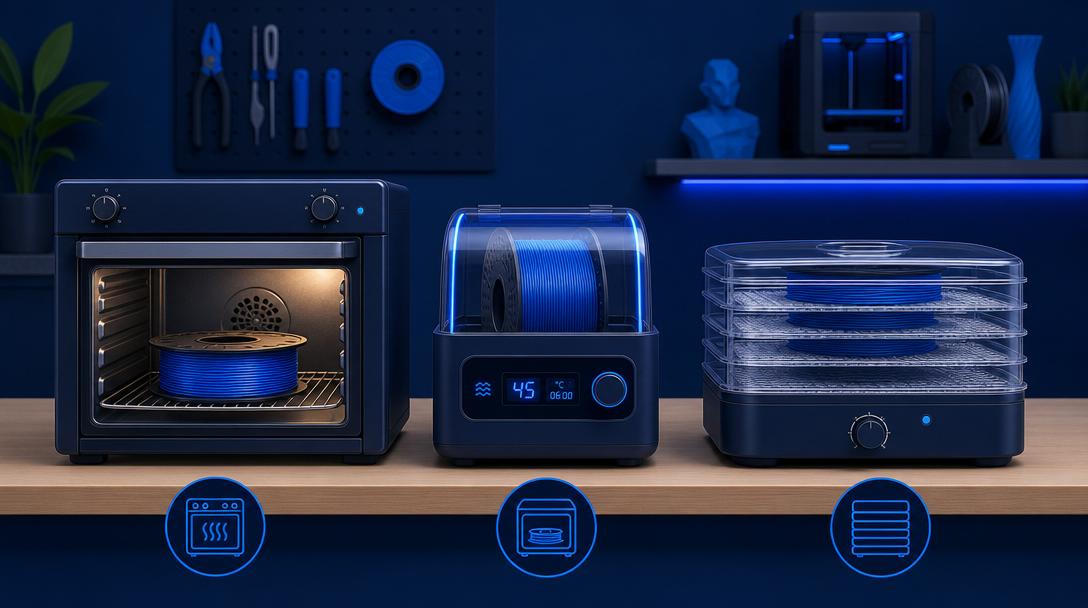
This is the most accessible method. Set your oven to its lowest temperature, but always check the actual temperature with an oven thermometer, because many ovens can run 10-20 °C above the set value. Place the spool on the oven tray and leave the door slightly ajar so the moisture can escape. Do not try to dry sensitive filaments such as PLA in ovens that lack a low temperature setting.
Dedicated Filament Dryer
Devices made for this purpose are the most reliable method. The temperature stays constant and, thanks to fan circulation, drying is even across the whole spool. They are especially ideal for materials such as nylon that require high temperatures and long times. Most dryers also work as a dry box that protects the spool from moisture during printing. Among our printing material options you can also consider specialty filaments such as nylon, PC and TPU.
Food Dehydrator
This is an excellent alternative for low temperature filaments such as PLA, PETG and TPU. Many food dehydrators operate in the 35-70 °C range and, thanks to their fan-driven design, provide even heat distribution. You may need to remove the trays to fit the spool inside. It is a safer choice than an oven, especially for filaments that need long drying times.
Storage After Drying
Once drying is finished the filament starts to absorb moisture again, so storage is at least as important as drying. Sealing it with silica gel in vacuum bags is the most practical solution. For filaments you use more often, building a dry box that also protects them during printing will make your life easier in the long run. For detailed storage tips, take a look at our How Should Filament Be Stored? guide.
Getting into the habit of regular filament drying instantly raises the quality of your prints and reduces material waste. If you would rather get professional results instead of experimenting on your own printer, you can send us your project and calculate your printing cost instantly.


 Türkçe
 العربية
 Русский
 فارسی
فارسی Deutsch