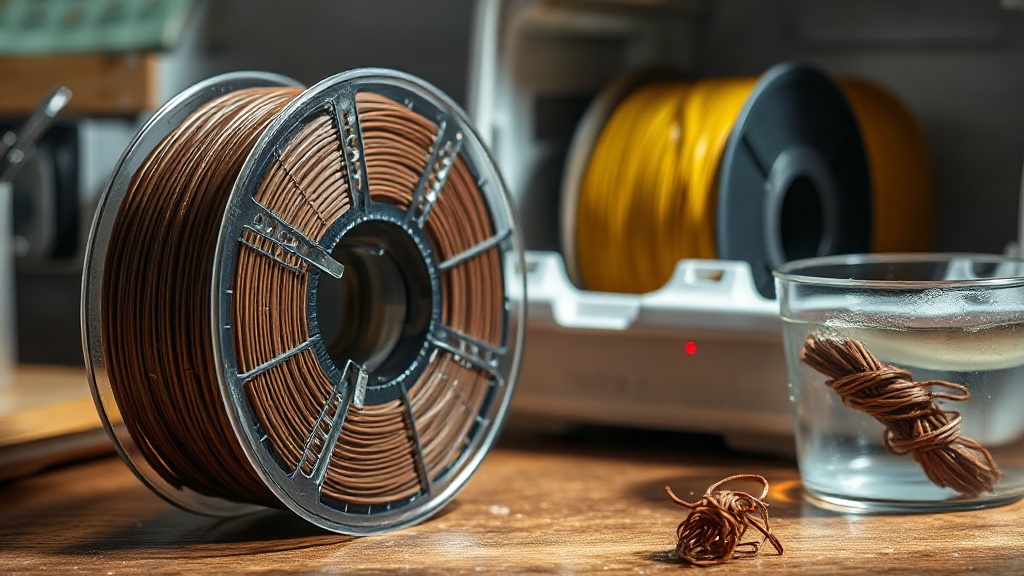

Filament Drying Guide: How Does Moisture-Absorbed Filament Ruin Your Print?
If you’ve ever heard a faint crackling from the nozzle during a print, or noticed unexpected bubbles on the surface, the culprit is most likely not your settings — it’s the moisture in your spool. Most filaments absorb water from the air, and that water vaporizes at the moment of printing, causing problems. That’s why filament drying is just as important as having the right temperature for a quality result.
What does moisture do to filament?
Filament is hygroscopic, meaning it absorbs moisture from the air. When the nozzle heats that moisture above 200 degrees, it instantly turns to steam. As the steam pops within the melt, it creates pores on the surface, wispy strings, and weak layer bonding.
Signs of moisture-absorbed filament
If you notice one or more of the following signs, your spool has absorbed moisture:
- Crackling and fogging: faint steam and popping sounds around the nozzle
- Stringing: fine threads and spider-web textures between parts
- Matte and rough surface: lines that should be glossy appearing dull
- Poor adhesion: layers separating easily, part becoming brittle
- Inconsistent flow: some areas under-extruded and others over-extruded with the same settings
How sensitive is each material?
Not all filaments absorb moisture equally. PLA is relatively tolerant; PETG, nylon, TPU, and especially water-saturated nylon variants are far more sensitive. Nylon can visibly degrade in just a few hours of exposure to open air.
Correct drying methods
The logic of drying is to keep the material warm — well below its melting point — for an extended period. A dedicated filament dryer is the most practical solution; a fan-assisted oven is an alternative, though temperature must be monitored carefully. As a general rule, 45–50 °C for 4–8 hours works for PLA, 60–65 °C for PETG, and 70–80 °C for nylon. After drying, storing the spool in a sealed container with desiccant packets solves half the problem.
At our workshop in Şile, we keep materials in dry storage and in a dryer when needed, ensuring that every model that comes to us prints with a clean surface and no moisture-related defects. If you want quality results without going through all this trouble yourself, simply upload your model on our quick order page.


 Türkçe
 العربية
 Русский
 فارسی
فارسی Deutsch