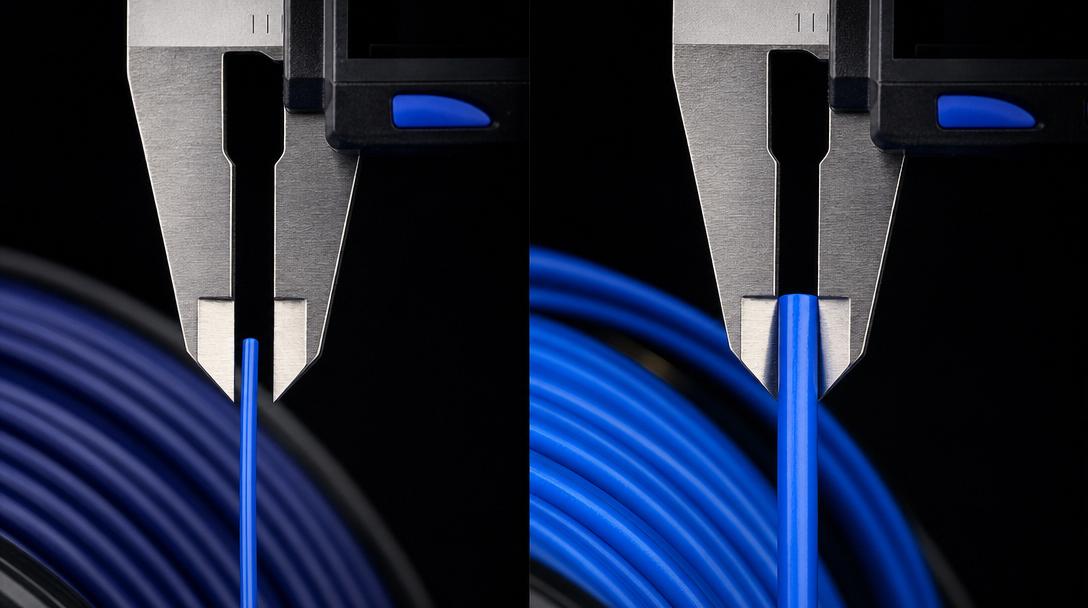

Filament Diameter Tolerance: Differences Between 1.75 mm and 2.85 mm
One of the most common questions beginners face in 3D printing is about filament diameter. There are two main standards on the market: 1.75 mm and 2.85 mm, and your filament choice depends on which one your printer uses. However, beyond diameter, filament diameter tolerance is also a critical factor that directly affects print quality. In this article, we explain the two diameter standards, why tolerance matters, and how to make the right choice.
1.75 mm and 2.85 mm: Two Different Standards
Filament diameters are determined by the printer’s extruder and hotend design. The 1.75 mm diameter has become nearly universal in desktop FDM printers. Most brands such as Bambu Lab, Creality, Prusa, and Anycubic use this standard. The 2.85 mm (sometimes referred to as 3 mm) is more commonly found on UltiMaker and older-generation industrial printers.
- 1.75 mm filament: Being thinner, the extruder motor controls the filament more precisely. Retraction is more effective and creates less resistance in Bowden systems. It is the most widely available diameter on the market.
- 2.85 mm filament: Being thicker, more force can be applied during extrusion. Due to its diameter, it creates more friction in the Bowden tube, but it is preferred in some industrial applications that require lower extrusion pressure.
Why Is Tolerance Important?
The filament diameter is not the same at every point along the spool. Depending on manufacturing quality, the diameter can vary between ±0.02 mm and ±0.10 mm. This is where filament diameter tolerance comes into play. Low-tolerance filament has a more consistent diameter throughout the spool, ensuring stable flow throughout the print.
Problems Caused by Poor Tolerance
The following issues are common with filaments that have deviations of ±0.05 mm or more:
- Flow fluctuation: Over-extrusion occurs in areas where the diameter thickens, and under-extrusion occurs in areas where it thins.
- Extruder gear skipping: Sudden thick spots cause the gear to slip over the filament, leading to feed errors.
- Surface quality degradation: Inconsistent flow causes waves on the layer surface and poor adhesion.
Which Filament to Choose and When?
First, check which diameter your printer supports. Most modern desktop printers use 1.75 mm. You cannot load 1.75 mm filament into a 2.85 mm printer; the extruder gear and hotend are not designed for it. In terms of tolerance, the most reliable brands typically produce filament with ±0.02 mm tolerance. Checking the tolerance value on the product page when purchasing a spool will help prevent unexpected printing issues.
Choosing the right printing material is just as important as your filament diameter. Each filament type has its ideal temperature, cooling, and flow settings. If you make your selection while also considering diameter tolerance, you will experience fewer issues with your prints and increase the durability of your parts.
If you are unsure about your filament choice or want to determine the right material for your project, you can calculate your instant price and reach out to us. You can also find more details about filament-nozzle compatibility in our guide on nozzle sizes and their effect on printing. Take your printing experience to the next level with the right material and settings.




 Türkçe
 العربية
 Русский
 فارسی
فارسی Deutsch