

FDM or Resin? Which Is Right for Which Job
Everyone who is just stepping into the world of 3D printing, or wants to choose the right technology, has the same question in mind: FDM or resin? Both technologies answer dozens of different needs, but the right choice depends on the part’s intended use, your budget, and the quality you expect. In this article we compare FDM and resin (SLA) printing in terms of function, durability, cost, and detail, and explain in plain language which one suits which job.
FDM and SLA: Two Different Manufacturing Worlds
FDM (Fused Deposition Modeling) melts thermoplastic filament and lays it down layer by layer. It works with common filaments such as PLA, PETG, ABS, TPU, and nylon. SLA (Stereolithography), on the other hand, cures liquid resin with a UV laser to harden it. Both technologies belong to the additive manufacturing family, yet the properties of the parts they produce are quite different. For a detailed comparison, take a look at our guide to the differences between FDM, SLA, and SLS technologies.
Which Technology for Which Part?
FDM: Durability and Functionality Come First
FDM is the right choice for parts where mechanical strength is the priority. Prototype fixtures, functional jigs, spare parts, and components meant for outdoor use deliver the required toughness and long service life when produced with FDM. Thanks to engineering materials such as carbon-fiber-reinforced filament, nylon, and polycarbonate, parts can be printed to withstand industrial conditions.
- Advantages: High durability, a wide range of materials, low cost per gram, large part sizes.
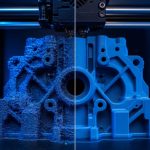
- Limitations: Layer lines are visible, and fine detail and smooth surfaces are not as sharp as with resin.
SLA: Superior Detail and Surface Quality
Thanks to very thin layers, SLA printing offers smooth surfaces close to injection-molded quality. Resin technology stands out for jobs that require high detail, such as jewelry molds, dental models, miniature figures, and anatomical models. However, SLA parts can yellow over time under UV light and do not have the same impact resistance as FDM.
- Advantages: Superior surface quality, high detail resolution, easy handling of complex geometries.
- Limitations: More brittle structure, high material cost, the need for washing and curing post-processing, and a limited range of materials.
Cost and Size Comparison
On a per-gram basis, FDM is significantly more economical than resin printing. FDM filaments are far more affordable per kilogram, while SLA resins cost more for the same volume. FDM also has a wide advantage in print size: while 250×250 mm beds are standard on hobby-class machines, industrial FDM printers can produce parts several meters long. With SLA printers, the typical build volume remains smaller.
Making the Right Choice
If you are looking for a prototype fixture, a mechanical part, a spare part, or an industrial jig, FDM is the right choice. By uploading your STL file and instantly calculating its price, you can see a transparent cost per gram and put together a plan that fits your budget. If you want a finely detailed medical model, a jewelry prototype, or a display piece, SLA may be more suitable.
At Ucuz3D we work exclusively with FDM technology. With our 17 different material options and large print volume, we produce a wide range of jobs at professional quality, from prototype parts to functional spare parts. By reviewing our printing materials, you can choose the filament best suited to your project.
If you want the best possible result for your project, you can quickly get a quote from our urgent order page, and our team will be glad to guide you.



 Türkçe
 العربية
 Русский
 فارسی
فارسی Deutsch