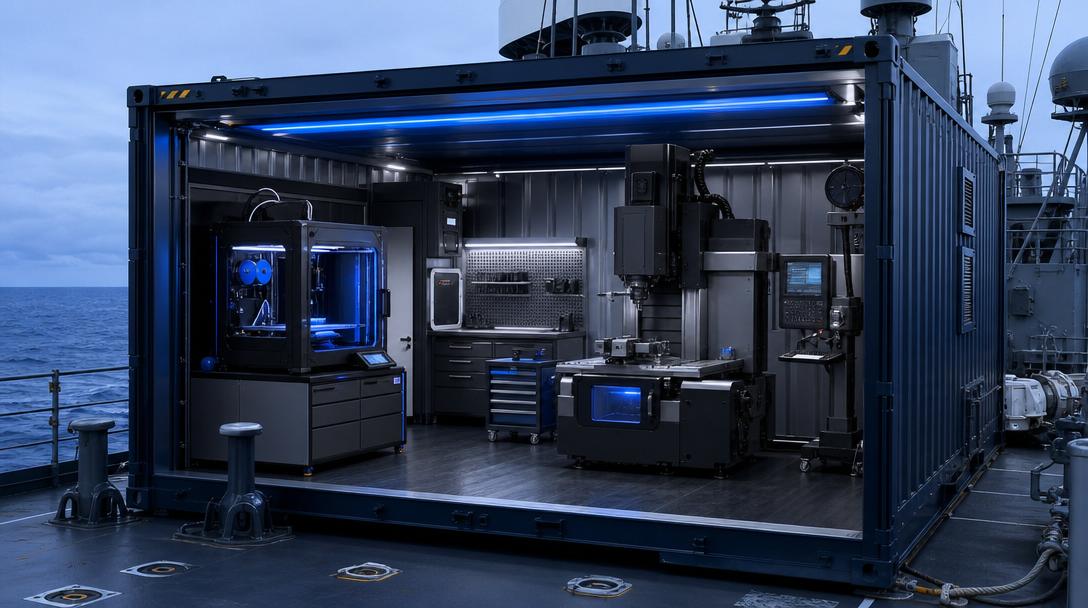

Distributed 3D Printing Trial at RIMPAC 2026: Spare Part Production Aboard Warships Enters a New Phase
The ongoing RIMPAC 2026 exercise in the Pacific Ocean is the stage for an important trial that shows just how far 3D printing technology has come in military logistics. Led by the Naval Postgraduate School (NPS), 3YOURMIND and Phillips Corporation Federal Division are testing a distributed manufacturing concept in a live operational environment. This development once again puts the spotlight on the role of 3D printing in the spare part supply chain, while also offering valuable clues about how accessible technologies like FDM could be used in defense logistics.
The RIMPAC 2026 Trial: Distributed Manufacturing Tested in the Field
Held around the Hawaiian Islands from June 24 to July 31, RIMPAC 2026 is one of the largest naval exercises in the world. In this year’s exercise, the CAMRE (Consortium for Additive Manufacturing Research and Education) consortium within NPS is putting distributed 3D printing capability to the test in an operational setting. 3YOURMIND provides its commercial platform to manage part identification, order management and production planning through a single digital thread. Phillips Corporation, meanwhile, has deployed container-based hybrid AM technology (3D printing + machining) aboard the USS Essex.
Before the trial, technical compatibility was validated during the JIFX (Joint Inter-agency Field Experimentation) and Valiant Shield exercises. As NPS CAMRE Program Manager Chris Curran put it, the goal is “to make sure the right unit gets the right file at the right time, so it can print in the field.”
Why Is Spare Part 3D Printing Gaining Ground in Defense Logistics?
For some of the parts used in military vehicles and ships, the lead time can stretch into weeks. The declining manufacturer support for aging platforms in particular is accelerating the search for alternative solutions. FDM 3D printing can cut the logistics time for low-volume and urgent spare part production from days down to hours. The U.S. Air Force saving fuel with 3D-printed micro vanes on its C-17 fleet, or the DLA Columbus test center producing test fixtures with FDM in hours instead of weeks, are concrete examples of this potential. The RIMPAC trial carries the same logic into naval logistics: production at the moment of need, at the point of need.
Defense Parts with FDM: Which Material Is Right and When?
Material selection for FDM parts intended for military environments is critical. For parts exposed to UV, salt water and temperature swings on a ship’s deck, standard PLA falls short. ASA, with its UV resistance and outdoor performance, is a longer-lasting alternative to ABS. Engineering materials such as nylon (PA) and polycarbonate (PC) stand out for structural parts that require impact and heat resistance. Carbon fiber reinforced filaments are preferred for drone and housing parts thanks to their stiffness and lightness, but their abrasive nature calls for a hardened nozzle.
Tolerance and Dimensional Accuracy
For a part to fit in place, it must be printed to the right tolerance values. In FDM, clearance values of 0.2-0.4 mm offer a general starting point for press-fit parts. However, part orientation and layer adhesion directly affect strength, especially along the Z axis. As in the RIMPAC trial, for a part produced on the spot in the field to be reliable, both the material and the print parameters must have been validated in advance.
The Cost and Time Advantage of Distributed Manufacturing
In a traditional supply chain, the design, production, testing and shipping process for a single spare part can take months. With a digital inventory approach, part files are stored centrally and printed at the nearest production point the moment they are needed. This model lowers stock costs while also shortening lead times. This is exactly what the 3YOURMIND platform is testing at RIMPAC: managing part demand digitally and routing production to the most suitable point. The same logic applies in the civilian sector too — instead of waiting for a small plastic part that has halted an industrial machine, you can produce and replace it with FDM within hours.
What Will the RIMPAC Results Tell Us?
The findings gathered at the end of the exercise will shape the direction of distributed AM investments in the U.S. defense supply chain. NPS will evaluate the research results against goals of shortening response times, expanding critical system capacity and enabling faster iteration in weapon systems. Trials like these are accelerating the move of FDM and other 3D printing technologies into a permanent place in defense logistics.
There are lessons to be drawn for civilian users as well: identifying spare part needs in advance, choosing the right material and building a model archive saves both time and money. Whether it is an appliance part or an industrial fixture, you can consider our FDM production with transparent per-gram pricing. From our urgent order page you can get a quote in just a few minutes and bring your project to life quickly.




 Türkçe
 العربية
 Русский
 فارسی
فارسی Deutsch