
Continuous Fiber Breakthrough in Military 3D Printing: Continuous Composites Signs a Contract with the U.S. Army
The defense industry takes a new step every day toward integrating military 3D printing technologies into the production line. Idaho-based Continuous Composites, Inc. (CCI) has announced a multi-year contract with the U.S. Army Combat Capabilities Development Command (DEVCOM) Aviation & Missile Center. The company’s CF3D continuous fiber 3D printing technology will be evaluated to solve manufacturability and cost challenges on precision-strike missile platforms. The work is being carried out through America Makes under the U.S. Army’s ManTech (Manufacturing Technology) program. Projects like these show how quickly additive manufacturing is maturing within the defense supply chain.
What Is CF3D Technology and How Does It Work?
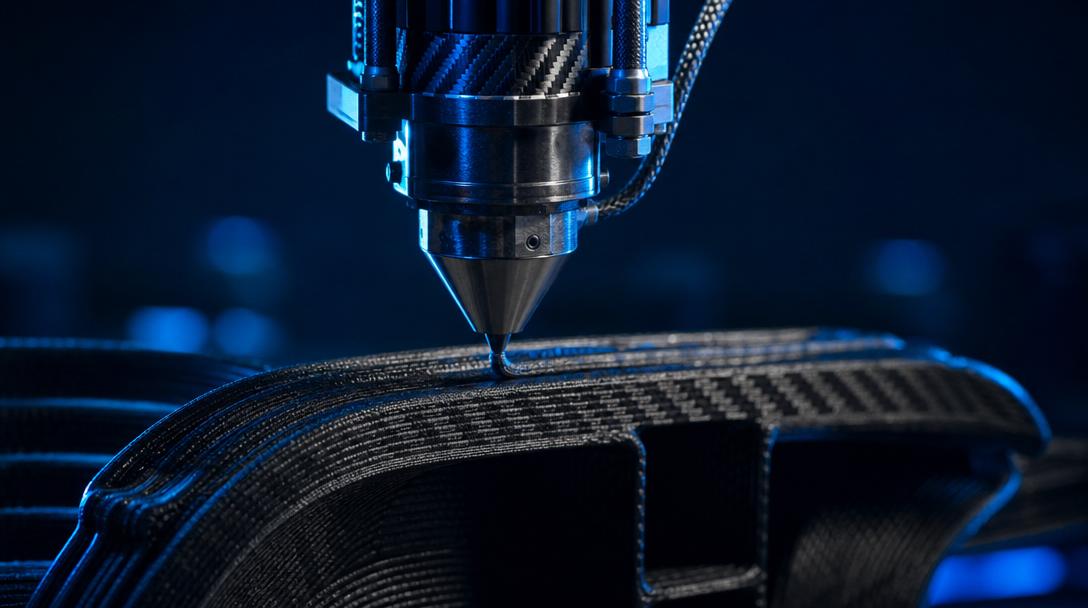
CF3D is a method that enables continuous fiber-reinforced composite materials to be produced through 3D printing. While traditional composite manufacturing requires fibers to be laid by hand or with a mold, CF3D designs the fiber orientation digitally and optimizes it according to part geometry. This both reduces material waste and allows fiber density to be increased in regions that are critical for mechanical performance. Using continuous carbon fiber or glass fiber embedded in a thermoset resin, the method achieves mechanical properties similar to traditional prepreg composites, while offering a major advantage in production time and tooling cost. CCI’s work on the Precision Strike Missile architecture focuses specifically on the yield and repeatability issues encountered in producing complex missile components.
The Growing Role of 3D Printing in Defense Procurement
This contract clearly illustrates where additive manufacturing now stands in the U.S. defense supply chain. Traditional production methods impose limitations on yield, repeatability and supply chain resilience, especially for low-volume, high-value missile components. Military 3D printing technologies such as CF3D are designed precisely to overcome these limitations. Under the contract, the company is focusing on three main goals: increasing production yield, reducing part-to-part variability, and strengthening supply chain resilience. CCI had previously received funding from AFWERX for CF3D joining methods, and this new contract proves that the technology’s maturity level is rising. The share of defense budgets allocated to additive manufacturing grows every year, which creates new opportunities in the industrial 3D printing market.
The Bridge Between FDM and Composite 3D Printing
Although CF3D is an industrial composite manufacturing method, the underlying principles share significant similarities with FDM technology. Continuous fiber-reinforced filaments can be thought of as enhanced FDM materials — much like the use of carbon fiber reinforced filaments in FDM printers. The spread of FDM in prototyping and spare-part production within the defense industry shows that these technologies complement one another. Examples such as Rheinmetall UK using FDM for tank duct components, or the U.S. Air Force switching to 3D-printed micro-valves on its C-17 fleet, prove that additive manufacturing in defense is maturing rapidly. The low cost and rapid prototyping capability of FDM technology make it an indispensable tool in the R&D processes of defense companies.
For your defense, aerospace or industrial projects, you can explore our defense and industrial 3D printing solutions for prototype or functional part production, and quickly have parts manufactured to suit your needs with FDM technology. To learn about our wide product range, from carbon fiber reinforced filaments to engineering materials, you can visit our engineering materials page. If you would like to find out the cost of your project, you can use our instant price calculation tool.



 Türkçe
 العربية
 Русский
 فارسی
فارسی Deutsch