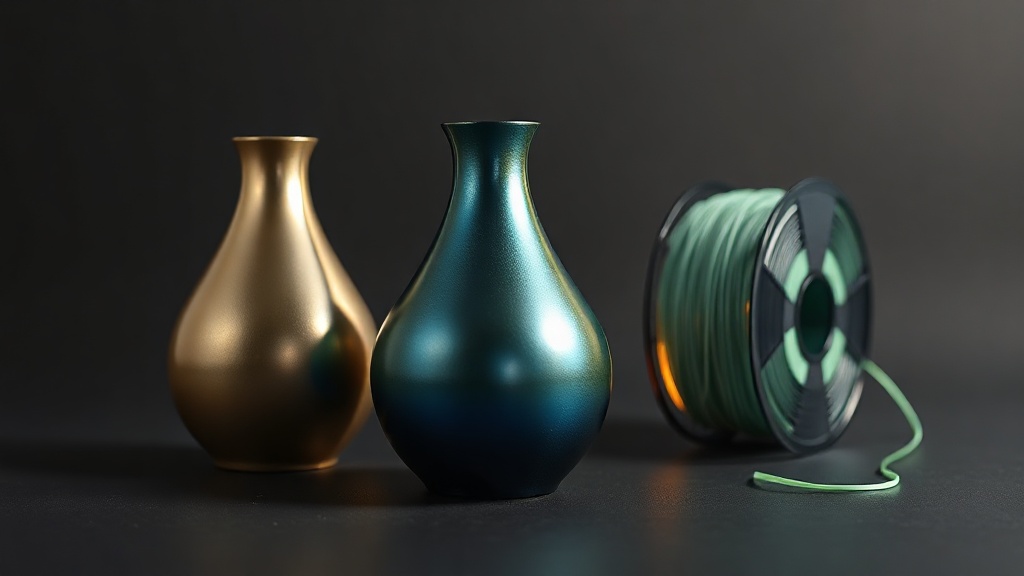

Special Filament Types: Silk, Color Gradient and Glow-in-the-Dark Options
That “wow” feeling you get when you look at the surface of a print often comes down to material choice. Standard PLA does the job perfectly well, but when you want models that truly stand out visually, special filament types come into play. In this post we cover silk, color-gradient (coil), and glow-in-the-dark options — and how each one behaves on different parts.
Silk Filaments
Silk filaments leave a shiny, almost metallic finish on the surface rather than a matte one. This sheen gives decorative sculptures, vases, and gift items a jewellery-like effect. That said, there are a few things to keep in mind:
- Layer lines are more visible on a shiny surface; using a finer layer height improves the result.
- Mechanical strength is generally slightly lower than standard PLA, so they are not ideal for load-bearing parts.
- Bridging and sharp details require slightly more careful tuning.
Coil (Color Gradient) Filaments
With these filaments, the color shifts gradually along the spool, so as the print progresses the model naturally takes on a rainbow-like transition. The biggest advantage is achieving a multi-color feel from a single spool. Because the final look depends on the part’s size and height, the same file can appear quite different at different scales. Large, single-piece models show a smoother transition, while smaller parts show a more abrupt one.
Glow-in-the-Dark (Glow) Filaments
These filaments absorb light and emit a glow for a period afterwards, making them popular for keychains, night-light bodies, and children’s room decorations. The phosphor-like additive they contain can wear down a nozzle over time, so using a wear-resistant nozzle gives better long-term results. The duration and intensity of the glow is directly proportional to the amount of light the surface has received.
Which Filament for Which Part?
Here is a simple framework to help clarify your choice:
- Want a visually striking gift item? Silk or coil gradient.
- Does it need to be visible at night? Glow.
- Is it a load-bearing or bolted part? In that case a structural material like PETG makes more sense.
If you are not sure which special filament suits your model, send us your file via our quick quote page along with a note about its intended use, and we will evaluate the design and suggest the best option.


 Türkçe
 العربية
 Русский
 فارسی
فارسی Deutsch