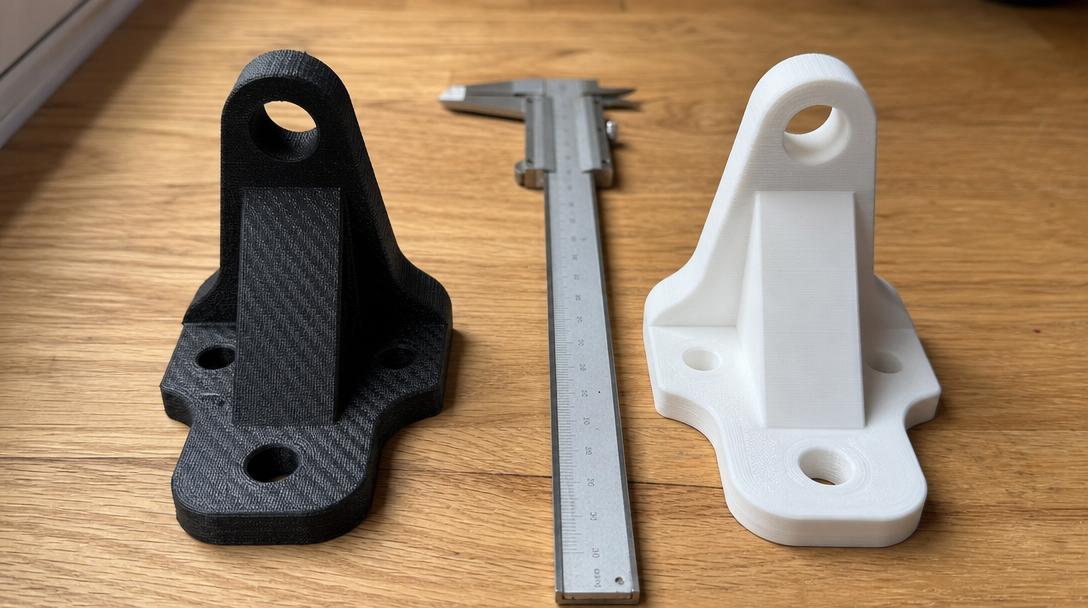

Carbon Fiber Reinforced Filament or Standard Filament? Making the Right Choice Among Growing Material Options
Material variety in the 3D printing world grows by the day. Making the right choice among dozens of options, from carbon fiber reinforced filaments to standard PLA and PETG, has become critical, especially for those who need industrial parts. In recent months, manufacturers such as Xenia, BASF and Spectrum Filaments announcing new carbon fiber reinforced materials for FDM has widened the options in this segment even further. So is carbon fiber reinforced filament really what you need, or will a standard filament more than cover the job?
Where Do the Advantages of Carbon Fiber Reinforced Filament Begin?
Filaments strengthened with short carbon fiber particles offer noticeably higher rigidity and dimensional stability than their standard counterparts. Options such as PLA CF, PETG CF and the new generation PPA CF in particular reduce the risk of a part deforming under heat and improve vibration damping properties. In applications such as drone parts, automotive fixtures and precision connectors, these properties create a direct difference in performance.
However, these advantages come at a price: the carbon fiber additive makes the filament abrasive. Standard brass nozzles can wear out within a few prints, distorting the bore geometry. For this reason, the use of a hardened steel or tungsten carbide nozzle is mandatory. In addition, CF filaments are typically 30-50% more expensive than standard PLA, and post-processing of the part (sanding, painting) is more difficult.
When Is Standard Filament Enough?
Standard filaments such as PLA and PETG are more than enough for the vast majority of everyday parts. Decorative objects, assembly jigs, prototypes and mechanical parts carrying low to medium loads can be successfully produced with standard materials. By optimizing slicing parameters such as infill ratio and wall count, sufficient strength can be achieved in most applications without the need for carbon fiber reinforcement.
To make your decision easier, answer these questions: Will the part be exposed to high temperatures? Is dimensional tolerance critical? Will the part be subjected to continuous vibration or cyclic loading? If you answer “yes” to at least two of these questions, carbon fiber reinforced filament is worth considering. Otherwise, a standard filament makes more sense both for your budget and for print time.
For beginners or one-off projects, PLA is an economical and reliable starting point. If you are looking for a more durable option, PETG offers a good balance between PLA and ABS. Carbon fiber reinforced filaments, on the other hand, are ideal especially for those manufacturing industrial parts or for projects where mechanical performance is paramount. Whichever material you choose, you can see your project’s cost within seconds with our instant price calculator tool.
For more detailed information about industrial parts and high-performance engineering materials, you can visit our printing with engineering materials page. To read our comprehensive guide on the properties and applications of carbon fiber reinforced filaments, do not forget to check out our carbon fiber reinforced filaments page.
Whether it is a prototype or series production, choosing the right material is critical for every project. At Ucuz3D we offer 17 different material options with FDM technology, and together we determine the material best suited to your needs.




 Türkçe
 العربية
 Русский
 فارسی
فارسی Deutsch