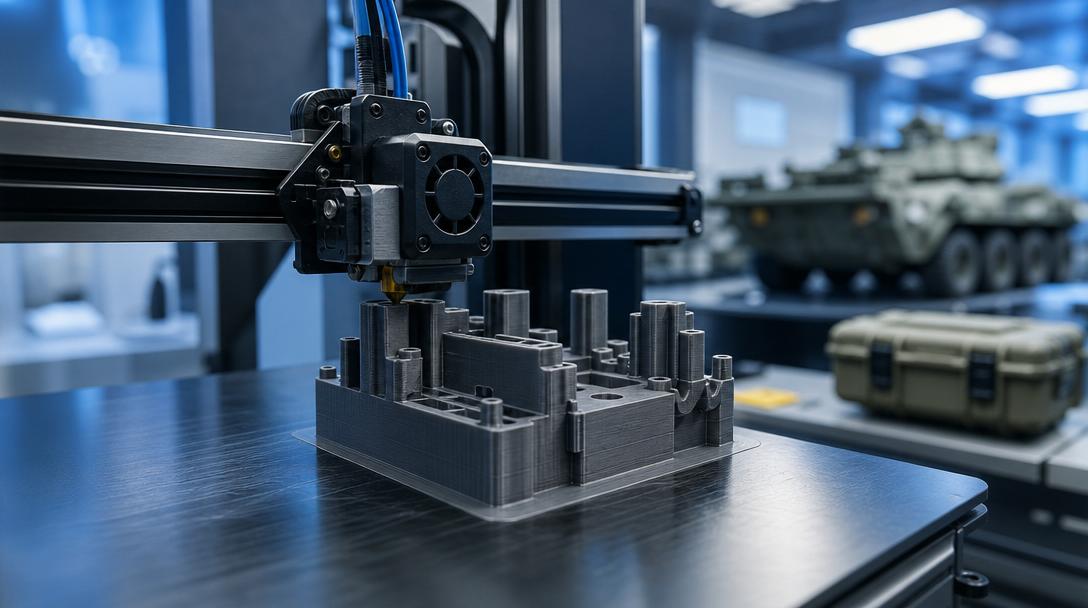

FDM 3D Printing Prototyping: A New Threshold for the Defense Industry – The DLA Columbus Case
In the defense industry, FDM 3D Printing Prototyping is ushering in a new era of test and prototype production. A recent application at the DLA Columbus Product Test Center makes this transformation tangible: with FDM 3D printing, the production time for custom test fixtures dropped from weeks to hours. This development shows just how quickly desktop FDM technology can deliver results at an industrial scale, offering a strong alternative to traditional manufacturing methods.
Where Did the Shift in Defense Supply Begin?
DLA Columbus, a test center under the U.S. Department of Defense, validates the quality and performance of a wide range of military equipment. Custom test fixtures made with traditional methods could take weeks or even months. Thanks to FDM 3D printing prototyping, that time is now measured in hours. Producing each fixture on demand to fit the specific need makes test schedules more flexible and gets equipment back into the field faster. What is more, there is no need to prepare a mold or special tooling from scratch for every new test; the CAD model can be sent straight to print.
The key advantages of this approach can be summarized as follows:
- Design flexibility: Each test part goes straight from CAD to print as needed, with no waiting on molds or special tooling. When a design revision is required, a new print is ready within hours.
- Low-volume economics: For one- or two-off fixtures, FDM's unit cost is far more favorable than traditional manufacturing. Cost is kept under control during the prototype stage.
- Material variety: A broad material range—from PLA and PETG to carbon-fiber-reinforced nylon and polycarbonate—allows parts to be produced for different test conditions.
Industrial Prototyping with FDM Is Now in Every Workshop
The DLA Columbus example proves that advanced FDM printers and engineering-grade materials can now be used not just for prototypes, but as operational parts directly within the test and validation process. Heat- and chemical-resistant materials make it possible to use FDM prints safely in defense industry testing. At this point, the FDM 3D printing prototyping process can clearly compete with traditional methods even in low-volume production.
Applications like these show that FDM is no longer just for hobbyists; it has matured into part production at industrial standards. If you would like to test a similar approach in your own project or quickly meet a prototype need, you can upload your STL file and calculate the price instantly, and start production the same day.
Why Will FDM Become Even More Widespread in the Defense Industry?
The defense and aerospace sectors are seeking speed and independence in their supply chains. FDM 3D printing offers the ability to produce spare parts and test equipment on demand, following a digital-inventory logic. The DLA Columbus case is a concrete reference proving this approach works in the field. In Turkey, too, defense industry companies are going through a similar transformation; the need for prototypes and test fixtures can be met with FDM without remaining dependent on the traditional supply chain.
The same logic applies on the civilian side: from a discontinued appliance part to a one-of-a-kind prototype, needs of every scale can be solved with FDM within a single business day. For your project, you can explore our 3D printing solutions for the defense industry or make use of our guide on the advantages of 3D printing in prototyping.
Where FDM technology stands today makes prototype and test-part production faster, more economical, and more accessible. Whatever your need may be, professional results are achievable with the right material and settings.


 Türkçe
 العربية
 Русский
 فارسی
فارسی Deutsch