
Beehive Industries Scales Up Drone Engine Production With a $50 Million Metal 3D Printer Investment
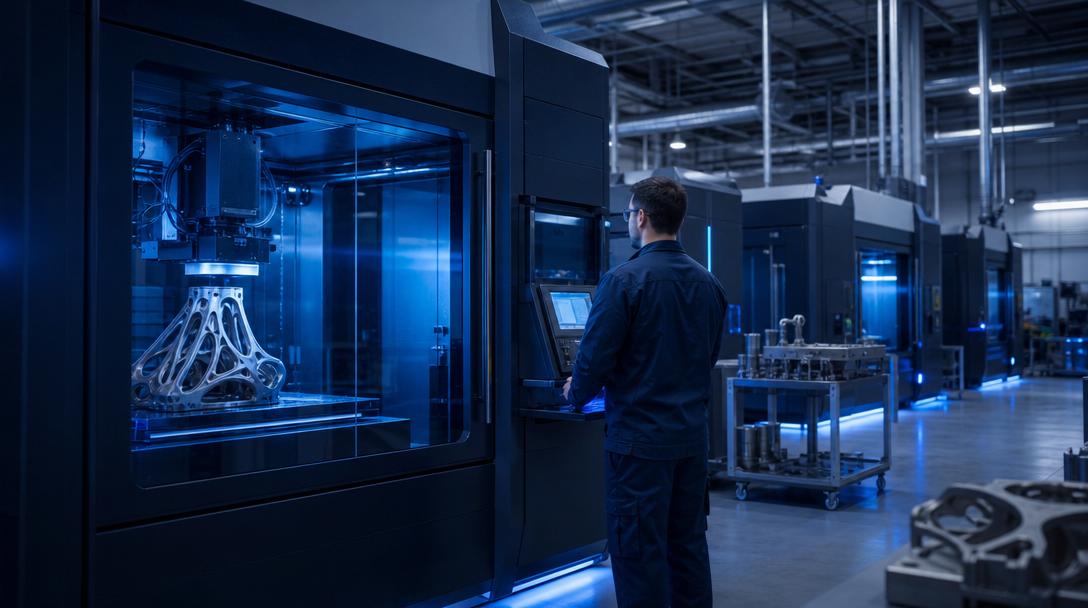
US-based propulsion system manufacturer Beehive Industries has signed a total investment deal worth $50 million, ordering 30 EOS M4 ONYX metal 3D printers. The systems will be installed at its Colorado and Tennessee facilities over the next 12 months, bringing the company’s total EOS metal 3D printer fleet to 50. This capacity is dedicated to the series production of the Frenzy 8 engine, developed specifically for swarming unmanned aerial vehicles (UAVs).
Why Does a $50 Million Fleet Expansion Matter?
This investment by Beehive Industries is one of the most concrete examples of additive manufacturing moving from the prototype stage to series production within the defense supply chain. The company had previously secured a $29.7 million contract from the US Air Force for the flight testing and qualification of the Frenzy 8 engine, and had successfully completed high-altitude tests.
The EOS M4 ONYX is a six-laser industrial metal printing platform unveiled at the 2025 Formnext trade show. Equipped with an expanded build volume, an integrated powder filtration system (RFS Pro) and process monitoring software, these systems are designed for reliable and repeatable production at defense-industry scale. Beehive plans to use this software infrastructure for production tracking and quality control.
A New Era in Defense Procurement
Behind this investment lies a structural shift in the US Department of Defense’s procurement policy. The $3.3 billion allocated to additive manufacturing in the FY2026 budget (an 83% increase over the previous year) and the $1 billion set aside for domestic low-cost drone production show that capacity investment is now being directly funded as well. As an alternative to the long lead times of traditional casting and machining, 3D printing offers the advantage of producing complex engine components without tooling costs.
Frenzy 8 and Swarm-Type Platforms
The Frenzy 8 is a family of jet engines developed by Beehive for swarming unmanned aerial vehicles. The company has also announced a larger platform called Rampart, which exceeds the 1,000-pound thrust threshold. The Frenzy 8 was showcased at the EOS booth at the Eurosatory defense fair in Paris in June 2026.
This development illustrates just how quickly additive manufacturing is finding its place in military aviation. Our 3D printing solutions for aerospace give industrial designers flexibility, especially in prototyping and low-volume custom part production.
Why Is Additive Manufacturing Growing in the Defense Industry?
Several key factors are accelerating the adoption of 3D printing in defense projects:
- Shorter lead times: Part production that takes weeks with traditional casting and machining processes drops to days with AM.
- No tooling costs: Design changes can be applied instantly, with no tooling expense.
- Complex geometries: Internal channels and cooling structures that cannot be produced with traditional methods can be printed in a single step.
- Spare-part flexibility: Thanks to a digital inventory, obsolete parts can be reproduced on demand.
An investment of this scale by Beehive confirms that metal AM is no longer the preserve of research labs alone, but has become part of series production lines. Within the scope of our 3D printing services for the defense industry, we offer industrial-scale solutions for prototype, fixture and spare-part production. For more detailed information on process and material selection, take a look at our guide to Additive Manufacturing in the Defense Industry.
If you’re wondering whether 3D printing is right for your own project too, you can upload your design and get an instant quote, and we can start printing within 1 business day.


 Türkçe
 العربية
 Русский
 فارسی
فارسی Deutsch