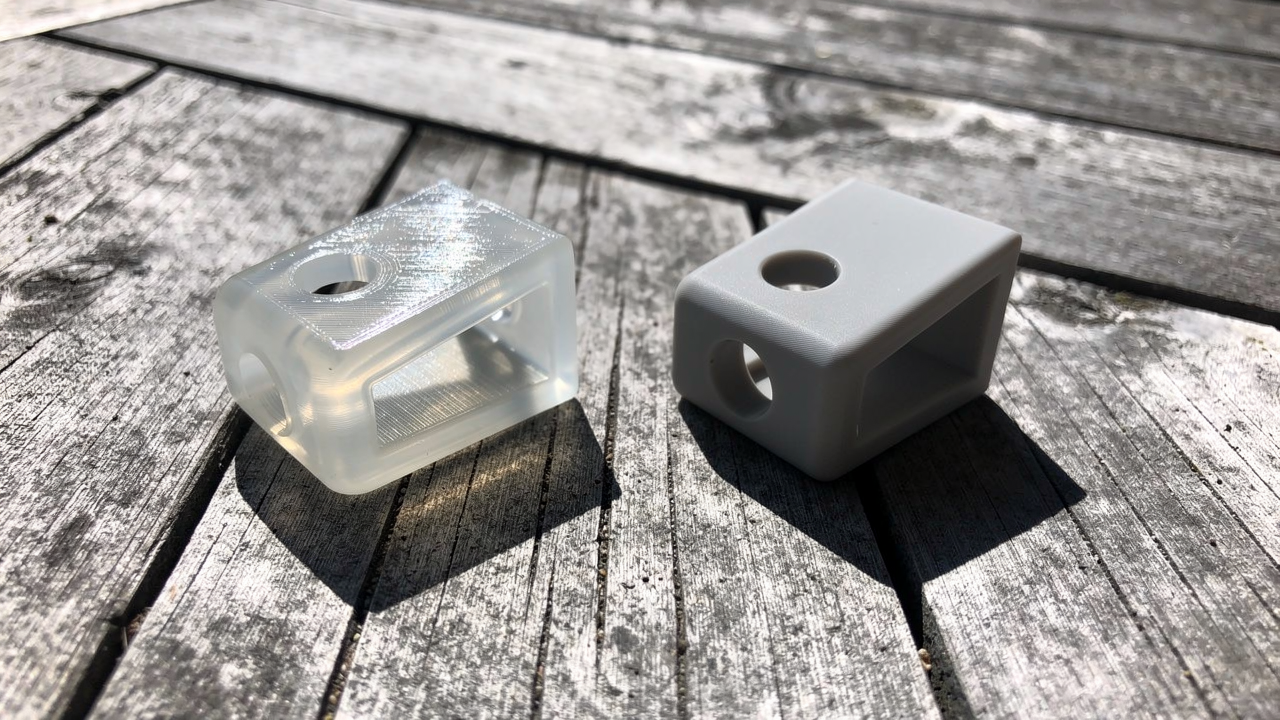

ASA or PETG? Which Is Right for Outdoor Parts
ASA or PETG the short answer is this: if the part will spend a long time exposed to sun, temperature swings and open-air conditions, ASA is usually the right choice; when print ease and cost balance matter, PETG is the more practical alternative for most projects. In other words, the choice should be based not only on durability but on where and how the part will be used.
Why is material choice critical outdoors?
A 3D printed part that goes outdoors is exposed not only to impact but also to UV rays, summer heat, rain and the temperature difference between day and night. That is why a part that works flawlessly indoors can quickly lose its shape on a balcony, in a garden, as roof-mounted equipment or as a mounting fixture in an open area. Especially for items left under the sun, the material’s tendency to soften in heat and its UV resistance become decisive.
If your goal is to see the cost balance before having a functional part made, you can upload your model and use the instant price calculation option to quickly see the weight and production cost. If you want to evaluate more durable options on the material side, the engineering material printing page also makes the decision easier.
The key differences between ASA and PETG
ASA and PETG are two functional materials frequently preferred in FDM printing; however, their outdoor behavior is not the same. PETG stands out with its balance of print ease and overall durability. ASA, on the other hand, is a more reassuring choice especially for open-air use.
- UV resistance: ASA preserves its color and mechanical properties under the sun better than PETG.
- Heat tolerance: Both materials outperform PLA; however, in hot car interiors and harsh summer conditions, ASA behaves more safely.
- Print ease: PETG generally causes fewer problems; ASA requires a more careful process in terms of warping and odor.
- Surface and appearance: PETG is glossier, while ASA can deliver a more technical, matte-looking result.
- Use case: PETG may be sufficient for short-term or semi-open work; ASA takes the lead for continuous outdoor environments.
When is PETG enough, and when is ASA needed?
PETG often offers sufficient performance for enclosed balconies, shaded outdoor areas, fixtures that go outside occasionally, enclosures and general-purpose functional parts. Its toughness against impact and a more manageable printing process make PETG sensible for fast prototypes and low-risk outdoor jobs. If you want to take a closer look at PETG’s material character, our PETG guide is a good starting point.
ASA, on the other hand, is a safer choice for mounting parts exposed to the sun, plastic fixtures near outdoor facades, garden equipment connections, protective parts used close to a vehicle’s exterior, and applications continuously open to weather conditions. Because here the issue is not only the strength on day one, but the part keeping its shape and function months later as well. As the outdoor load increases, so does the risk taken with PETG.
Practical decision summary
To speed up the decision, you can use this simple framework:
- If the part will be in direct sunlight: choose ASA.
- If the part will be used in a semi-open area: PETG is usually enough.
- If ease of production matters more: starting with PETG is more practical.
- If long life and outdoor weather resistance are the priority: ASA is the better investment.
In short, there is no single universal answer to the ASA-or-PETG question; but for genuine outdoor use, ASA is most often the safer choice. Once you clarify where your project will be used and how long it needs to last, choosing the right material becomes easier too. If you like, you can send us your model and we can evaluate the suitable material together to determine the most sensible path to production.




 Türkçe
 العربية
 Русский
 فارسی
فارسی Deutsch