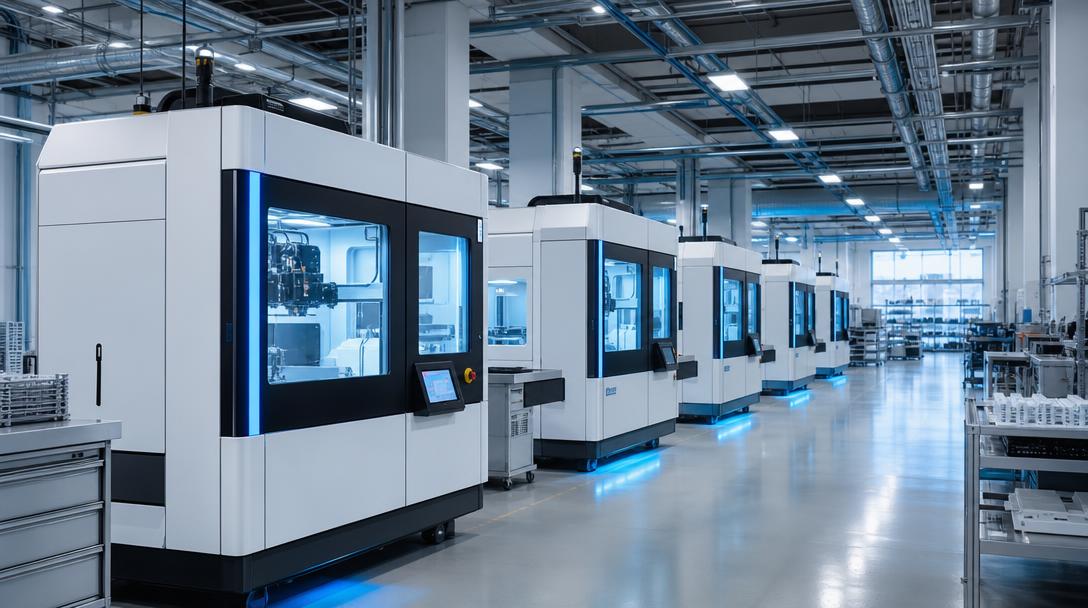
ADDMAN Plans to Add 81 More Systems to Its HP 3D Printer Fleet
ADDMAN’s plan to expand its 3D printing production capacity is another example of additive manufacturing moving beyond one-off prototypes toward repeatable serial production. According to a 30 September 2026 report by TCT Magazine, the company plans to install 81 more HP Multi Jet Fusion 5620 Pro systems. Once the investment is complete, ADDMAN’s total capacity across this technology family is expected to exceed 125 systems.
Why does the capacity increase matter?
When a manufacturing service provider adds a large number of systems using the same technology, it means more than simply having more machines. Production planning, consistency between parts and delivery capacity also become important for high-volume work. ADDMAN aims for its expanded fleet to support larger production programmes and maintain repeatability in industrial applications. Since the company has not yet shared details of the installation schedule, these targets should not be treated as already available capacity.
The systems mentioned in the report use Multi Jet Fusion (MJF) technology; they are not the same process as FDM printers or filament printing. Even so, this development is useful for understanding how demand for additive manufacturing services is being met at production scale. Not every technology suits every geometry, quantity or operating condition; the right method depends on the part’s function, material and required production volume.
What does demand for serial production tell us?
ADDMAN’s announcement points to manufacturers looking to incorporate additive manufacturing into larger programmes. This approach is often discussed for scenarios such as design validation before investing in tooling, complex geometries or on-demand production. However, a capacity investment alone does not prove that every part will be cheaper or faster to produce than with conventional methods. The cost per part should be assessed alongside geometry, material, quantity, post-processing and quality requirements.
The same basic decision applies to FDM: first clarify what the part needs to do, then choose the appropriate material and production method. When considering a 3D printing service for a prototype, enclosure, jig or low-volume spare part, consider the load, temperature and operating environment. You can review the general properties of FDM filament options on the printing materials page.
How should you decide at the part level?
When applying production-capacity news to your own project, distinguish investment at the scale of a large facility from the needs of an individual part. First, check whether the CAD file is suitable for printing and identify critical dimensions; then specify the required strength, finish and quantity. This lets you compare quotes based on actual requirements rather than the technology label alone.
- Geometry: Thin walls, internal channels and mounting surfaces can affect the production method.
- Use: Specify continuous loads, impacts, temperature and outdoor conditions from the outset.
- Quantity: The cost calculation may differ for a one-off prototype and repeat production.
You can estimate the cost using the 3D printing price calculator with your file, and discuss your printing requirements before making a decision. ADDMAN’s plan is a current industry signal of additive manufacturing capacity scaling up; for your part, the key factors remain the method, material and operating conditions considered together.


 Türkçe
 العربية
 Русский
 فارسی
فارسی Deutsch