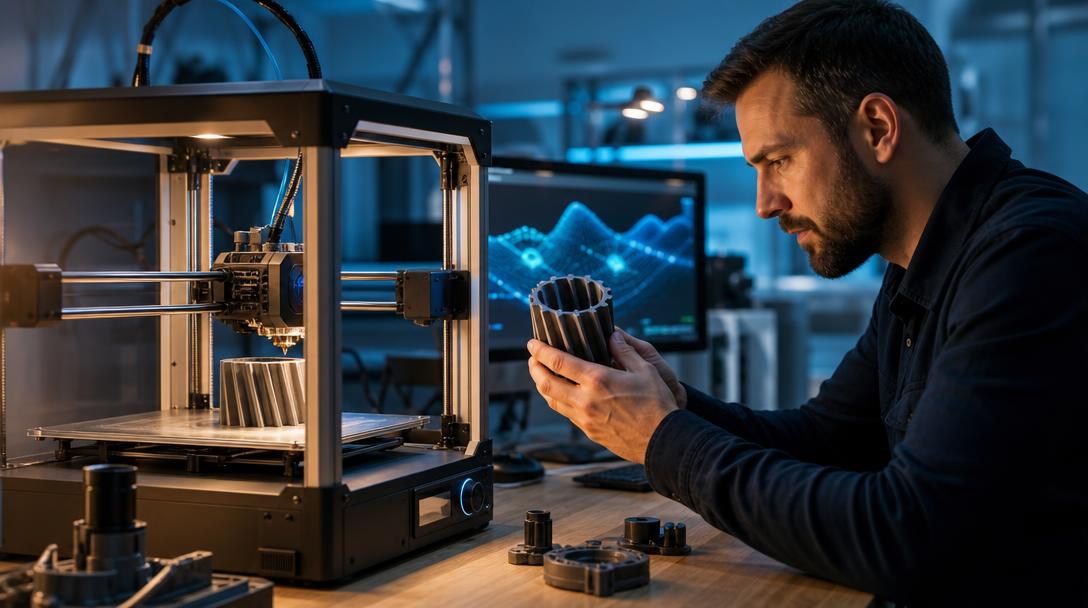

WSU Researchers Aim to Reduce Trial and Error in 3D Printing with AI
Achieving the desired result in 3D printing is often not just a matter of slicing the model. When variables such as layer height, print speed, temperature, cooling, and infill change together, the same part can produce different outcomes. The work of Washington State University (WSU) researchers aims to use AI to reduce this trial-and-error burden.
According to Advanced Manufacturing’s August 31, 2026 report, the team is working on an AI approach that can use a limited number of experiments more efficiently in 3D printing processes. The idea highlighted in the report is simple: instead of testing every possible setting one by one, data from previous prints can be used to make a more informed choice for the next trial. This approach is not a direct promise that “every part will come out perfect on the first try”; it is a search for ways to shorten the learning steps in the production process.
Why is this approach important for FDM users?
In FDM printing, finding the source of a problem can sometimes take longer than making the part itself. One print may look good on the surface while remaining weak between layers; in another, dimensions may be accurate while bridges or thin walls deform. In addition, the result depends not only on the printer model, but also on the behavior of the filament used and the environmental conditions.
If AI-supported process prediction matures, manufacturers may be able to see which setting is more meaningful to test instead of changing every variable at random. This could reduce wasted time, especially in workshops and print farms producing large quantities of the same part. For small manufacturers, it could also mean fewer failed prototypes, less waste, and a more predictable workflow.
What can AI solve here, and what can’t it solve?
This type of system tries to establish the relationship between measurable process data and the print result. For example, in a specific material and printer combination, it may be possible to predict the effect of changes in temperature or speed on surface quality, dimensional accuracy, or layer integrity. However, the reliability of the prediction depends on the quality of the data provided to the system.
For this reason, AI cannot replace poorly dried filament, a loose belt, a dirty nozzle, or faulty model geometry. In addition, when switching to a different printer, a different spool batch, or a different design, the model may need to be validated again. Before research results are transferred to production, testing, measurement, and quality control with real parts will still be mandatory.
Possible impact on workshop practice
- Prototyping: The number of print iterations needed to reach a functional part may decrease.
- Material selection: The suitable process window for PLA, PETG, or engineering filaments may be identified more quickly.
- Series production: The consistency of the same settings across different printers may be monitored more systematically.
- Quality tracking: Failed prints may be evaluated not only as outcomes, but together with process data.
For now, it is more accurate to view this development not as a magical automation that will replace slicing software, but as a data-driven assistant. FDM printing still requires proper design, suitable material, good machine maintenance, and controlled testing. The real value of the WSU study lies not in eliminating these steps, but in its potential to give a better answer to which step should be tested first.
Before moving into production, you can get a professional 3d printing service evaluation for your part’s purpose and operating conditions. When making material and production decisions, reviewing the logic of price per gram helps plan the budget more realistically as the number of prototypes increases. If your file is ready, you can make the first calculation with the instant quote flow; and to see FDM options, you can review our printing materials.
For these results to be reflected in everyday production, the habit of collecting data will also become more important. If the filament used, nozzle, print profile, and failure type are recorded regularly, later trials become more comparable. In this way, AI can be seen not only as a layer that generates predictions, but also as a support layer that accumulates the workshop’s own experience.




 Türkçe
 العربية
 Русский
 فارسی
فارسی Deutsch