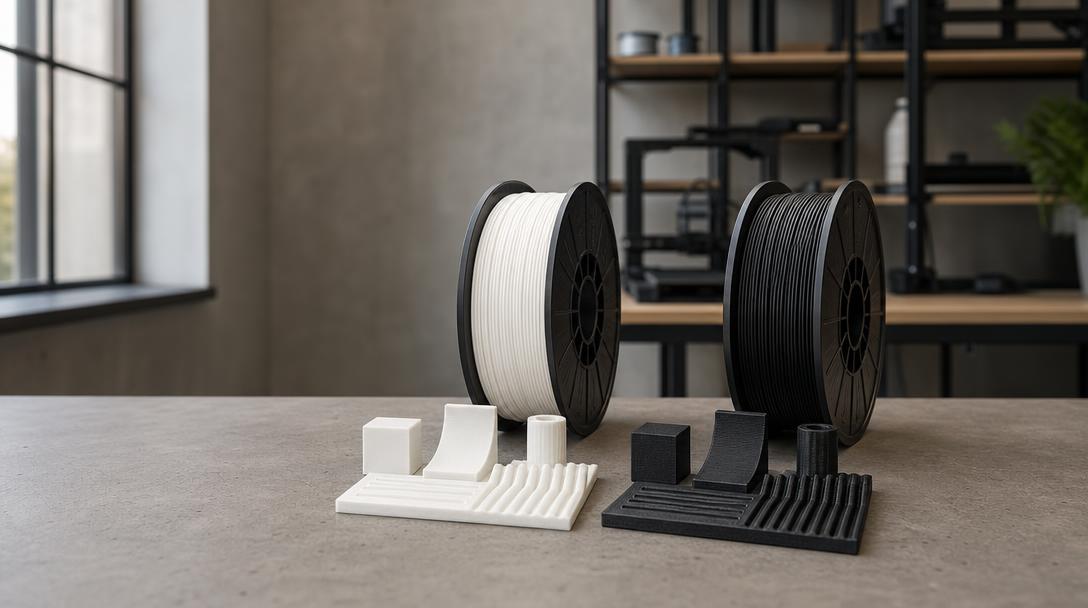

TPE or ABS+? Flexible Part or Rigid Functional Part?
Does a part need to deform during movement, or does it need to retain its shape under load? The answer to this question largely determines the choice you will make between TPE and ABS+. Both filaments can be used in FDM printing; however, their working characteristics are quite different. While TPE stands out for flexible and impact-dampening parts, ABS+ is a more suitable option for more rigid parts, with better heat tolerance and better suitability for producing mechanical housings.
What is TPE used for, and what is ABS+ used for?
TPE is an elastomer-based filament. After printing, the part can be bent, compressed, or flexed in a controlled way. It makes sense for gasket-like components, vibration-reducing feet, cable pass-through protectors, bumpers, and soft-contact surfaces. TPE offers an advantage when flexibility is part of the part’s function.
ABS+, on the other hand, is a material category that aims to improve the printing behavior of standard ABS and may have different formulations depending on the manufacturer. It can be preferred for rigid boxes, connection fittings, enclosures, support brackets, and functional parts used in daily life. The name “ABS+” does not guarantee the same performance across all brands; you should check the values in the technical data sheet and the recommended printing conditions. To see the material options, you can take a look at our printing materials page.
Flexibility, rigidity, and impact behavior
The main strength of TPE is flexibility. Since it can absorb part of impact energy through deformation, it works well in protective or vibration-exposed parts. In return, it should not be expected to maintain precise dimensions for a long time, remain rigid in thin sections, or hold screw connections tightly. Under load, the part may show creep over time.
ABS+ offers a more rigid structure and is more suitable than TPE for maintaining dimensions in housing-type parts. Its impact resistance can be good; however, layer orientation, wall count, printing temperature, and enclosure conditions significantly affect the result. To prevent a rigid part from cracking under impact, it is important to reduce sharp corners and distribute the load correctly across the layers.
Which one makes more sense for outdoor use and heat?
TPE’s outdoor performance depends on the product’s chemistry, UV additives, and whether it operates under continuous load. Being flexible does not automatically mean it will withstand sun and rain for a long time. For a gasket or bumper to be used outdoors, you should check the manufacturer’s data.
ABS+ is generally a more suitable starting point than TPE for rigid enclosures and fittings exposed to heat. Still, for direct sun, high temperatures, and large temperature fluctuations, it may also be worth considering outdoor-focused materials such as ASA. For both filaments, the actual service temperature, part geometry, and ventilation conditions should be considered together.
Ease of printing and cost logic
With TPE, slower print speeds, a controlled filament path, and in many cases a direct-drive extruder provide safer results. Flexible filament carries the risk of compression, buckling, and stringing. It is possible to get results with thin-walled models, but it is a good idea to verify tolerance and retraction settings with small tests on the first attempt.
Because ABS+ is more rigid, it is easier to manage on the feeding side; in return, bed adhesion, edge lifting, and interlayer cracking may require a heated bed and, if possible, an enclosed chamber. In cost decisions, look not only at the spool price but also at the risk of failed prints and any post-processing required afterward. For your project, you can review the logic of price per gram and request a quote based on quantity and geometry.
Which one should you choose for which part?
- TPE: flexible foot, bumper, cable protector, vibration damper, and soft-contact part.
- ABS+: rigid enclosure, bracket, fitting, connection body, and a functional part exposed to moderate heat.
- If you are undecided: if the part will bend continuously under load, make TPE your choice; if it needs to keep its dimensions and carry a connection, make ABS+ your starting candidate.
Instead of producing the part yourself, you can get 3d printing service by sharing your intended use and dimensions. If your file is ready, getting an instant quote makes it easier to compare TPE and ABS+ options for the same project.



 Türkçe
 العربية
 Русский
 فارسی
فارسی Deutsch