
What Does Quantum Cyber’s 80-Printer FDM Production Farm Tell Us?
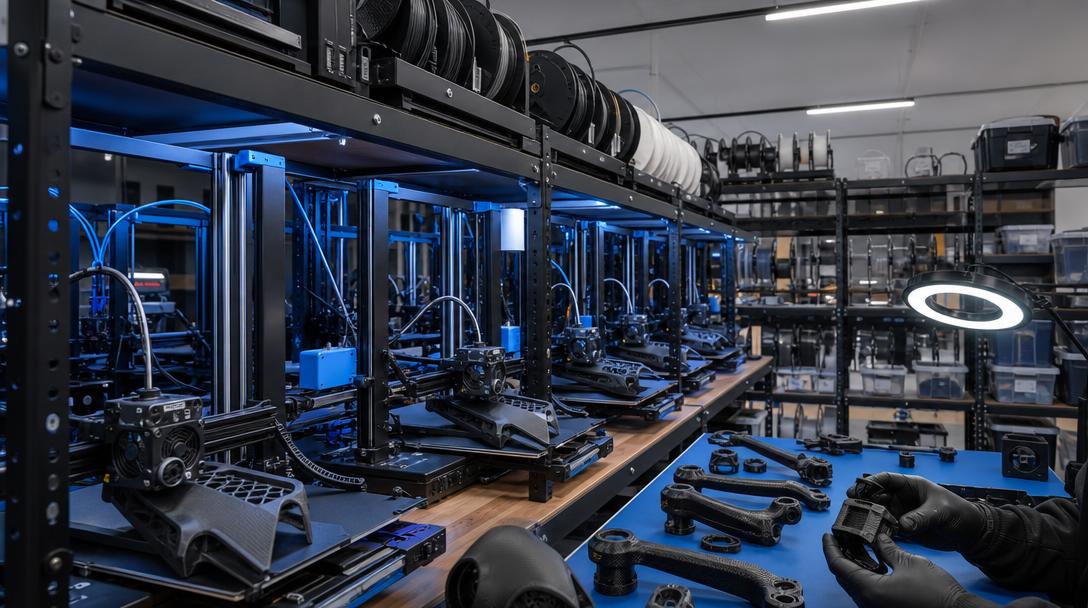
Connecticut-based Quantum Cyber announced that it has established a production farm consisting of 80 3D printers for autonomous drone manufacturing. According to VoxelMatters’ news report dated August 31, 2026, this investment signals a shift from a single prototype printer to a distributed FDM workflow that repeatedly produces large numbers of similar parts.
The main importance of this news for Ucuz3D readers is that it shows 3D printing is not limited to producing only models or test parts. A large number of desktop-class FDM printers can be used to manufacture parts from the same product family one after another with the right file management, material tracking, and quality control. This approach can offer the advantage of responding quickly to design changes without investing in molds, especially in low- and mid-volume production.
80 printers alone do not make a production line
For a print farm to operate efficiently, more is needed than just the number of printers. A shared slicing profile, consistent material lots, regular bed and nozzle maintenance, print naming conventions, and records of failed parts are all necessary. Even small calibration differences between printers of the same model can affect results in terms of dimensions, surface quality, and layer bonding. For this reason, the first step in production farms is to check each device with a reference part and define acceptable tolerances.
In a lightweight, multi-part product like a drone, body sections, electronics enclosures, cable channels, assembly fixtures, and protective covers all have different requirements. Instead of printing every part with the same filament, it is more accurate to evaluate the part’s load, temperature exposure, impact risk, and whether it will remain outdoors. During this decision process, you can review 3D printing materials options according to the intended use.
The key strength of an FDM production farm: speed of change
In a traditional manufacturing workflow that requires molds, a design change may create the need for new tooling or fixtures. In FDM, however, the digital model can be updated and the new file can be added to the production queue. This is especially valuable in projects where feedback from the field is quickly reflected in the product. Still, rapid change should not mean uncontrolled change; file versions, material profiles, and approval records should be maintained together.
Another contribution of a print farm is that capacity can be increased gradually. When demand rises, new printers can be added instead of changing the entire production infrastructure. On the other hand, a separate plan is needed for energy consumption, operator time, spool feeding organization, post-processing cleanup, and quality control. The real cost does not consist of filament alone; failed prints, maintenance, labor, and delivery time must also be taken into account. When evaluating affordable 3D printing prices and the per-gram pricing logic on a part basis, these items should be considered.
What does this model teach small businesses?
- Repeatability first: If you cannot print the same part on different days with similar results, increasing the number of printers may only make the problem bigger.
- Design the part for production: Orientation that reduces support requirements, sufficient wall thickness, and surfaces that are easy to inspect reduce the total production time.
- Choose material according to the task: Stiffness, impact resistance, flexibility, and outdoor-use expectations should be evaluated together; a single filament is not ideal for every part.
- Organize the digital file: Files without a version number, production profile, or inspection result create confusion in serial production.
The Quantum Cyber example reminds us that the value of FDM emerges not only from print volume, but also from the processes connected to one another. As you move from prototyping to repeated part production, you can first standardize within a small group of printers, then expand capacity with measurable quality criteria. For parts you want to outsource, you can review 3d printing service options, upload your file, and get an instant quote through the online 3d printing workflow.



 Türkçe
 العربية
 Русский
 فارسی
فارسی Deutsch