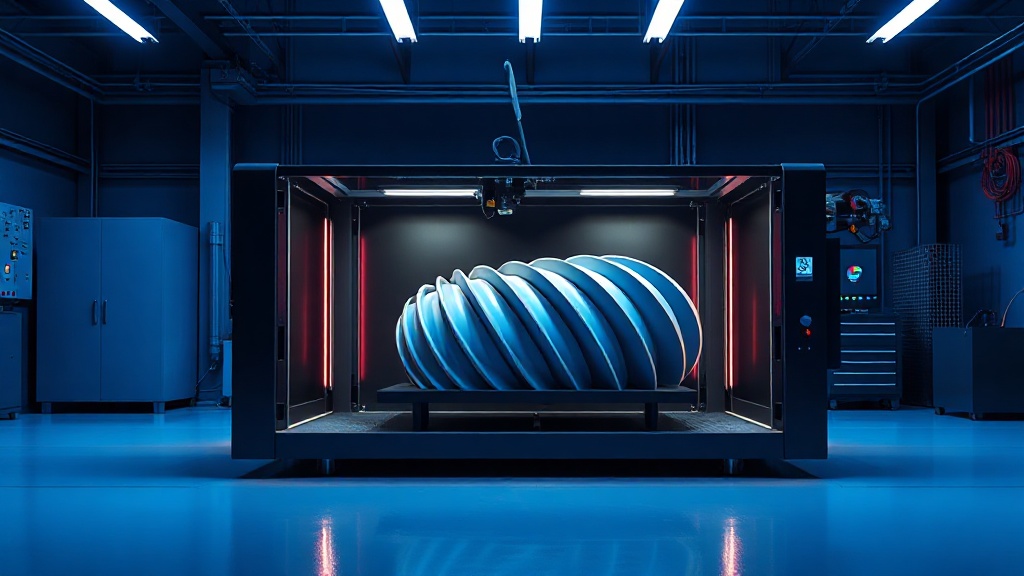

Why Voltage’s Eclipse X9 Material Is Turning Heads in LFAM
The Eclipse X9 LFAM material is a recent development that once again reminds us why material selection is a strategic decision in large-volume 3D printing. According to a report published on 3D Printing Industry on June 12, 2026, Voltage introduced its new basalt-reinforced, recycled-PETG-based composite for large-format additive manufacturing (LFAM). This is more than just a new product announcement; it also points to where the search for stiffer, more stable and more sustainable industrial-scale materials is heading.
Why is there a search for a different kind of material in LFAM?
Unlike desktop FDM printers, LFAM systems are used to print much larger parts at higher flow rates, often in scenarios close to the production floor. At this scale, it is not enough for a material to simply be printable; dimensional stability, surface behavior, stiffness and suitability for the end-use environment all become important. Approaches such as basalt reinforcement stand out here, because the fiber structure added to the polymer matrix can help the part behave in a more controlled way.
Especially when producing fixtures, mold aids, prototype bodies and large-scale industrial enclosures, the material is expected to strike a good balance between cost and performance. For this reason, every new material announcement on the LFAM side is followed closely not only at lab scale but also in real production workflows. For similar projects, comparing 3D printing production prices in advance can speed up your decision-making around print time, part geometry choices and production approach.
What does basalt-reinforced recycled PETG promise?
The highlight of the report is that the material tries to answer two different expectations at once: mechanical balance and a stronger sustainability narrative. PETG is already a relatively easy-to-process thermoplastic widely used in production-oriented FDM applications. Adding recycled content to it can be significant, especially for companies with corporate sustainability goals. Basalt reinforcement, in turn, stands out as a composite approach that can help the material deliver stiffer behavior.
- A more balanced structure for large parts: In LFAM, the risk of warping and flexing in large geometries is always one of the critical concerns.
- A stronger sustainability message: The recycled-PETG base brings environmental impact to the forefront of material choice.
- A focus on industrial use: Composites of this kind make the most sense in fixtures, prototypes and production support equipment.
Of course, the final decision is never made by looking at a material announcement alone. Topics such as nozzle wear, layer adhesion, surface quality and real field testing are also decisive. Even so, this launch offers an important signal for seeing how 3D printing scales across different industries.
How should production teams in Turkey read this news?
For teams in Turkey that use 3D printing not only for prototypes but also for production support parts and low-volume functional applications, the real value of this news lies in the expansion of the material portfolio. Because in large-format printing, fast production alone is not enough; you need a solution that is more robust, more predictable and has a manageable total cost depending on the part’s operating environment. This makes it essential to evaluate the material-machine-settings trio together.
For teams that want to understand how composite filaments behave, the guide to carbon-fiber-reinforced filaments in the Ucuz3D Knowledge Center can also be a good starting point. Basalt and carbon fiber are not in the same material family; however, it offers a similar way of thinking for understanding why reinforced polymers require different printing strategies.
Conclusion
Voltage’s Eclipse X9 announcement shows that material innovation on the LFAM side is taking shape around performance and sustainability, not just speed or size. In the coming period, the results of such composites on real production floors will become clearer. If you would like to evaluate the right production approach for your large-volume or functional FDM parts, you can reach us through the Ucuz3D quick order page for a solution and quote tailored to your project.




 Türkçe
 العربية
 Русский
 فارسی
فارسی Deutsch