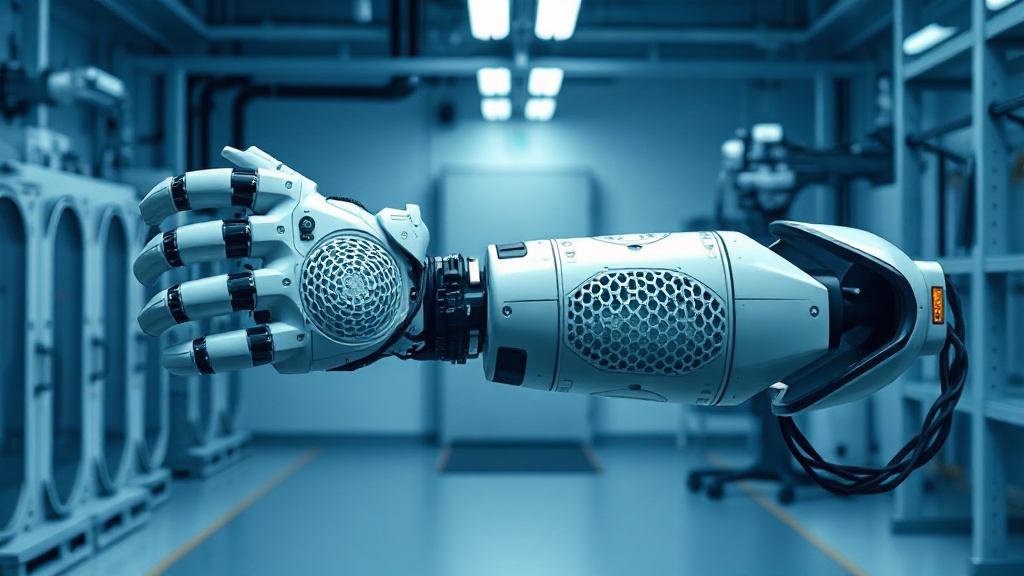

Why Is ESA’s 3D-Printed Robot Shield Project Attracting Attention?
The concept of a 3D-printed robot shield may sound like a niche solution for space missions, but according to a 22 May 2026 report by 3D Printing Industry, a new project supported by the European Space Agency clearly demonstrates how additive manufacturing can strengthen robotic systems in demanding operating environments. A consortium led by the Danish Technological Institute is developing a smart coating designed to protect the arms of space robots from dust, radiation, and extreme temperature fluctuations. This development sends important signals not only to the space sector but also to heavy industry and automation lines.
What exactly is being developed in the project?
The project, called Smart Skin for Exploration Cobots, revolves around a 3D-printed skeletal structure placed over a robot arm. This structure aims to combine heat and dust protection, flexible power and data cabling, collision-detection sensors, and human-machine interaction improvements — all in a single body. The working timeline mentioned in the report spans 2026–2028 and is proceeding with a budget of approximately €1.65 million. When you consider the conditions between -150 °C and +120 °C that could be encountered on lunar and Martian missions, it becomes even clearer why conventional enclosure solutions fall short.
Why does 3D printing play a critical role here?
In this project, the value of additive manufacturing goes beyond simply producing a part quickly. The real advantage is the ability to create a lightweight, functional lattice structure that can be adapted to different robot arm geometries. Achieving protection, cable routing, and sensor integration all in one piece using conventional manufacturing methods can be far more complex and costly. A similar design logic is gaining increasing importance in automation and robotics 3D printing applications around the world. When you consider that every gram carried on a robot, along with ease of maintenance and modularity, affects production line performance, this approach becomes highly meaningful.
- Design freedom: Custom geometries adaptable to different robot arms can be produced.
- Function integration: Protection, cabling, and sensor infrastructure can be combined in a single structure.
- Weight optimisation: Unnecessary mass in moving systems can be reduced.
- Faster iteration: The transition time from prototype to test part can be shortened.
Why is this an important signal for industrial use?
One of the noteworthy points in the report is the explicit emphasis that the technology being developed could later be adapted to harsh working environments outside of space. Foundries, for example, are environments where hot surfaces, dirt, and constant mechanical motion coexist. In such environments, robots need to be not only durable but also maintenance-friendly, replaceable, and purpose-built for protection. Material selection also becomes critical here. That is why early-stage evaluation of topics such as nylon (PA) filament’s industrial durability matters in industrial part development. Not every application demands a space-grade solution, but the same engineering logic can be transferred to many manufacturing scenarios.
What does this news mean for Ucuz3D?
This project demonstrates that 3D printing is now the preferred choice not only for prototyping but also for functional system integration. Rapid iteration provides a major advantage especially in robotics, fixtures, protective enclosures, sensor carriers, and custom mounting components. With the right design and material selection, low-volume but high-value parts can be produced far more flexibly than with conventional methods. If you have a similar protective part, robot peripheral equipment, or functional prototype need in your project, you can share it with us via our quick quote page and we can evaluate the manufacturing approach best suited to your application together.


 Türkçe
 العربية
 Русский
 فارسی
فارسی Deutsch