
Why ORNL’s Origami-Inspired 3D Printing Method Puts Mold-Free Composite Manufacturing in the Spotlight
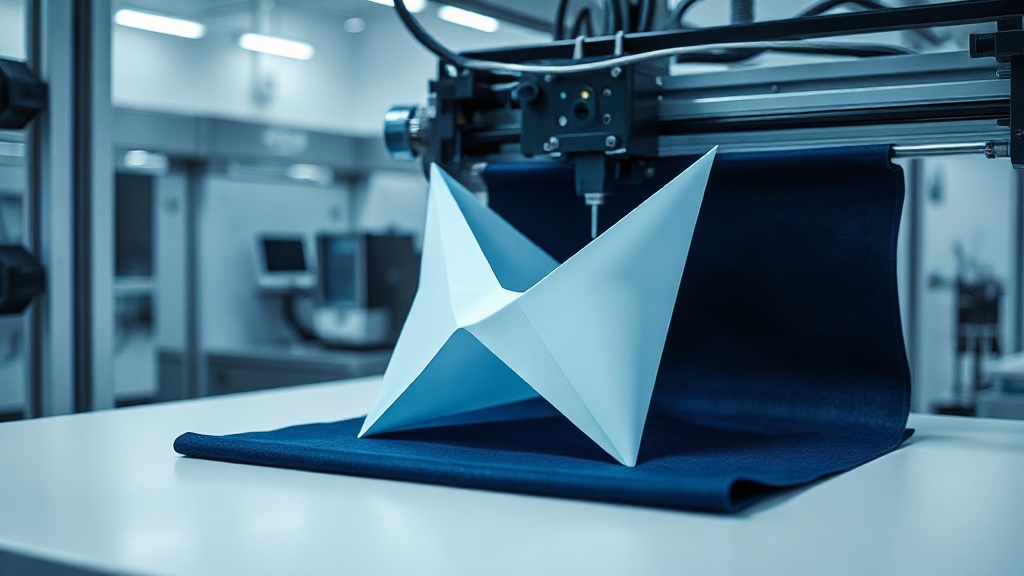
Industrial 3D printing saw one of its most striking recent developments in Oak Ridge National Laboratory’s new origami-inspired manufacturing method. According to the announcement dated 15 June 2026, the team can produce structures that move from a flat sheet into a three-dimensional, mold-free form by depositing an integration layer and composite material directly onto a flexible surface. This approach shows exactly why a new production window is opening, especially in areas where light weight, fast iteration and custom geometry are in high demand.
Why is mold-free production so important?
In traditional composite manufacturing, mold preparation is often one of the main steps that lengthens the process and drives up cost. ORNL’s method largely removes this need by adding a bonding layer onto a nylon-like flexible base and then depositing reinforced composite material on top. According to the test results shared in the announcement, removing the mold from a unique design can cut production time by 95 percent and cost by 90 percent. That is a hugely significant signal for low-volume parts that still demand a high degree of customization.
From Ucuz3D’s perspective, the real value of this news is the reminder that additive manufacturing is not just about “printing parts” but about a production approach that also changes design logic. Teams that want to move forward with the same mindset on fixtures, enclosures, prototypes and functional load-bearing parts can upload their STL files and run an early cost-benefit assessment with the instant price calculation flow.
What does the origami approach change in industry?
One of the most interesting aspects of this method is that the part is first produced in a flat form and then transformed into a three-dimensional structure. This opens up far more flexible scenarios on the production and logistics side of large or hard-to-transport structures. The announcement notes that by using a high-strength fabric base, a thermoplastic polyurethane-like bonding layer and reinforced materials such as carbon fiber reinforced ABS together, rigidity and flexibility can be balanced within the same design.
This is not exactly the same as the production model Ucuz3D offers, because we focus on FDM-based filament printing. But the message of the news is clear: the right material choice and the right layer strategy can radically change part performance. That is why printing with engineering materials options matter for teams developing strength-focused functional parts.
Practical lessons for the FDM world
Even though not every advanced research project filters directly down to desktop production, this news holds concrete lessons for FDM users too:
- Material-architecture compatibility is critical; the material combination determines performance just as much as the geometry.
- In low-volume custom production, mold-free methods provide a very serious time advantage.
- For light yet functional parts, the internal skeleton, shell thickness and reinforced filament choice should be considered together.
- In the move from prototype to end use, early validation lowers the total cost.
If you want a clearer picture of what carbon fiber reinforced filaments offer in particular, our Carbon Fiber Reinforced Filaments guide is a great companion read to this news.
Why is it worth following?
ORNL’s work shows that additive manufacturing can be a real production strategy for large and complex structures, not just a prototyping tool. In the coming period it would be no surprise to see similar approaches appear more often in aerospace, robotics, portable structures and industries that require rapid on-site deployment. If you too are planning to develop a light, customized or functional FDM part, you can get in touch with us to validate your project early and determine the most suitable production path.



 Türkçe
 العربية
 Русский
 فارسی
فارسی Deutsch