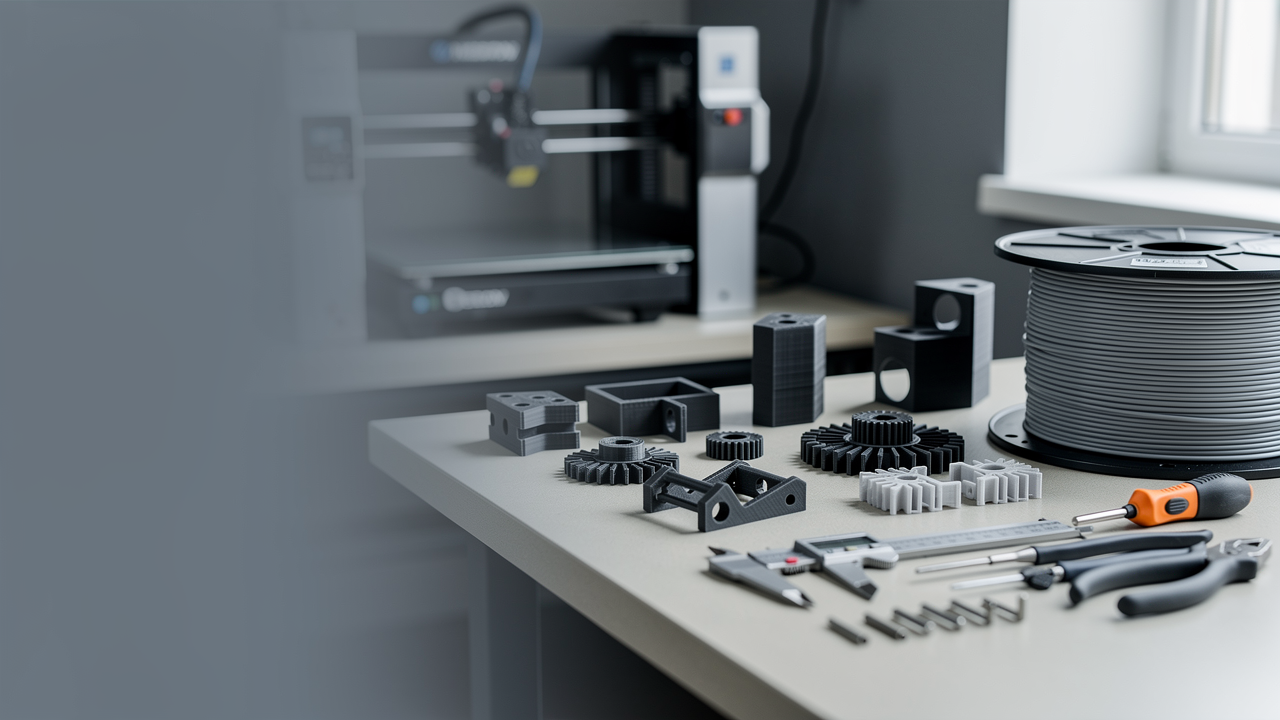

Why Is the HP 600 HT Important? High-Temperature Filament Printing Reaches a New Threshold with a More Open Material Ecosystem
HP has now officially entered the filament side as well, following its powder-based Multi Jet Fusion line. According to 3D Printing Industry’s report dated July 30, 2026, and the technical information HP shared on its product page, the new HP Industrial Filament 3D Printer 600 HT aims to place FFF/FDM production on a more industrial footing, especially for engineering plastics that require high temperatures.
Why is it important?
For desktop FDM users, the main message here is that we are not looking at a new “rapid prototyping printer,” but an industrial platform designed for challenging materials. While PEEK, PAEK, PEI, and some carbon-fiber-reinforced technical filaments look extremely strong on paper, in practice these materials can easily cause printing problems without a stable thermal environment. Layer separation, warping, dimensional drift in long prints, and jobs failing in the middle of the night are all very familiar problems in this class.
The difference HP is putting forward here is a stronger approach to active chamber heating and a broader material range through a modular structure. According to the information on HP’s page, the system comes with a heated enclosed chamber up to 195°C, a build plate up to 190°C, and interchangeable printheads at 280°C, 360°C, and 500°C. This shows that the same platform can extend from engineering-grade materials such as ABS and PA-CF all the way to PEI, PEEK, and PAEK.
What does this mean in practical terms for the Ucuz3D reader?
At first glance, news like this may seem relevant only to large factories. In reality, its impact in the field is broader. As the industrial FDM side becomes stronger, heat-resistant fixtures, lightweight but rigid carrier parts, electrically insulating components, and low-volume functional prototypes become safer to manufacture. In other words, this is not just about the launch of a new printer; it is about which parts can now shift more comfortably to filament-based production.
For teams moving from prototyping to small-batch production in particular, the open-material approach is also noteworthy. HP says the system can support third-party 1.75 mm filaments as well. In theory, this means a more flexible supply structure that does not lock the user into a single material brand. In practice, however, not every third-party filament will be integrated with the same ease; profile creation, validation, and process repeatability will still be required. But the direction matters: controlled openness instead of a closed ecosystem.
Two technical details worth watching
1) Traceability and process control
HP’s emphasis on NFC-tagged spools and its material management system is not there for nothing on the production side. Even in medical, aerospace, rail systems, or similarly regulated sectors, the question of “which spool was used to manufacture which part” can be critical. For that reason, traceability is not just a corporate convenience; in some jobs, it is a requirement for being able to submit a quotation at all.
2) The real operating cost of high-temperature materials
Being able to print PEEK or PEI alone is not enough. Nozzle, chamber, drying, annealing, part orientation, and quality control all need to be considered together. For that reason, the wider adoption of a platform like this may also lead to more informed questions on the engineering materials side. When you want to clarify the right production path for your part, it is healthier to evaluate material and process options through a professional 3d printing service.
Why should this news stay on your radar?
Because filament-based manufacturing has long been moving beyond the perception of “easy prototyping” toward more serious applications. The fact that a major player like HP is officially entering this area shows that high-temperature FDM is no longer seen as a niche corner case, but as a serious production segment. If you are also calculating cost versus benefit on a part basis, the logic of affordable 3d printing prices should be read not only by gram, but together with material class, print risk, and end-use requirements.
In short, the HP 600 HT is not a machine that everyone will place in their workshop tomorrow. But it is a strong signal for understanding where high-temperature filament printing is heading. If your goal is a functional prototype, a low-volume technical part, or a custom manufacturing fixture, evaluating your file early in an online 3d printing workflow makes it easier to start with the right material path from the beginning.


 Türkçe
 العربية
 Русский
 فارسی
فارسی Deutsch