
Why Is Spare Part 3D Printing Gaining Ground in Defense Vehicles? An FFF Ducting Example from Rheinmetall UK
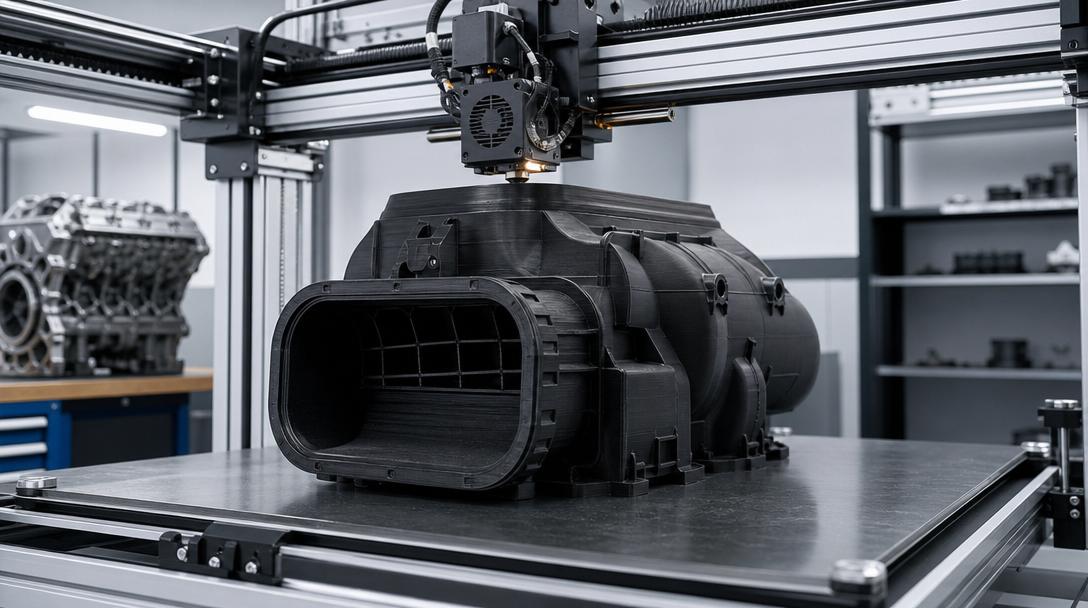
Rheinmetall UK starting to produce complex air duct parts with FFF in its Challenger 3 program clearly shows why the spare part 3D printing approach is becoming increasingly strategic. For parts that are needed in low volumes, require frequent revisions and barely justify the investment in tooling, 3D printing can reduce lead time, risk and inventory pressure all at once.
According to VoxelMatters’ news report dated 18 June 2026, the company put an industrial polymer extrusion system called miniFactory Ignite into service for complex ducting components. The critical point here is not just that the part is being “printed”; because of the new vehicle architecture, classic sheet metal fabrication, injection molding or rotational molding fall short on both flexibility and cost. In low-volume programs in particular, dependence on tooling can make every design change expensive and slow.
Why does this news matter for the FDM side?
The decision Rheinmetall UK made shows that even large industrial players are shifting to a “solve the need first, not the production line” mindset for certain parts. Among the reasons FFF was chosen, the news highlights lower initial investment, a more limited safety and training burden, an open-material approach and fast iteration. This logic applies not only to defense projects; it holds in many scenarios such as fan ducts, protective covers, carrier fixtures, custom housings and low-volume field spares.
Even more importantly, the news says that when the Rheinmetall team makes a design change, they can reproduce the spare part within a single day. That statement is a reminder that the only advantage of 3D printing is not “complex geometry.” The real value is often the ability to quickly update a part based on feedback from the field and to retry without waiting through a long supply chain.
On the defense and technical part-focused 3D printing solutions side of Ucuz3D, similar needs come to the fore: when the waiting time of traditional production grows or a part becomes geometrically complex, FDM-based production builds a strong bridge between rapid prototyping and end use. Especially when the part is suitable, iteratively updating the design and reproducing it offers a far more agile workflow than classic methods.
3 points where 3D printing stands out for ducting parts
- Low-volume economics: Because production is possible without cutting a mold, the total cost is more manageable for small quantities.
- Design revision speed: When a connection point, channel cross-section or assembly detail changes, there is no wait for new tooling.
- Spare parts on demand: Instead of keeping parts in a warehouse for years, the produce-when-needed model grows stronger.
The news also emphasizes that the miniFactory system can process high-temperature materials. This does not mean every project requires the same material; however, if the temperature, vibration, impact and assembly conditions the part will operate under are read correctly from the start, the material choice is made much more soundly. That is why, for functional parts, not only the geometry but also the service environment is as important as the design. It is possible to see this perspective in a broader frame in the 3D Printing in Spare Part Production guide.
Because Ucuz3D does FDM-focused production in its daily work, it would not be right to talk about copying every industrial defense application one to one; yet the basic lesson the news tells is very clear: when low volume, fast revision and the need for a functional part come together, 3D printing produces a serious advantage. That is why the same logic also finds commercial validation in many technical parts, from prototypes to broken plastic spares.
If you too have a low-volume technical part, custom duct, housing or field spare need, you can quickly test the production logic of the part by using the instant price calculation option with your STL file. Especially in jobs with a high probability of revision, 3D printing turns into not just a production method but a practical engineering tool that increases the speed of decision-making.



 Türkçe
 العربية
 Русский
 فارسی
فارسی Deutsch