
Why Is Medical 3D Printing Becoming Key for Custom Orthotics? ScolioLife’s New Integration
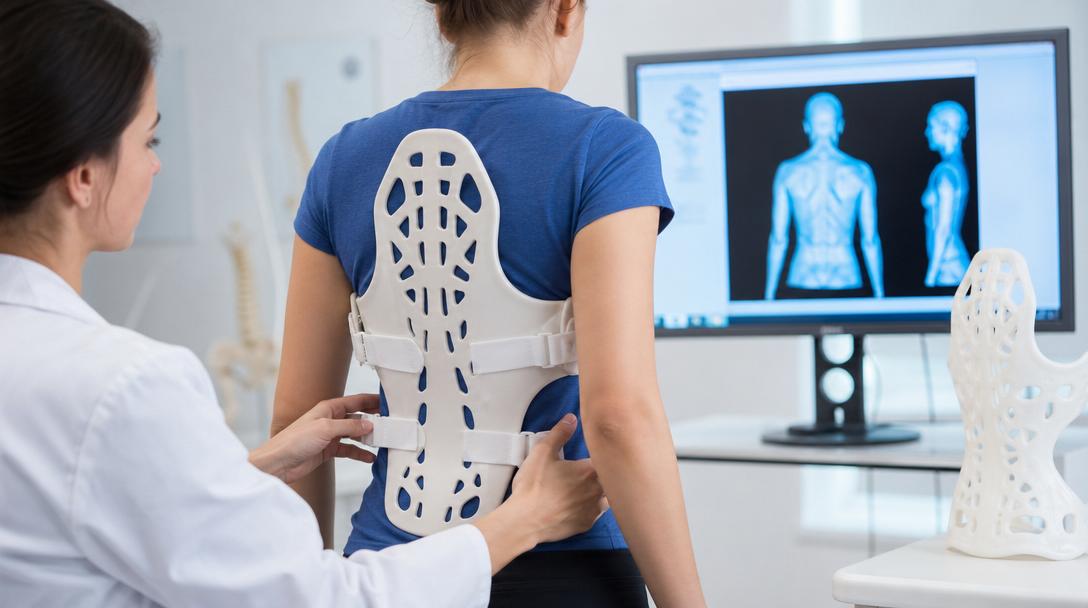
Medical 3D printing is coming back into focus for custom orthotics because it offers lightness, breathability and the ability to be tailored to the individual patient. According to a VoxelMatters report dated 22 June 2026, ScolioLife aims to make this approach more systematic by integrating both 3D printing and an AI-supported platform into its scoliosis care model.
The key point highlighted in the report is not merely the production of a device; it is the creation of a business model that brings scanning, design, follow-up and clinical communication together in a single workflow. ScolioLife’s ScolioAlign 3D program combines 3D body scan data with computer-aided design and in-house production to prepare custom spinal braces. The goal is to produce braces that are lighter, breathe better and sit closer to the body’s shape. This represents an advantage that can directly affect patient compliance, especially in orthopedic solutions that require long-term use.
Why does it matter?
With classical manufacturing methods, the time needed for measuring, revision and delivery of custom medical aids can stretch out. On the 3D printing side, linking digital scan data directly to the design can reduce the trial-and-error loop. That is exactly where the significance of this news lies: ScolioLife is not only offering a 3D-printed product, it is also developing a platform called ScolioConnect aimed at monitoring the patient between clinical visits as well. The platform is said to be designed to interpret 3D body scans with AI, support custom brace design and gather progress tracking all in one place.
From Ucuz3D’s perspective, this development explains well why digital manufacturing is growing in the healthcare sector. Although Ucuz3D’s service model focuses on FDM-based parts, prototypes, enclosures and auxiliary fixtures, the logic of custom production is the same: design to measurement, fast iteration and agility in low-volume production. For similar industry needs, the medical and dental 3D printing solutions page is a good reference for seeing where this approach creates value.
Lessons for the FDM side
- Personalization: When each user requires a different geometry, a digital workflow provides a major advantage.
- Fast revision: Design updates can be made more quickly for a prototype, a test fixture or an auxiliary part.
- Low-volume economics: For one-off or small-series needs, you can move forward without investing in molds.
Since the right measurement process is critical, especially for healthcare, wearables and auxiliary components that contact the body, the 3D Scanning and Reverse Engineering guide is a fitting companion for understanding the background of this news. Because the true value of custom production emerges not only at the printing stage, but in turning the right data into the right model.
Of course, this news should not be read as a direct call to “just produce the same product with FDM.” In medical applications, material selection, patient safety, regulations and clinical validation are assessed separately. But the message for the industry is clear: 3D printing is no longer merely a prototyping tool; it is settling into the center of a data-driven, personalized product flow. This can support growing demand in the future in areas more directly related to FDM, such as patient-specific enclosures, auxiliary fixtures, training models and process validation parts.
Likewise, if you need a custom plastic part, enclosure, prototype or auxiliary fixture, you can quickly start the digital manufacturing process through Ucuz3D with the request a quote now option.


 Türkçe
 العربية
 Русский
 فارسی
فارسی Deutsch