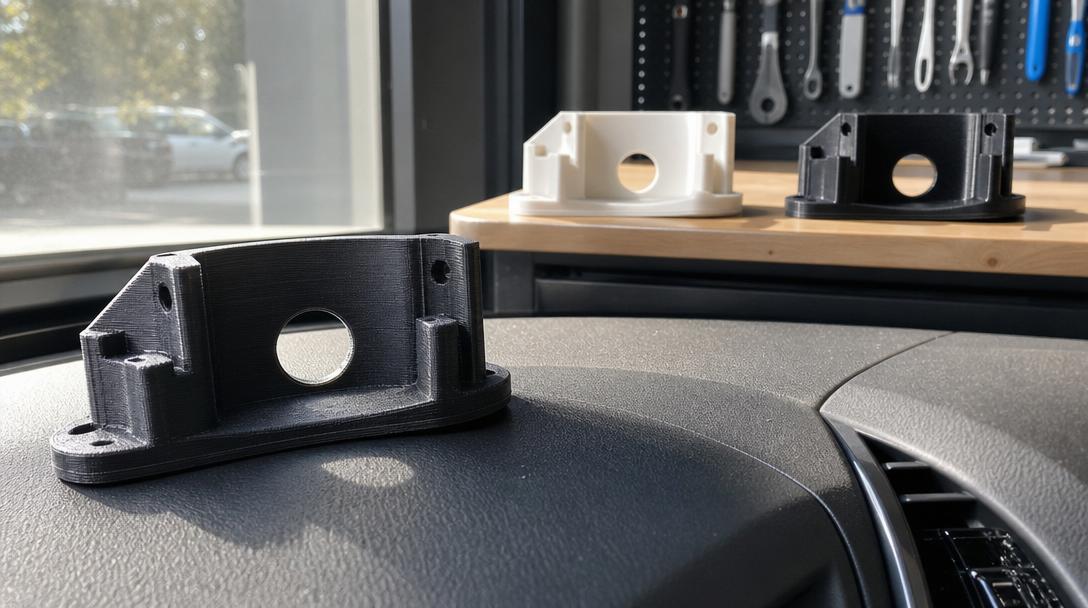

Does PLA Withstand Sun and Heat? What Happens in a Car and Outdoors?
Does PLA Withstand Sun and Heat is a common question, and the short answer is: it holds up to a limited degree, but it is usually not the right choice for a hot car interior or prolonged outdoor use. In most cases PLA prints keep their shape; however, since it begins to soften at around 55-60 °C, you may see deformation on parts left in a car under the summer sun, near a window, or constantly exposed to the open air.
Why does PLA become risky in hot environments?
Thanks to its ease of printing and clean surface quality, PLA is one of the most popular FDM materials. It performs very well for desktop organizers, models, decorative parts, and lightweight prototypes. The trouble begins when the heat load increases. Especially in environments such as a closed car interior, the surface temperature rises very quickly, and the PLA part can slowly bend, slip out of its slot, or show permanent deformation if there is a load on it.
For this reason, PLA is often not on the safe side for a phone holder, an in-car clip, a connector left under the sun, or a part meant to stay outside in the garden permanently. In such a use case you should choose the material not just by ease of printing but by the environmental conditions. If you want to evaluate more durable options, it is wiser to look into printing with engineering materials.
Is the result the same in a car, on a balcony, and in the shade?
No, it is not the same. PLA’s performance varies significantly depending on the environment it is in. The most practical distinction can be made as follows:
- Inside a car: This is the riskiest scenario. In summer, the temperature inside a closed vehicle can quickly reach a critical level for PLA.
- Outdoors in direct sunlight: Since UV and heat act together, a long lifespan is hard to expect.
- A shaded but hot balcony: It may not be as harsh as full sun, but caution is still needed for load-bearing parts.
- Indoors, a relatively cool environment: Here PLA is still one of the most practical and economical options.
In short, the issue is not only “does it get sun?”; questions such as how hot the part gets, whether it bears a load, whether it stays fixed, and whether it takes impacts also determine the outcome. If you want to review your material choice based on its general properties, the PLA Filament: Properties, Advantages and Use Areas guide is a good starting point.
Which materials should be considered instead of PLA?
For outdoor use or applications more exposed to heat, the most common alternatives are PETG and ASA. PETG behaves tougher than PLA and offers a safer margin against heat. ASA, on the other hand, is a better candidate especially for jobs that require resistance to sun, weather conditions, and UV. Of course, each material differs in printing difficulty, surface character, and cost; that is why the “most suitable material for the job” approach is healthier than the “best material.”
If you have an idea for an in-car holder, an outdoor sensor box, a garden fixture, or a spare part that will work in a hot environment, choosing the right material from the start reduces the need for re-manufacturing later. When your project is ready to plan production with a suitable model and material, you can share the details using the request a quote now option.
When does it still make sense to choose PLA?
There is no need to rule PLA out entirely. If the part will be used indoors, will not see high temperatures, and your priority is fast, clean, and economical production, then PLA is a very sensible choice. It is still a strong option for concept validation, models, desktop accessories, lightweight fixtures, and educational models.
In short, PLA is not for every job exposed to sun and heat; it is a very good material for controlled environments. If your part will work outdoors or inside a car, describing the usage conditions from the very beginning helps you choose the right FDM material for a safer result.




 Türkçe
 العربية
 Русский
 فارسی
فارسی Deutsch