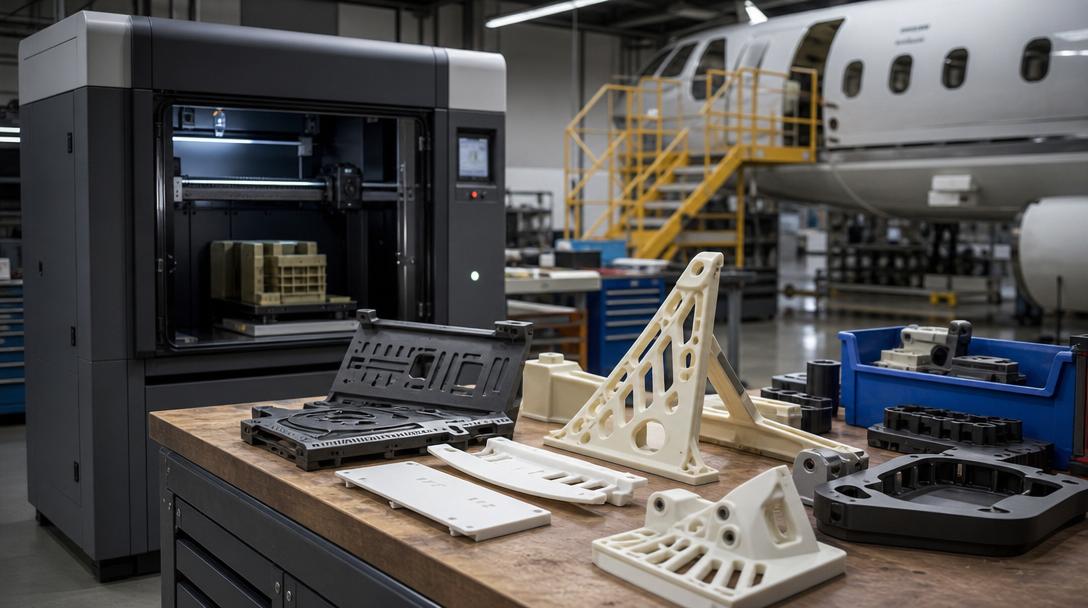

Why Is Aerospace 3D Printing Growing? Airbus’s 25,000 Flight-Ready Parts Milestone
Aerospace 3D printing is no longer limited to the prototype stage; Airbus producing more than 25,000 flight-ready plastic parts throughout 2025 using Stratasys technology shows that FDM-based manufacturing has taken on a permanent role in maintenance and supply operations. This development clearly demonstrates why low-volume functional parts, fixtures, and components that require rapid revision are increasingly being handled with additive manufacturing.
According to information shared by Engineer Live, Airbus is producing approved plastic parts at scale for cabin interiors and operational use, especially by using Stratasys’s ULTEM 9085 filament. The important point in this news is not the success of a single part; it is that 3D printing has now become a regular production tool that reduces maintenance time, eases stock pressure, and lowers supply chain risk.
Why does it matter?
In a sector like aerospace, where tolerance for error is low, the 25,000-part threshold shows that 3D printing has moved beyond being “experimental” and become embedded in the process. Its impact is especially strong in the following areas:
- low-volume spare parts
- lightweight plastic covers, housings, and routing parts
- custom tools and assembly aids for maintenance teams
- rapid iteration of components with long lead times
This is also where the key takeaway for Ucuz3D begins: Not every project has to be flight-certified, but the same way of thinking applies to many industrial jobs. A well-designed 3d printing service can save significant time when validating low-volume functional parts without waiting for conventional manufacturing.
Why is FDM becoming such a suitable tool?
FDM is a powerful method, especially if part geometry changes frequently and the main goal is functionality without investing in molds. In aerospace, certification and material traceability are much stricter; even so, the core advantages are the same in other sectors: fast revisions, on-demand production, and a digital inventory mindset. Similarly, in applications such as automation, electronic enclosures, test fixtures, or custom apparatus, the 3D printing approach developed for aerospace makes it easier to understand why design decisions tend to center on lightness, accessibility, and part simplification.
The real message here is not to produce every part with the same material; it is to move the right part to 3D printing at the right risk level. Tools, covers, guards, and assembly aids that will not go into flight but will save time in the field are the group that delivers the fastest return in most businesses. For this reason, when planning a budget, it may be more practical to look at affordable 3d printing prices to see the per-part cost, and then begin trial production with the approach of uploading the STL file and using calculate its instant price.
What is the practical takeaway for Ucuz3D?
This news provides a strong reference point, especially for low-volume prototypes, test apparatus, lightweight housings, routing parts, and functional validation models. If you also want to see your design before mass production, it makes sense to first run a small FDM trial and test tolerance, assembly, and ease of use. To see the scenarios where this approach stands out, the guide 3D Printing in Spare Part Production is also a good place to start.
In short, the Airbus example shows that the value of 3D printing is not only its ability to “print complex parts”; it is its ability to put the right part into production at the right time without creating unnecessary stock. If you have also prepared your file for a similar prototype, tool, or lightweight functional part, starting with a small pilot print is often the most accurate first step.




 Türkçe
 العربية
 Русский
 فارسی
فارسی Deutsch